
One of the themes in V.C. Myers’ work is the connectedness of human experience: what happens in Appalachia ripples outward to connect with the experiences of people all over the world. In this new collection, Ophelia, Myers adds temporal and narrative connections between past and present, myth and lived experience, by interspersing erasure poems created out of text from Hamlet (all titled “Ophelia”) with non-erasure poems that take on the experience of sexual predation. Throughout this collection, a horrifying chorus forms: Cassandra, Medusa, Philomela, Ophelia, Lavinia, and others. Every character and speaker adds a me too to the refrain. It doesn’t matter whether these characters are fictional, mythical, or real; their stories reflect a world in which women are punished for the actions of men, and then silenced through often violent means. Before I go any further, I’d like to reiterate my first point, which is that the poems are still widely resonant despite their sharply focused lens. They speak for all manner of beings who can’t speak for themselves: the poor, the disenfranchised, the colonized, the hunted, the marginalized, or the Earth itself.
As in Myers’ previous collection, Give the Bard a Tetanus Shot (Vegetarian Alcoholic Press), the poems mix dead seriousness with a dark sense of humor, and by doing so, slice deep. “Labor of Love” puts this trait on full display:

These lines shift from a simple rethinking of a worn-out myth, and then come in with a punchline that seems funny until you realize it’s what many of the perpetrators in this collection of poems would say—She got herself into that mess—as Apollo might have said of Cassandra when she promised herself to him, then reneged. In fact, in many of these stories, mythical and not, a man’s actions bring blame and punishment upon the woman. Women are figuratively turned into rocks, unable to speak or testify. This collection tells their stories.
The erasures in Ophelia’s voice take words spoken by others and appropriate them, erasing Shakespeare and all the characters but Ophelia. Since I follow Myers on social media, I recall some of the compositional journey of this book, and the decision to integrate the Ophelia poems with the other poems. And I am reminded of something Louise Glück said of two of my very different poems during a workshop: They came from the same mind. That seems apt here. I was surprised by how seamlessly many of the erasure poems flowed into and out of the non-erasure poems.
Writers often say that they can’t write about a traumatic event right away–that their voices were taken away by the act of violence, and must be regained. Ophelia is considered to have gone mad when it’s perhaps more accurate to say that no coherent words can convey her experience. If we imagine being in that position, we can also imagine the resonance of lines in another text, when they are about a character who has suffered some of the same slings and arrows of outrageous fortune. Erasure poems convey how their author reads and identifies with a text. Erasure is what flares out at us when we’re reading. Erasure is a way to have a voice because no speaking is involved. The silences tell the story.
The first non-Ophelia poem, “Papier-mâché,” sounds, in voice and content, as though it could have been spoken by Ophelia. It begins, “I befriended the red paper wasps / flying around my garden. I sang / as they circled me” (17). By the poem’s end, the book’s central trauma emerges:
                                                                                                         The nest

                                                        cocooned my throat so I couldn’t

                                                        breathe, sealed my mouth so I couldn’t

                                                        scream, covered my eyes so I couldn’t

                                                        see what too much trust made of me.
This is Myers wielding sound and line break with devastating accuracy, the couldn’ts yanking on the reader’s throat to force them to feel what the speaker feels. couldn’t couldn’t couldn’t.
I appreciate Myers’ tendency to alternate between heady linguistic acrobatics and blunt, plain-spoken confessionalism. The pattern reminds us that this poet, capable of elevated language, also has waded through some dirt in life. Yet these moments, too, contain the incantatory, as in these lines from “greenhouse, glasshouse, it’s all the same & broken,” a poem about the ways past trauma manifests as present-day issues in the body:

Ophelia’s poetic mode is a departure from the modes of the last collection, Give the Bard a Tetanus Shot, though both collections deal in the autobiographical and confessional. There is more formal reach and attention to line break in Ophelia, a development perhaps brought on by working with erasure, which has so much to do with how words appear on the page.
Despite its inherent limitations, Myers manages to wrest erasure into the incantatory rhythms of the non-Ophelia poems, while also retaining the atmosphere of the original text. The Ophelia poem on p. 24 begins:

and a moment later: “enter ghost,” which, in this collection, serves as a metaphor for the appearance of traumatic memory. Enter ghost.
But then the poem builds to:

The last four lines can be read left to right, then down (your fate this body called) or downward first (your fate called this body), giving two different but accurate meanings. Erasure convention is to preserve the words where they were on the page in the original text, but with a text like Hamlet there is no standardized page layout, or even a definitive text, so Myers’ layout doesn’t need to adhere to any “original.” Instead, it can be flexible to accommodate different readings.
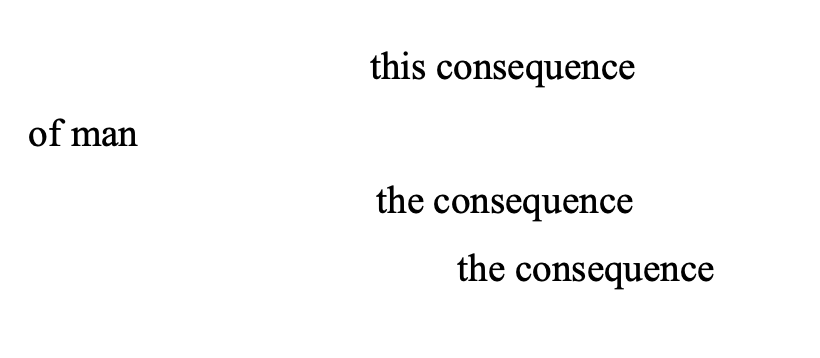
Myers’ erasures also emphasize the repetitions that are buried when the full text of the play is present, as in the Ophelia poem on p. 48:

These poems, Ophelias and not, capture the experience of women, how their voices are unheard, and how their lives are fraught with constant and daily dangers that the women themselves do not invite.
In Greek drama, the chorus comments on the action with a unified voice, rather than as individual voices. Myers has created a collection of poems that is both a chorus, speaking in unison, but also individual voices telling their stories. The function is the same as in a theatrical production: the chorus warns, makes sense of, reacts. It also serves as a reflection of the world—in this case a world of many, many women who have been objectified, used as pawns, or subjugated to male desire. Relationships with men are portrayed as dangerous in their unpredictability, the way they can turn to madness, as Hamlet does in the play.
In Ophelia, Myers has reworked the idea of the chorus, giving each voice its moment, using repetition and incantation to force the world to hear—or, finally, to listen.
J.D. Ho holds an MFA from the Michener Center at the University of Texas in Austin. J.D.’s work has appeared in the Georgia Review, Missouri Review, Shenandoah, and elsewhere.
 Moist Poetry Journal
[…] I’m so grateful for J.D. Ho’s beautiful, insightful review of my forthcoming book, Ophelia, published at Moist Poetry Journal. […]
LikeLike
[…] “This is McCabe wielding sound and line break with devastating accuracy…alternating between heady linguistic acrobatics and blunt, plain-spoken confessionalism. The pattern reminds us that this poet, capable of elevated language, also has waded through some dirt in life. Yet these moments, too, contain the incantatory…”– JD Ho, Moist Poetry Journal […]
LikeLike
[…] “This is McCabe wielding sound and line break with devastating accuracy…alternating between heady linguistic acrobatics and blunt, plain-spoken confessionalism. The pattern reminds us that this poet, capable of elevated language, also has waded through some dirt in life. Yet these moments, too, contain the incantatory…”– JD Ho, Moist Poetry Journal […]
LikeLike