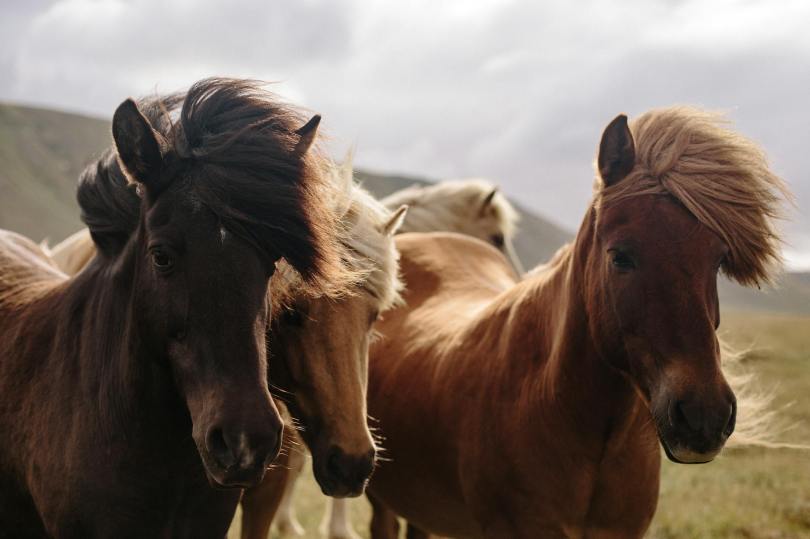
- Read the below poem by Judith Barrington, Why Young Girls Like to Ride Bareback, out loud several times to find the rhythm of the poem, noting how the title gives you a specific entry point and physicality to follow, but the word choice, tone and structure, line breaks and all, give us a parallel experience of sensuality, eroticism, and/or young sexual awakening.
- Next, write a poem about doing something like washing the dishes, cleaning your car, planting a garden, roller skating, walking alone by the river–anything you know how to do well that you can describe in a similar way as Barrington. The more mundane or ordinary the better! Write into a kind of hyper-description, choosing diction, sounds, line breaks, etc. that create a suggestive parallel experience to the thing you’re describing. For example, how can washing the dishes suggest deep grief?
WHY YOUNG GIRLS LIKE TO RIDE BAREBACK
      by Judith Barrington

You grasp a clump of mane in your left hand,
spring up and fall across her back;
then, pulling on the wiry black hair
which cuts into your palm and fourth finger,
haul yourself up till your right leg
swings across the plump cheek of her hindquarters.

Now you hold her, warm and alive, between your thighs.
In summer, wearing shorts, you feel the dander
of her coat, glossy and dusty at the same time,
greasing up the insides of your calves,
and as she walks, each of your knees in turn
feels the muscle bulge out behind her shoulder.

Trotting's a matter of balance. You bounce around
unable to enter her motion as you will when the trot
breaks and she finally waltzes from two to three time.
Nothing to be done at the trot but grab again that mane
that feels, though you don't yet know it, like pubic hair,
and straddle her jolting spine with your seat bones

knowing that when the canter comes, you will suddenly
merge -- you and that great, that powerful friend:
she, bunching up behind, rocking across the fulcrum,
exploding forward on to the leading leg, and you
digging your seat down into the sway of her back,
your whole body singing: we are one, we are one, we are one.
Tara Shea Burke is from Paris, Virginia and teaches at Virginia Commonwealth University and the Visual Arts Center of RVA. Her writing, both poems and short creative nonfiction, is recently published in Moist, Screen Door Review, Shenandoah Literary, Khôra, and Southern Humanities Review. Their creative practice has recently expanded to textiles and sewing, quilting, collage, and lyric prose–both a memoir in essays and spec fic about living in the in between of climate change. Her teaching focuses on the human mind, memory, writing, thinking, and creating as a process, and our experiences in and of the natural world.
 Moist Poetry Journal