Aphorism | Paroxysm by Remi Recchia (fifth wheel press, 2025). 40 pages. $12
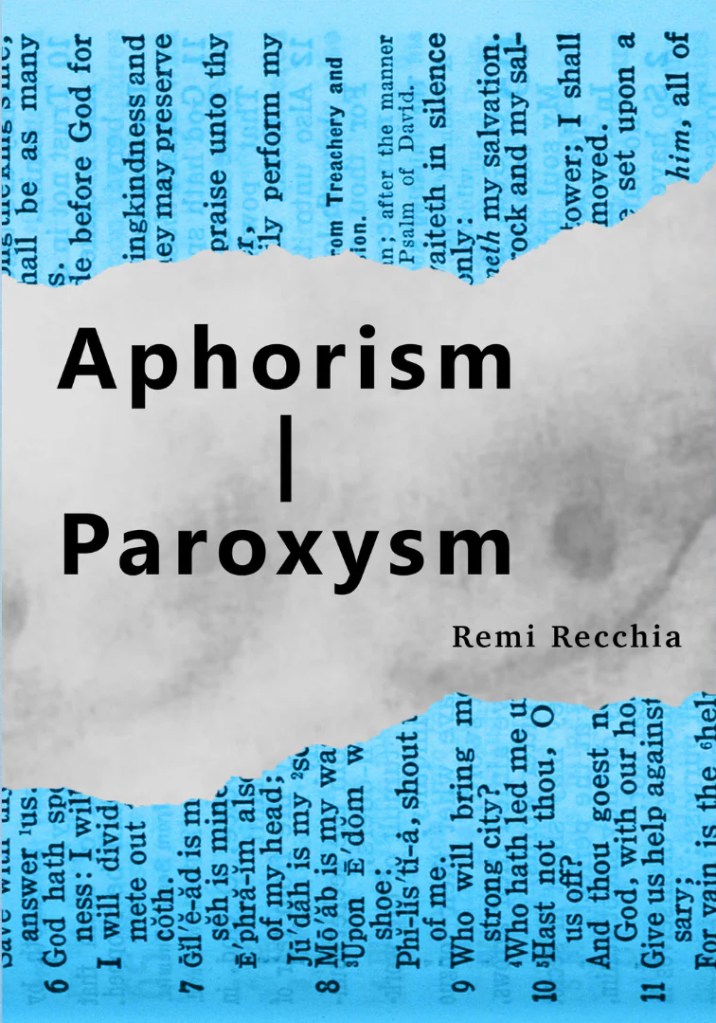
In the opening phrase of “Psalm 111,” an erasure poem titled after its biblical source text, the autobiographical speaker of Aphorism | Paroxysm (fifth wheel press, 2025) identifies the chapbook’s personal animating force: “my heart, / upright, // studied.” Author Remi Recchia’s hybrid manuscript, which blends selected free verse compositions with nearly a dozen biblical erasures and over two dozen facsimiles of the transmasc writer’s social media posts from 2022, directly addresses the contested intersection of trans bodies and Christian beliefs. Recchia’s work demonstrates related ideas that transcend poetics and theology: that erasure can be a creative act, and that human creation can be a fulfillment of God’s love.
The decision to reproduce relevant social media posts within the text complicates genre by foregrounding documentary and commentary. Recchia’s 2022 archive includes unabashed statements that lend precise context to his verse, including defining confessions (“The thing about me is I’ll write trans erotica in church and then go out and preach the gospel of Jesus Christ”), self-aware jokes (“As a post-op transmasc, it is simply a Rule that I must wear tank tops whenever it broaches 68° or higher”), and philosophical positions (“Literally the only ‘self-made man’ is a trans man. This is the hill I will die on”). Without the elaboration of an essay or the figuration of verse, many of the character-limited posts might indeed qualify as aphorisms: concise and accessible distillations of truth or sentiment. Instead of attempting to delineate truth from sentiment in a persuasive mode, Recchia’s social media reproductions illuminate and celebrate, affirming the truth of the writer’s authentic perspective.
The levity of Recchia’s posts offers a satisfying complement to the solemn style of his verse. The book’s opening text, “Dead Name” (previously a final selection for the 2021 Best New Poets anthology), is a poignant elegy in tercets that historicizes trans perspectives as more than a passing fad or contemporary symptom. The poem’s epigram identifies “Frank Dubois and other ‘female husbands,’ 1883” as antecedent figures, representatives of a time when “We didn’t have the words” to fully describe trans experiences. Readers are also shown complementing details from Recchia’s own lived experience, such as how “I still turn when I hear my dead / name at the coffee shop, feel etymological / bomb spray shrapnel across the room.” Past and present collide in the poem’s conclusion:
But the only witch now is the hunt I’m dodging
with Frank Dubois. He’s not behind or ahead, he’s with me,
in me, evading this hunt without beagles or guns, French

horn transformed into the echoes of our old names, excess
syllables filling our heads while we strut on the streets
crowded with the girls & deaths we used to look like.
By linking trans struggles for belonging across disparate frames of history and vocabulary, Recchia advances an understanding of trans identity as a naturally emergent phenomenon, a small but persistent pattern in the variegated fabric of human biology.
A prose poem that substitutes mid-line slashes for line breaks, “Gifts,” explicitly imbues this understanding with a Christian concept of providence, or divine guidance of worldly action. The text sustains its momentum on the anaphoric current of the repeated phrase, “God gave,” interspersed with periodic responses by the speaker. Recchia’s choice of form streamlines the juxtaposition of positive and negative events, such as “God gave me a pet dog / God gave my dog arthritis, twisted joints & inflamed nerve” and “God gave me white spots on the brain / God gave me an MRI.” To this litany of bodily complaints, Recchia adds one that can be read to represent trans identity: “God gave me a body / I said wait it doesn’t fit quite right.” When considered in light of the book’s adjacent social media posts, the overall effect becomes one of interrogation: where do we draw the line between permissibly medical and impermissibly heretical acts of intervention into God-given creation? If accepting God’s providence does not mean embracing complacency, but instead recognizing human action as a constituent element of divine creation, what criteria might we use to discern the Godliness or worthiness of intentions and results?
The book’s erasures of the Bible engage these questions at the level of form. Among the most striking, “Psalm 23,” forges its response using the text of the famous passage which begins, “The Lord is my shepherd,” and details walking through “the valley of the shadow of death.” Recchia selectively erases words from the text to create new verse, a minimalist narrative that connects the traditional “shadow of death” with what can be read as a gender dysphoric experience: “my / want / makes me lie / and / revives / pathways for / shadow death,” claims the speaker, who fears that “my head / is running over / and shall follow me my / for ever.” In contrast to this presentation of misaligned living as a source of pain and suffering, Recchia offers affirmative texts such as “Psalm 84:1–6,” which reads:
How dear to me is
My desire and
my flesh.

The sparrow has found a house
and a nest
by the side of
my God.
Celebrating the flesh as a house on the side of God, in a text fashioned by erasing scripture, is the poetic complement to another of Recchia’s pointed social media statements: “Trans people are perfect and exactly as God made them (trans).” In this sense, transformative procedures that use excision and creation to save a life from cancerous despair—biopsy, surgery, prosthesis, and more—can be seen as providential acts, or choices of faith that enable God to work through human action.
Aphorism | Paroxysm offers a genuine rendition of surprising synthesis, showing readers that the space between queer and Christian communities allows room not only for conventional disagreement, but also for principled alignment. Recchia’s hybrid approach to this task succeeds by channeling a colloquial voice in the American tradition of Whitman: a voice that sings the body electric, in order to illuminate the multitudes contained within the body politic.
Remi Recchia is a Lambda Special Prize-winning poet, essayist, and editor from Kalamazoo, Michigan. A nine-time Pushcart Prize nominee, his work has appeared in World Literature Today, Best New Poets 2021, and Best of the Net 2025, among others. He is the author of two collections of poetry, four poetry chapbooks, two children’s books, and the editor of two contemporary poetry anthologies. Remi has received support from Tin House, PEN America, and the Poetry Foundation. He holds an MFA in poetry and a PhD in English. Remi is currently pursuing an M.Div. at Yale Divinity School, where he serves as poetry editor for LETTERS Journal and lives with his wife, daughter, and two cats.
D.W. Baker is a poet and editor from St. Petersburg, Florida. His poems appear in Identity Theory, fifth wheel press, Sundog Lit, and BRUISER, among others, and have received nominations for Best of the Net and the Pushcart Prize. His reviews appear in Variant Lit, Philly Poetry Chapbook Review, Paraselene, and more. See more of his work at www.dwbakerpoetry.com







 Moist Poetry Journal