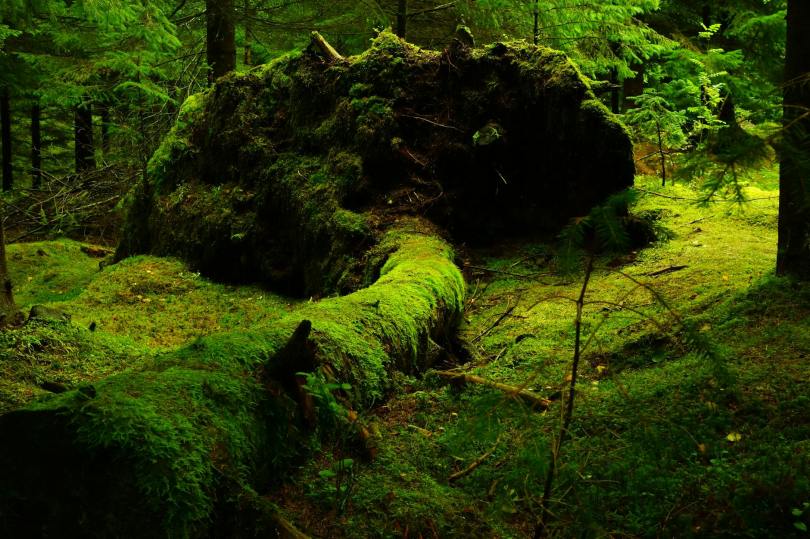
“I was a child, all body.” by Tara Burke

It was always the mountain
and me. Paris Mountain.
The woods were mine:
tree tops, rocks, creeks,
space between. I topped
for the first time on leaves
straddling felled trees.
The way they laid across
space, over huge limestone,
and moss, rocks begging me
to shimmy across. I laid
on my belly, wrapped
my young arms and legs
around her girth. I couldn’t
reach my own fingertips,
pressed into the rough bark,
pressed my ear too, so I
could hear her breathe.
This was around the time
my pelvis had a body
of its own, my pubic bone
close to anything at all
and a rhythmic rocking
took over. I let myself
be all pelvis, all fingers
and ears, all torso and legs
and tongue. I was a child
who’d pressed herself
into many things but
the forest took me in.
I came alive, moaned
like an animal, looked
around. Was it me, or this
tree? Or the wild, how it
always seemed to see?
Alone, usually, but not
here. She, the trees. She,
the mountain. She, the space
between my sound and hers.
We came up together, I learned
my body, she taught me what
it is to be alive, how to be a wild
beast on this blue green earth.


Tara Burke is from Paris, Virginia and teaches at VCU and the Visual Arts Center of Richmond. Her poems were recently published in Screen Door Review, Shenandoah Literary, Khôra, and Southern Humanities. Lately, she’s absorbed in making shorter, surreal love poems, speculative stories, handmade quilted things, and clay houses.

“108 degrees, honey” by Thanh Bui

there will still be humans, my lover says 
though we might not be included in that.
our kind isn’t just going to die out immediately,
to which i envision the skin of the ones who’ll
live. visit a Titanic museum—to predict which
persons will survive, you’d need to know their
statuses. an iceberg does not discriminate, nor do
fires, but people? we aren’t natural. did you know
the world is running out of sand? we’re not even
wealthy enough to know what to hoard, to hide.
for now, i can get water whenever, i am rich with
someone else’s thirst. our guide this summer
was from Quảng Trị, & didn’t know of electricity
until 2004. while he used candles, i moused
computers, i watched tv. during covid, i witnessed
my relatives pray for the vaccine already in my body
waters away. watching is another kind of pain.
that’s why they use it as torture, too. what’s as
un-human as having no power to change what’s
in front of you? bó tay as it all sinks. is it a good
thing i don’t know what species we’ve lost? which
cats are the last of their kind? my phone keeps
turning off, says it’s too hot to function. the summer
construction workers have a tip: turning off the AC
in their homes an hour+ before work helps them
acclimate to the heat. elsewhere, they’ve invented more
ways to survive. but we are a country of litigators.

Thanh Bui was born in Gò Vấp and raised in Dorchester & Alief, and is a writer & actor based out of Austin, Texas. She loves constantly.

“Band Camp” by Millie Tullis

There were jokes.
When I put my clarinet reed
in my mouth (fourteen
and C-cupped) I was told
I had a cute sucking face.
But Band Camp was clean.
Mostly Mormon kids.
Mostly nerds. Almost half
never-been-kissed-kids.
Not literally clean.
Across from the football
field the college dorms
we slept in stank.
Boys’ apartments north
of the parking lot.
Girls’ south. Four
to a room two
to a bed. We braided
each girl’s hair into
increasingly complex
patterns. We sweated.
The baby hairs curled
against our foreheads.
Volunteer parents cooked
family reunion meals
in the parking lot where
our two genders met and filled
paper plates. We ate
along the lot’s edges.
We perched on concrete
curbs. I played the clarinet.
I marched. Then
I played the tenor
saxophone and marched.
I liked being the only
girl carrying a sax.
I carried the reed
with just my bottom lip
and a little teeth. At fourteen
I liked being called girl.
I liked sleeping by a girl
in the dorm of girls.
I offered to turn her hair
into a chestnut crown.
I did not like playing
the clarinet or the sax.
I liked being in it.
I worked to keep
my small piece
of wood wet
play some notes right.
My job was to not
disappoint.
I liked marching.
I liked being a point
of the straight line.
I could almost step
without sound.
I knew where to
stand and I knew
where I was.

Author’s Note: I attended my younger sister’s viola recital early this summer. While listening to her perform, I thought about the role music played in my life when I was younger and jotted down the start of this poem. When I was a teenager in marching band, my relationship to music was simultaneously quotidian and erotic, a chore and a gift. For me, the marching band’s body-heavy work revolved around a week-long summer band camp, where we communally ate, slept, practiced, played, sweated, marched.

Millie Tullis (she/her) is a writer, teacher, folklorist, and researcher. Her work has been published in Sugar House Review, Rock & Sling, Cimarron Review, Ninth Letter, and elsewhere. Millie is EIC of Psaltery & Lyre, an online literary journal. Raised in northern Utah, she lives in upstate South Carolina.