“I Search the Internet for Evidence to Justify My Melancholy” by Jacqui Zeng

Yes, headlights are 15% brighter now
and plane turbulence is actually worse.

Birds crash into windows,
little yellow packages dropped

onto the sidewalks, announcing
the death of spring and the rise

of brutal summer. Someone
is trying to poison the rats

in my neighborhood, but
the squirrels lay belly-up

instead. Covid rates are spiking,
again. Last week’s death count buried

in a webpage few are reading.
Our city will get 30 days

of dangerous heat next year.
I know 30 people who don’t

have air conditioning. Heat
has a bitter taste. Like asphalt.

Lightning bugs are going extinct.
Little kids don’t understand

what the glowing circles are
in books and movies set in summer.

The U.S. Military is the largest
polluter in the world. 51 million tons

of CO2 per year. Also, our bombs.
Also, dust flumes six stories high.

The official death toll in Palestine is
massively, massively, undercounted.

Any rain big enough, anywhere,
could sweep a house away.

I need to reacquaint myself
with the Earth I actually inhabit.

I keep a pit in my stomach
so I don’t blow away.

Jacqui Zeng’s poems have appeared in Black Warrior Review, Mid-American Review, HAD, and TIMBER, among others. She received her MFA from Southern Illinois University, Carbondale. They are a poetry reader for Tinderbox Poetry Journal and currently live in Chicago.
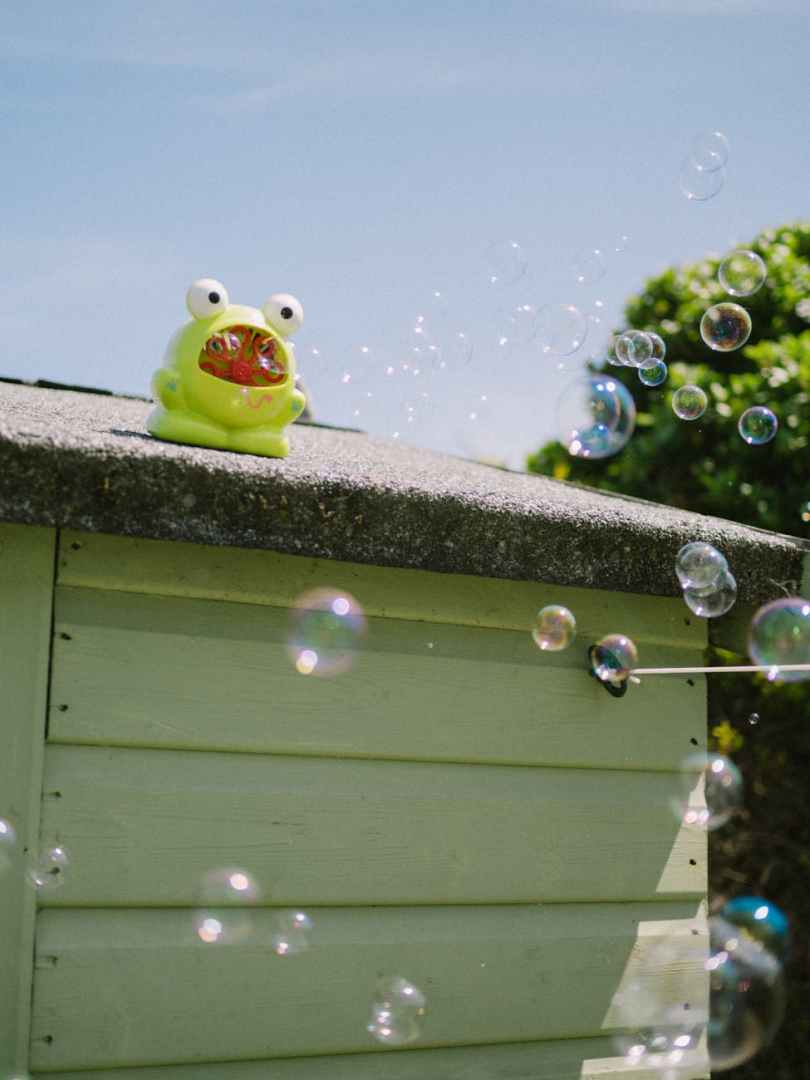
“Stockton Blvd.” by Nicholas Viglietti


Northward,
On Stockton Blvd.

Cruisin’ under an ocean sky;
It's a sun blazed,
kinda day.

Strollin’ south –
Thickness.

That makes you drop
Your mouth.

On night-club heels.

Beauty is both ways,
All ways & always.

Fuck shade,
Shine anyways.

Nicholas Viglietti is a writer from Sacramento, CA. Katrina ripped the gulf coast, he rebuilt homes there for 2 years. Up in Mon-tucky, he cut trails in the wilderness. He pedaled from Sac-town to S.D. He’s a seventh-life party-hack, attempting to rip chill lines in the madness.

“THE SPEED OF THINGS AT SPRING RUN” by Andy Fogle

A green frog on the bank,
and we just watch.

Everyone knows this
from cartoons and/or

being outside: the leap
is a single, swift, arc

from right there at our feet
to somewhere else

we don’t even know.
It happens when we get

too close. If we’re lucky,
if the water

is clear enough,
if the light is right,

we can see the creature
that lives in both worlds

living in the other now,
and the single kick that

flicks it from one side
of our vision to

the other. Everyone
knows about the land

and water deal,
but amphibian also means

of doubtful nature.
Were we made

for both worlds?
It’s good we started

with just watching, ok
that we’re fuck-all to the frog,

the one that haunts stone,
and a miracle

that we manage to track
its flight through the stream

because—God!—it gets
so far away so fast.

Andy Fogle is poetry editor of Salvation South, and author of Mother Countries, Across From Now, and the forthcoming Telekinesis, collaborations with Hope LeGro (Ghost City). He’s from Virginia Beach, spent years in the D.C. area, and now lives with his family in upstate New York, teaching high school.

Two Poems by Chris Corlew

I MAY NEVER BE STRAIGHT EDGE BUT IT IS PUNK ROCK TO QUIT DRINKING

in the NOFX song Bob spends 15 years gettin loaded until his liver exploded
saying he wanted to think about nothing

am I made of the same weakness
afraid of checking my mail?

cockroaches & bedbugs my first apartment like Charybdis’ maw of misery
molded paperbacks thanks to a busted ceiling pipe like
cosmic justice for my settler ass like all streams flow
into the sea & yet the sea is never full homie


all becomes dust
it is not a sin to recycle a book


the best conversations happen in a tavern but
the revolution doesn’t happen because you got drunk

the revolution is clear-eyed & callous-handed & joyous in struggle
the revolution is constant as a river & leaves you sore but naturally high
the revolution is dancing with everyone on the floor

in community garden mornings
in the drag punk band hollerin on the street festival north stage
in the public school fundraiser night

it is song you started but only the rest of the band could finish
it is a reliable bus route
it is a shared box of blueberries

WHITE PARENTS OF BIRACIAL CHILDREN

do people ignore you
at the airport
if you’re the parent not holding the kid’s hand?

our kid’s pre-k3 teacher called him a ‘bright light’
which was as adorable as hummingbirds
of course that’s exactly what you are yes it is you are bright light

cut to a couple years later
talking about being half-Black half-white
he asks how much of him is bright light

every part of you is bright light I tell him
but that’s not the point it’s Black History Month
& sun is shining at the park
& my wife teases me he still needs sunscreen you know

one day my son will grow up
& be another Black man
I can screw up a handshake with

Chris Corlew is a writer and musician living in Chicago. His work has appeared in Cotton Xenomorph, Whisk(e)y Tit, PassionFruit Review, Cracked.com, and elsewhere. He can be found at lazyandentitled.org or on Bluesky @thecorlew.

“poem for drinking down that gin and kerosene” by nat raum

my firespit slicks bridges
for miles, i swear to you—

i am through with structures
that seek only to support

their kin. if my refusal
to go on like this forever

means i must build a town
of my own edifices, so be it.

i want baby blue and cotton
candy pink banners strung

up between the bank
and the fire station. i want

no cops, including the ones
in your head. in chemistry

class, we mixed metals
with bunsen burner flames,

made a rainbow of elements.
may copper and rubidium

ions decide to salt the surface
of this planet, cause a flurry

of proud flames when
the first molotov cocktail hits

the spans. i am past renewal,
past peaceful assimilation;

we must destroy to rebuild
a world that could hold us.

nat raum is a disabled artist, writer, and genderless disaster based on unceded Piscataway and Susquehannock land in Baltimore. They’re the editor-in-chief of fifth wheel press and the author of the abyss is staring back, random access memory, camera indomita, and others. Find them online at natraum.com.

“Apocalypse Love Poem” by Wendy Wisner

This week, as I watched the sky turn ash orange,
saw the air quality ticker go red, purple, maroon,

glimpsed two construction workers exchanging soft blue masks
under the dusky morning moon,

witnessed my children sink into the couch—
“Not this again!” my son raged, hazel eyes hot with tears—

I wondered if I’d loved enough, risked enough for this earth,
which is clearly raging back at us all,

how my son would sit under the desk during remote learning,
fists red as beets, biting his nails till they bled.

Last night, I dreamt again about losing my kids in a surge
of stormy black water, the levees failing again, again.

I dreamt and dreamt until I had to push myself out of the dream
so I could walk through the dense summer morning

with you, the two of us catching our breaths
as the sky swelled, finally, with rain—

oh the blue blue sky in all its merciful radiance.

Wendy Wisner is the author of three books of poems, most recently The New Life (Cornerstone Press/University of Wisconsin Stevens-Point). Her essays and poems have appeared in Prairie Schooner, Spoon River Review, The Washington Post, Lilith Magazine, and elsewhere.

“Missing Parts” by Sam Rasnake

                   – after “It is essential… to undertake
the reconstruction of the primordial Androgyne
that all traditions tell us of… within ourselves.”
André Breton & Androgyne III
(1985, Magdalena Abakanowicz)


as if these definitions –

she and him, she and her,
he and him, they and
her, they and him, they
and them, she, they, him

– weren’t enough, the dark
blurs of who, what, and why

coil their supple excesses
through the night hours
and behind walls – when
the heart only

knows the heart

Sam Rasnake is the author of Fallen Leaves (Ballerini Press, forthcoming), Cinéma Vérité (A-Minor Press) and Like a Thread to Follow (Cyberwit). His works have appeared in Wigleaf, Stone Circle Review, Anti-Heroin Chic, UCity Review, Best of the Web, Southern Poetry Anthology, and Bending Genres Anthology. Follow Sam: Bluesky @samrasnake.bsky.social.

Two Poems by Catherine Rockwood

Inverie, Knoydart, June 2024

By the harbor again and once again low daylight.

When the mountains are illuminated
we receive them.

Somewhere uncoastal, southward,
teens

are keeping themselves alive
as they can in little towns

where hairdresser shops
outnumber other business.

No. Strike that.
Even here

where robins land
on sustainable pub-tables

to receive a peanut, shelled:

here
in these isolated

regenerating districts
with their managed woodlands

and fences,
their reiterated

statements of difference
from the mainland

here too
teens

are keeping themselves alive
as they can

in low light
near breathless June waters.
Boston Seaport, July 2024

Where the unpredictability of the body
meets weather
is the world.

To weather is to survive
and fall apart.
Like this.

I am weathering, every day
and laughing sometimes:

loving my children
according to their specific ways

even as cloud comes right down to the water
and summer loses its sum

becomes mer

a salty fog we swim in, having missed

the sea.

Author’s Note: I guess what I found by Loch Nevis and Boston Harbor was a surprising commonality of quiet gray haze and overcast skies. That’s a more frequent phase of summer now, when it isn’t bright/scorching or cloudy/scorching. * I also found a surprising but to me sustaining commonality of care. Wherever I was I ended up thinking about kids, both my own and the children of others. The work children do to live their lives. The quotidian deprivations and difficulties that are, even in a best-case scenario, part of growing up. The way this present time is different, yes, but not cut off from how kids have lived in the past and will live in the future. The way we must and will go with them.I placed myself next to the sea a lot, this summer.  It’s much on my mind, the sea, and what our relationship with it will be in the coming decades of climate instability.

*(fuck Exxon, fuck Shell, fuck BP, etc., and their enablers) 

Catherine Rockwood lives fairly close to Boston. She/they reads and edits for Reckoning Magazine, and reviews books for Strange Horizons. Two chapbooks of her/their poetry, Endeavors to Obtain Perpetual Motion and And We Are Far From Shore, are available from the Ethel Zine Press.

Two Poems by Chris Corlew

WINDY MORNING KAYAKING PRATT BEACH

today I take
only what the Lake gives me

what oceanographer can measure the height of swells
on sight? no conquest only quagga mussel infestation

today the Lake wants me like a pawing overeager lover
& I sprawl myself on top of its welcome

today is white-capped & the first time
swells knock me off my kayak shoulder missing lake bottom rocks

humble thyself homie
in the sight of the Lake

northwestern winds & no room for ego
do you want to go home? do you want your arms to yearn to

nag in neglect until before bed when you do push-ups?
or do you want to have fun?

no concern for horizons no pondering time in these swells
only the water in front of you

paddle droplets on a life jacket
puddles in the boat

ribs in the sand after & pluck
a hair from the back of my thumb
THE TREES MY DUDES THE TREES

headbanging kelp forests the sea-cats
of Chile’s beaten coast hunt with agility implying they
could probably guard Kevin Durant one-on-one (in the dark

the stoned horror writer
makes a note of vampire bats on screen)
evergreen rainforests where I

would maybe melt out of reverence can I kiss the mapungauri’s hand?

ambush is easy enough when you
look like a leaf
the narrator says about frogs

reincarnate me as a dew drop above the Valdivian Forest
seems a million times more
purposeful & fulfilling than 21st century USA

the trees the trees are so many can you
see the trees & not praise the trees my comrades-in-leaves?
can you see the Chilean palm trees mix with Valdivian species & not worship the earth?

the trees the trees marvel at the trees
& cacti grow in the clearings

the trees depend on monito del monte
to swallow their seeds whole & shit out germinating pods in sticky residue
this animal is 40 million years old we’re talking first mammal old

that should be sacred the trees should be
considered a holy site

& the monkey puzzle tree resistant
to volcanic ash can you even believe
how big the world is? how tall the trees?

can you even believe how impossibly small
even a 20-story apartment building is? & yet each life contained within a treasure? even thousands of miles from these sacred trees? what a treat
to be alive to be stoned & up late
& watching a streaming service I only have
so my son can watch Mickey & Bluey & Spider-Man (& I can watch Star Wars)

& no there’s more there’s the divine
dewey & shaggy with cacti in the clearing
the trees my dudes the trees

we end as we began
water-bound
confronted with wave battering

Author’s Note: Summer—and by extension kayaking season—is fleeting. Yet the water is eternal if we manage it properly. There should always be a Lake Michigan and therefore should always be summer days I can spend cradled and held atop its currents, one of millions of grateful water passengers. I’ve never personally seen the beauty of Chile’s landscape or wildlife or people or culture, but I really hope to one day, and it bums me out how much climate change could affect all of that. So these poems, to borrow an idea from my friend and co-host Bob Sykora, are attempting to freeze two marvelous moments in time: a day I went kayaking and a night I spent watching a nature documentary. With hopes that this act of reverence through art can honor such sublime connection with the wider world and inspire more.

Chris Corlew is a writer and musician living in Chicago. His work has appeared in Cotton Xenomorph, Whisk(e)y Tit, The Rumen, Cracked.com, and elsewhere. He can be found blogging at shipwreckedsailor.substack.com or on Bluesky @thecorlew.

“After the Start of Summer” by Kevin Risner

the lake blooms a bright green more vivid than geckos.
When these blooms enter the household, it’s only natural
to collect them, place them in a glass vase, burn eyes
with pollen. Pink and orange petals flutter onto the table.

They say that algae blooms mean an overabundance
of phosphorus. It’s toxic.

We drink up facts, reap the consequences, even when
it’s not our fault. I am a wooden raft headed down
the river after a heavy rain. The water’s thick there.

I hope to make my way out of this sand trap
through storm into sunlight, no longer
hidden by mattress-stuffing clouds in
the endless overcast that is November.

Author’s note: This poem spent a long time percolating and undergoing changes, much like how lakes do each year. In 2014, a severe algal bloom formed on Lake Erie off the coast of Toledo, which led to extreme water restrictions (for drinking, bathing, washing dishes). The result of agricultural runoff, this particular bloom shows vividly how much we, humans, have adversely affected waterways of all sizes and shapes. I try to explore the beauty of such events and how they can become disastrous, and how often they may return. The blooms will be pretty severe this year, but not as bad as the ones a decade ago in 2014. That’s a small sliver of hope. And I hope we can find these slivers from time to time, not just here in the crevices of this poem, but elsewhere in the world.

Kevin A. Risner is from Ohio. He is the author of Do Us a Favor (Variant Literature, 2021); You Thought This Was Just Gonna Be About Cleveland, Didn’t You (Ghost City Press, 2022); and There’s No Future Where We Don’t Have Fire (ELJ Editions, 2025).