My favorite film has an original script;
is shot, and directed by me—
I’m the star, too, in a cast of three.

Your wife speaks no lines.
The opening scene starts after she dies

painlessly, expectedly, unavoidably—
you were prepared as one can be
for the kindest possible removal

of a sympathetic character,
sadly unprotected

by the plot. My character attends
the graveside service—
notes her stiff hands do not claw

through the rain-black earth in protest
of my presence.
The sun supplants the clouds on cue,

and I hold back
while out-of-focus mourners disappear
off screen conveniently.

Our eyes connect with static shock—
the shot breaks to follow a wet, ripping sound
near the trees

at the far end of the cemetery—
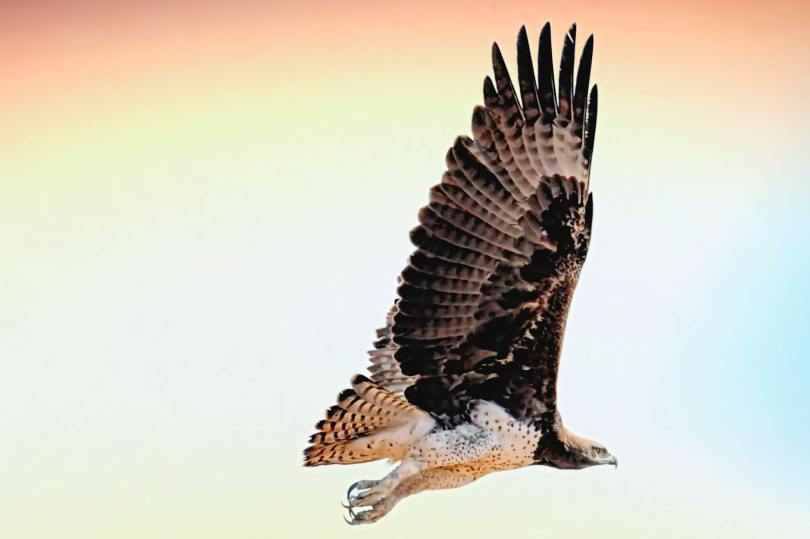
a Cooper’s hawk has caught a vole.

Her talons pierce and quell
the fruitless struggle.

Her banded belly and golden eyes
are striking against the faultless lawn

as she eviscerates her prey.
Nature undeterred and matter-of-fact
requires sacrifices.

The camera leaves the carnage
and we stroll towards your car—
lean back in easy silence

against the immaculate black of the doors.
We pass a flask of bourbon back and forth—
we’ve done this before.

The lens zooms in to capture how your lips
and tongue linger on the flask’s rim.
Time slows, music begins softly,

then swells, heightens
the impression of a quiet, buried longing
which never dissipated

but collected itself;
grew deeper without outlet over years.

I’m collected; controlled: not touching you,
not leaning close—
despite memory of how you used to breathe

in as I exhaled as if I were an antidote,
and you a dying man.
The camera angle shifts to capture your hand

surprising even you
as it finds its way home,

your thumb a gentle knife
on the underside of my jaw—
fingers hardly squeezing
the back of my neck.

The audience holds their breath.
They know what kind of kiss comes next,
and no one

not me, not you, not the hawk,
has done anything
wrong at all.
Author’s note: I have often been asked if I ever write happy poems and or love poems. The answer is, to the first, I think never, and to the second, only if the love poem explores the pain, grief, and hunger that so often accompany love. I recently reread this poem, written a few years ago, wondering if it didn’t need revision so much as the proper title was missing. The annoyingly cliched MFA workshop question rose up to face me, like a spectre: What’s at stake? The speaker of the poem here imagines a world where wanting what they cannot have is not transgressive, but totally acceptable, socially, morally, and emotionally. Issues of conscience are easily and matter-of-factly dealt with, something that is not possible in reality, but in the world of poetry, all one needs is imagination to open doors to possibility that reality locks up with impenetrable finality. I changed the title to reflect what is at the heart of this poem, which, in the imagination of the speaker, is bargaining about a longing that in order to be admitted to and explored, must occur within an ecosystem of morality.
Staci Halt’s work has appeared or is forthcoming in Rattle, december Magazine, Salamander Magazine, The Los Angeles Review, Driftwood Press and others. She parents six rad humans, and a slew of cats, and teachers and writes near Boston, for now.

 Moist Poetry Journal