1.
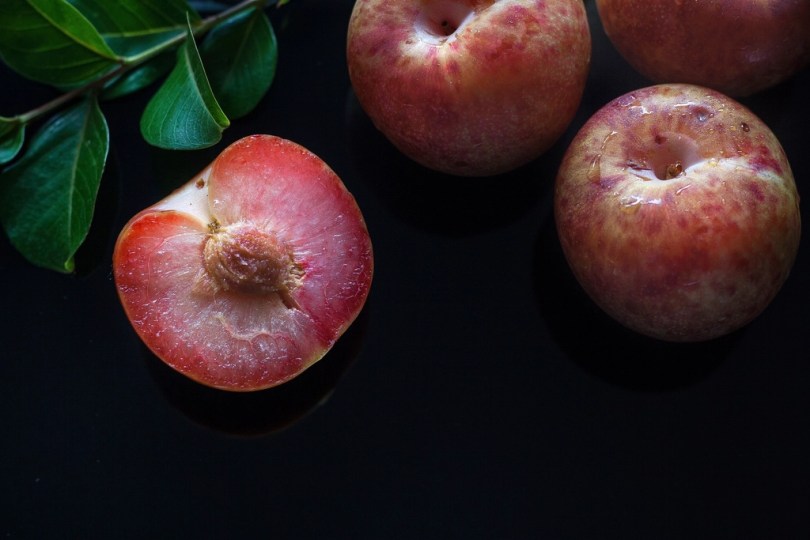
A drupe—the flesh of its fruit enclosing
the fruitstone-pit
of its seeds.
To droop and sag on the branch in the heat,
fresh swelling beneath taut sun
seared skin.
2.
To break skin; to bite into
flesh; to drip down yourself
into crevices.
To be atopic to stone fruits
and to eat them anyway, desperate
and ripe for the anchoring.
3.
And I think to kiss your mouth
is to eat a seed; to kiss and to eat and to seed.
And I think to kiss your mouth
is to cede ourselves to the blank
palimpsest, rubbed out hard
for growing.
4.
Oxidation of flesh; slight foxing;
lentigines that persist past fall.
The age and the wearing
of the page and the fruit,
sliver of thigh, high rise
suggestion of blush-pale meat.
5.
So what I really was doing was kissing myself
the way I used to kiss the side of my hand
when I didn’t think I’d survive you.
So what I really was doing was subjecting myself
to reaction the way the catalyst persists
unchanged and unchanging despite.
6.
Drupe—so close to dupe; to
duplication; to mark. Long lessons
patient bees can teach you.
Fuit—it was missing
the r for reduplication. Erit—it will
be loose transposition for writ.
Author’s note: “Fruit” came into Middle English from the Latin frui, meaning “to enjoy” (cf. fruition and fruitless). Fuit / erit: Latin indicative perfect and future indicative tense of esse, “to be,” respectively. The title is from W. Paley’s 1802 Natural Theology: “The flesh of an apple, the pulp of an orange, the meat of a plum, the fatness of the olive, appear to be more than sufficient for the nourishing of the seed or kernel. . . . when we observe a provision to be more than sufficient for one purpose, yet wanted for another purpose, it is not unfair to conclude that both purposes were contemplated together.”
Emily Kramer is an editor living in Boston, MA. She received her BA in English from Barnard College, and her PhD from Boston University’s Editorial Institute. Her critical edition of Arthur Henry Hallam’s collected poems is forthcoming from Oxford University Press. This is her second publication in Moist.





 Moist Poetry Journal