A Review of Ayesha Raees’ COINING A WISHING TOWER

COINING A WISHING TOWER by Ayesha Raees (Radix Co-op, 2024). 72 pages. $17.95

by Burgi Zenhaeusern

COINING A WISHING TOWER BY Ayesha Raees (Radix Co-Op, 2024)

As little as we write in a vacuum, we read in one, and I feel that a reading memory is akin to a body of sounds and images, of wavelengths all in a jumble (like an orchestra before a concert) until the wavelengths of one text hit another’s, producing an accord of sorts. Coining a Wishing Tower rang with collections as seemingly unrelated as Benjamin Niespodziany’s whimsical and poetic one-act plays in Cardboard Clouds, the sparse poetry and rich interiority of Josie Foo’s Tomie’s Chair, or the sharp-eyed portrayal of existing between heritages of Monica Youn’s From From, and Maureen Seaton’s wryly celebratory Sweet World; and of all these, particularly Seaton’s short poem:

I think in spirals;


therefore,


I am infinite.

The numbered sequence of prose poems in Coining a Wishing Tower manifests a spiral formally—by the use of anaphora for example—and thematically. Unlike a circle, a spiral implies direction—inward/outward, up/down, as in the -widening scope of the collection’s narratives. The spiral embodies and symbolizes infinity as recurrence in changing contexts and as continuous motion. Poem number 40 could be read as a metaphorical, mini abstract of the collection’s spiral storytelling while also presenting one of its central themes. I quote it here in its entirety:

Google says: No! Cats have one life just like any other living creature! The fiction of feline immortality is due to how cats function! In awed resilience! Prone to survival! Yet in a fashion that is always barely! To survive and heal and continue, cats strive in chapters, skipping from one existence to the other, from birth to separation to shelter to settlement to abandonment to ravagement to wilderness to car accidents and then to eventual demise. Each chapter becoming a disappearing act from the last, a knowing deeply settled in a body, a knowledge that permanence is a human fantasy, that in the end, living is dying many times in one singular life, to grow and adapt is a technique to survive, to give adherence to a lineage is continued as a mark that we were all once here, occurring in the narratives of the ones that will lead us into the future. (50)

On its own, number 40 may not be a captivating read. Its effectiveness is rooted in its placement deep within the fabric of the poems’ sequence; and all it says—with the concise language and matter-of-fact tone characteristic of the collection—feels necessary: key information thrown in as if an aside and easy to overlook, thus imparting understatement and irony. This poem smiles at itself and at the reader by the time they come to it. There are other moments where the hint of a wry smile shines through the dioramic series of scenes—scenes arranged like lit windows of a building otherwise in the dark, behind which various dramas unfold.

Prose poems especially favor fragmentation, a stop-and-start flow, loose ends, a permeable border between the imaginary or interiority and what counts as empirical reality, and play. The poems in Coining a Wishing Tower do this with ingenious imagery and a combination of memoiristic and myth- or fairytale-like stories, which keep getting recontextualized, underscoring the speculative and ever-shifting nature of all stories—the ones we tell ourselves, the ones we tell each other, and what we hear—depth acquired by offering layers and the freedom to peel them back or not.

The collection begins and ends with House Mouse, who is one of its mythlike figures and undergoes a metamorphosis. It is also an alter-ego of the speaker who left her home in Pakistan for the US, a long-imagined destination:

1.
House Mouse was running to the mountains but nothing came out of its climbs. Every peak held another peak, and every reach held another reach. At the end of all possible height, House Mouse found itself inside a tower. The tower looked like a black, elongated box, sharp at the edges, smooth and silky on the sides.

Behind all there was was just was: a view called beautiful only because it was now distant. (11)

In the course of events, House Mouse dies, House Mouse returns, and nothing is the same, as in all coming-of-age and emigration stories. The tower is House Mouse’s living shrine in both senses of the word: “to be alive” and “to live in.” Its significance overlaps with the Ka’bah’s significance in the speaker’s life. House Mouse’s story with the tower is in part a meditation on faith/trust and religiosity, especially on the tension between wish, prayer, and ritual, and the pervasive question of authenticity. “Coin” and “coining” as verb/noun imply shaping and monetizing simultaneously, as in the minimal statement “A wish a coin” (20)—a softening of distinctions, resulting in fluidity and an interrogation of intentionality.

Godfish, another mythlike figure, “lives in the crystal clear aquarium behind the crystal clear window of a giant wooden house in New London, Connecticut” (13), where it is the focus of both the moon’s and the cat’s unconditional love, while it itself is happily infatuated with an oblivious sun. Their impossible love is trusting as a child’s, and reciprocity is assumed rather than sought. Its story is as sad as it is endearing. An untrodden “Desire Path” leads to the isolated wooden house:

22.
A Desire Path is created through an inevitable erosion by an animal. It is a constant back and forth trod in the same narrow area. It is a natural act that connects two suffering destinations in their lack of constant hold. No one liked coming to the giant wooden house in New London, Connecticut, where the winter had a bad bite, the summer brought strange pesticides, and spring hardly lasted in the rain. There was no path, no trod, and no desire deep enough for any kind of create. (32)

Here, the usage of the infinitive as verb/noun creates tension by blurring the line between in progress/motion and outcome/stasis, foreshadowing a similar blurring of animate/inanimate later on. The wooden house isn’t simply the setting for “windings, convolutions, and unnatural happenings” (26). Unwittingly or not, it impacts the action. Godfish’s story might also be read as a parody of the biblical fall from grace—“Paradise Lost” in a “giant wooden house” in New London, CT.

Maybe the speaker chose New London as an imaginary scene for her quasi-American “dream” because it could well embody small town USA: mostly white, overly tended lawns in summer, cold in winter. She sets New London, CT’s remoteness against one of her first encounters with “America” in the form of Happy Meal toys, pinpointing the ubiquity of US culture everywhere, including in her Pakistani childhood, yet with an added local flair. The localness is what she needs to trust: that something in her heritage remain inviolate and resistant: “These toys are different from the toys American children get. I believe. I believe. I believe.” (42)

Coining a Wishing Tower also reflects on different ways of learning and knowing. At one end of the spectrum is the speaker’s mother, who imparts traditions—knowledge built on experience and relationships over a long time—and at the other, knowledge obtained by way of Google—factoids and an uneasy trust in them. Both meet in the speaker’s imagination. As House Mouse and Godfish, they tell a story of aspiration and discovery, of leaving behind the assuredness of home, of loss which can be a form of liberation, as can adulthood. The prose poems’ multifaceted interiority shifts borders, strews sand, sows doubt, then wonder, and joy about yet another beautiful re-invention of the wheel. Ayesha Raees’ Coining the Wishing Tower has added its clear voice to the chorus on my bookshelf.


Burgi Zenhaeusern (she/her) is the author of the chapbook Behind Normalcy (CityLit Press, 2020). She co-edited the translations of the anthology Knocking on the Door of The White House (zozobra publishing, 2017). Her work appeared, most recently, in Sugar House ReviewJMWWLittle Patuxent ReviewMoist Poetry, and as broadside (Ashland Poetry Press). https://linktr.ee/burgitree
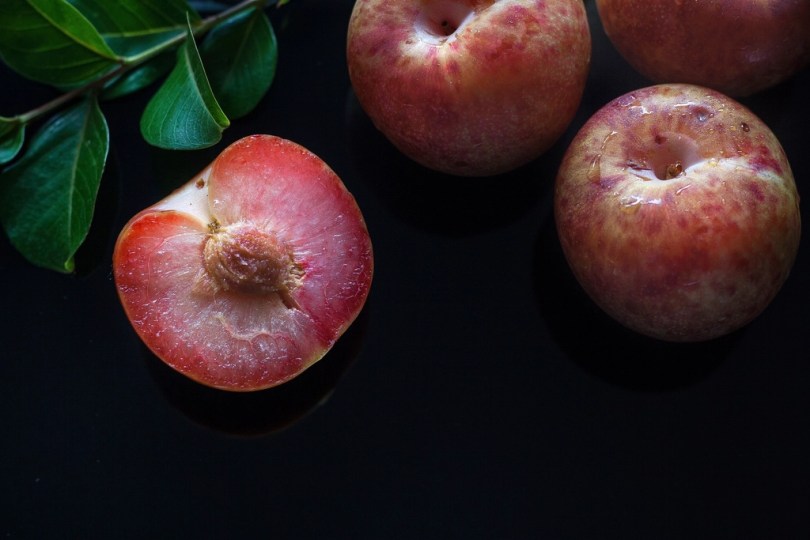
“The Meat of the Plum” by Emily Kramer

1.
A drupe—the flesh of its fruit enclosing
the fruitstone-pit
of its seeds.

To droop and sag on the branch in the heat,
fresh swelling beneath taut sun
seared skin.

2.
To break skin; to bite into
flesh; to drip down yourself
into crevices.

To be atopic to stone fruits
and to eat them anyway, desperate
and ripe for the anchoring.

3.
And I think to kiss your mouth
is to eat a seed; to kiss and to eat and to seed.
And I think to kiss your mouth

is to cede ourselves to the blank
palimpsest, rubbed out hard
for growing.

4.
Oxidation of flesh; slight foxing;
lentigines that persist past fall.
The age and the wearing

of the page and the fruit,
sliver of thigh, high rise
suggestion of blush-pale meat.

5.
So what I really was doing was kissing myself
the way I used to kiss the side of my hand
when I didn’t think I’d survive you.

So what I really was doing was subjecting myself
to reaction the way the catalyst persists
unchanged and unchanging despite.

6.
Drupe—so close to dupe; to
duplication; to mark. Long lessons
patient bees can teach you.

Fuitit was missing
the r for reduplication. Eritit will
be
loose transposition for writ.


Author’s note: “Fruit” came into Middle English from the Latin frui, meaning “to enjoy” (cf. fruition and fruitless). Fuit / erit: Latin indicative perfect and future indicative tense of esse, “to be,” respectively. The title is from W. Paley’s 1802 Natural Theology: “The flesh of an apple, the pulp of an orange, the meat of a plum, the fatness of the olive, appear to be more than sufficient for the nourishing of the seed or kernel. . . . when we observe a provision to be more than sufficient for one purpose, yet wanted for another purpose, it is not unfair to conclude that both purposes were contemplated together.” 

Emily Kramer is an editor living in Boston, MA. She received her BA in English from Barnard College, and her PhD from Boston University’s Editorial Institute. Her critical edition of Arthur Henry Hallam’s collected poems is forthcoming from Oxford University Press. This is her second publication in Moist.

Dramatic (Dear Stranger, I)

       You are more authentic the more you resemble what you’ve dreamed of being. —Pedro Almodóvar

Need another word, not irony, for what happened when I fell
in love not-quite-with-you-but- with your poem about falling

in love with the idea of a woman, with a myth, with history,
with wanting to ask do you want to go swimming? to someone

who was never real but maybe also was, or maybe who’s the realest
when we all believe in her. (Clap, clap, goes the idea of Audience. Fairy-wings.)

I wanted to reach through the fourth wall and touch you, but the wall was not
a wall, it was a screen: your lipstick smile on the other side of it. So close

and way-too-far, and when you touched my (real, small, living, human) hand
in the park, just once, by accident, I full-body-unlocked in a way I didn’t know

what else to call except love, but maybe it was more like seeing,
or like the future’s aperture opening up to living-through-it—

me face-to-face with some other me, the one I hadn’t
been, yet. I know it’s boring, but I’m saying you changed me.

I’d still call that love, but love’s the loaded-est of loaded guns,
and all I want this thing to mean is open seas of something soft

or looking at you looking at the sky and thinking closer. Full-volume radio,
every stupid pop song I used to be too-scared to sing along to.

I guess I’ll never know, or care, what kind of love this is except the truest
kind I’ve ever felt: the kind where all the women stay alive

in this weird picture—my hands / your hands in separate oceans, girl-fish
bodies underwater, all the tallest marbled opalescent statues of ourselves:

full-frame visible, longed-for (wanted wanted wanted wanted) by some brief myriad
(who knows how long) (I know: not long) of infinite, enamored strangers’ eyes.

Prompt: Instructions to be Followed, Revised, and/or Ignored

1) Scholar Jay Leyda describes Dickinson’s poems as often having an “omitted center” — I take
this to mean that sometimes her poems are about something that can’t quite be said directly, or
that something important has been left offstage. Write a poem that works this way, in whatever
way you find meaningful. Remember that “success in circuit lies.”

2) Use a uniform stanza length (couplets, tercets, quatrains, etc). Metric choices are up to you. If
you’re going to break your own constraint, you’d better do it for a reason.

3) It is often the case that the I in a poem both does and does not speak for its author. This works
in different ways in different poems. Write a poem in which the I is fairly close to your lived
human self, like the part of an asymptote where the line approaches infinity. Consider subjectivity
as an unsolvable math problem, unless this gets in your way.

4) If you’re bored of your own errors, try creating some new ones. Franco “Bifo” Berardi says
poetry does this, and I like to think he’s right.

5) Say something true, even if it pains you. Otherwise aren’t you just wasting your own time (and
possibly that of your reader)?

6) On the other hand, consider the truth to be found in fiction.

7) Refer to mythology in some way. There are plenty to choose from. Proceed from an abundant
mood. Poetry, like living, thrives in contradiction.

Jo(ely) Fitch is a poet living, thinking, reading, and walking in and around Cincinnati, Ohio. Find her in most of the usual webspace places: @joelyfitch on Twitter/X, @jo_elyly on Instagram, @jo-ely.bsky.social on Bluesky, and joelyfitch.com. Jo coedits Atmospheric Quarterly. 

Dream, with an interior

1.

Dream, with a tool. If this is rock, or stone. The stone
becomes hammer.

Rare outings mouth the words. We sing, behind the scaffolding
of facemasks.

I daily walk a slim incline, and steady. The ponderous framework.

A composite of inactivity, and lockdown patterns.

Robert Kroetsch: What is a letter? Sometimes it is a star that fell.

If dismember is actually the opposite of remember.


2.

To translate, sound. Rose: the doorbell. Electronic adaptation
of Westminster chimes.

I can barely hear. They saw the decades go, between us.

Toys on the shelf. Two towels decorate their floor.

I have been thinking, lately, of Falstaff. Let him come, they say.

Aoife: I am sad for your father. I remember Grampy. A name
they never called him.

To make so fine a point: in this economy?

To kneecap grief. What might that look like.


3.

An event, of saltwater. Rubble. Dreams of flying, falling.

And then, she woke. Our bedroom doorknob, rustles.

Prompt

If you’ve a short poem on a particular idea or thread or consideration, attempt to write a third around some of those same ideas. And then write another. And then another. Keep going. Once you move yourself through the expected, obvious material in that direction, then you are forced to see where else you might go. It is one thing to write a poem on the colour blue or the memory of a house, for example, but what might the tenth poem on such look like? What might the fifteenth? This is where your mind begins to move in directions entirely unexpected, even by you. See how far you can take it. See how far you can go.


Born in Ottawa, Canada’s glorious capital city, rob mclennan currently lives in Ottawa, where he is home full-time with the two wee girls he shares with Christine McNair. The author of more than thirty trade books of poetry, fiction and non-fiction, he won the John Newlove Poetry Award in 2010, the Council for the Arts in Ottawa Mid-Career Award in 2014, and was longlisted for the CBC Poetry Prize in 2012 and 2017. In March, 2016, he was inducted into the VERSe Ottawa Hall of Honour. His most recent titles include the poetry collection World’s End, (ARP Books, 2023), a suite of pandemic essays, essays in the face of uncertainties (Mansfield Press, 2022) and the anthology groundworks: the best of the third decade of above/ground press 2013-2023 (Invisible Publishing, 2023). His collection of short stories, On Beauty (University of Alberta Press) will appear in fall 2024. An editor and publisher, he runs above/ground press, periodicities: a journal of poetry and poetics (periodicityjournal.blogspot.com) and Touch the Donkey (touchthedonkey.blogspot.com). He is editor of my (small press) writing day, and an editor/managing editor of many gendered mothers. He spent the 2007-8 academic year in Edmonton as writer-in-residence at the University of Alberta, and regularly posts reviews, essays, interviews and other notices at robmclennan.blogspot.com

Self Portrait as a Leading Man

Less than fur but more than shadow. If I were a boy:
a good start. But I have always been a girl,
even when I wanted
not to be,

wanted to play Harold Hill and lean across the desk
to sing to Marion (in the moonlight, a man
could sing it. In the moonlight
…).
Why was it the boys
got all the best
songs?

Now, with age, I hardly see it, have to tilt my face
to the bathroom spotlight to find it.
Grown blonde, somehow,
on its own.

Not the harsh practically shimmering gold accusation
it became at age twelve,
Charlene and I

pinched in her tiny, back-of-the-medicine cabinet
mirror, buttering the top of our lips,
school paste thick and thicker the bleach
because we couldn’t get it
gone, make it
disappear
fast

enough. Out out damn spot. Oh, those auditions
for grade school plays. Charlene, Prince John.
Charlene, Lady MacBeth, instead of me
because I didn’t think I’d be allowed
to say damn.

Damn you, mustache, you resistance
to a dainty kind of girlhood,
shoes I couldn’t
kick the ball in,
dresses frilled
with itch.

I wanted to pitch overhand. I wanted
to sing Dulcinea. I wanted
Danny Zucko’s
leather jacket

and a pair of black Chuck Taylors that could
run me out of the neighborhood’s
bracket of lawns to the
outskirts,

new houses going up but no walls yet,
foundations only in that
good red clay

my Mama would scrub all day
and never get the stain out.

I wrote this poem from the following prompt in Jessica Jacobs’s and Nickole Brown’s Write It! 100 Poetry Prompts to Inspire, a glorious, generous book that I highly recommend:

“An ode is a poem that addresses a particular subject, often in praise. In the poem “Ode to Fat,” Ellen Bass revels in her wife’s boundless breasts and marshy belly. / I adore the acreage / of your thighs and praise the promising / planets of your ass. Standing in front of a full-length mirror, see if you can look at the parts of your body you tend to criticize and resee then as opportunities for celebration. Write a description in which you extol the virtues and strengths of these parts, making them—just for the brief duration of this page—each their own kind of superhero.”


Rhett Iseman Trull‘s first book of poetry, The Real Warnings (Anhinga Press, 2009), received the 2008 Anhinga Prize for Poetry, as well as the Brockman-Campbell Book Award, the Devil’s Kitchen Reading Award, and the Oscar Arnold Young Award. Her poems have appeared in The American Poetry Review, Prairie Schooner, The Southern Review, and other publications. Her awards include prizes from the Academy of American Poets and the Dorothy Sargent Rosenberg Foundation. She received her B.A. from Duke University and her M.F.A. from the University of North Carolina at Greensboro where she was a Randall Jarrell Fellow. She and her husband publish Cave Wall in Greensboro, North Carolina.

Turn

OED, v.: 31. Followed by into or to, indicating the result of a change. a. (a) transitive. To cause (a person or thing) to become something else; to change, transform, or convert into something. 

Before this conversion we have to turn
one’s body; turn foes against one another; turn
a sentence toward a different cast; turn an instrument
so precisely now for shaping. We must turn
as the door turn upon hinges. We must turn thee
hither, turn thee.
We must turn for rest, trying
each corner of my Bed, / To find if Sleep were there, but Sleep
was lost.
Before changing into, we must twist (an ankle) out
of position (esp. by landing awkwardly); we must wrench, or
we must sprain. We must first acknowledge that turning or
peeling mushrooms is an art that practice alone can attain.

We must turn about, and we must play.

Why must progression start first with so much
practice? Why must practice acknowledge before
its process so much grief? A clumsy knocking against
glass, music turned down soft? (Bed turned down; these rocks,
by custom, turn to beds of down.
A bed turned down.)

What is that which I should turn to? Every door is barr’d
with gold, and opens but to golden keys.

This poem started off, once, as birds.

Prompt

Write a poem using as many senses of one word as you can.


Emily Kramer is an editor and miscellany living in Boston. She received her B.A. in English from Barnard College where she studied with Saskia Hamilton, and her PhD at Boston University’s Editorial Institute, where she created a critical edition of the poems of Arthur Hallam, forthcoming from Oxford University Press.

Inescapable. Impossibly Present.

“How could a place so fraught with historical
pain appear to be so ordinary?”


– Sally Mann, on one of her photographs of
the Tallahatchie River, Deep South series


1. Spanish Moss

The dead walk here in the hours just before dawn – when the earth is cool and waiting. Their questions, like Spanish moss, hang in the mist, but there’ll be no answers today. And none tomorrow. That’s why they walk the wet ground – a ground that’s littered with former lives though there are no footprints here – nothing to give away the truth. I’ve heard them in the early hours. Unseen. Moving. I know they’re there. I’ve walked where they do – and I will.

after Untitled (Fontainebleau)


2. Something Hidden

I can’t seem to remember 1989. It’s become a lost year. I only remember the kudzu from that year – though I don’t know why. I’ve never done anything remarkable with my life – nothing to stand out – I’ve spent decades, one foot in front of the other – careful not to disturb, not to draw attention or too much scrutiny on my whereabouts or doings – and I’ve done nothing that is deserving of your conversations over coffee or a beer. There’s nothing to talk about here. But I’d give anything to remember. Why is it always ’89? and why kudzu? and the days, endless? Why does no one listen to me? Have I designed the universe this way? I can’t recall – I don’t. Why won’t you answer me? … Maybe the answers are the questions.

after 1989


3. Cumulonimbus

A storm is coming. Your feet are heavy as you try to slip to safety. Words you wrote will follow you – their anger, perspective, and prediction – will find their podcast, voices explaining why this, why that, and what it all means. The storm is coming – you feel it in your leg. You trudge forward, at least you think it’s forward – though you’ve no sense of direction and no way to find the path because there is no path – only more bog. Snakes are here, but they don’t trouble you. Fog drifts the trees as if to say the message is constant change. You keep going though there is no other side. You are always here, moving, sloshing, but arriving nowhere. And though you can’t really see, the sky is shaping the storm. You know it. It’s coming.

after Untitled (Deep South #30: Boney Swamp)


4. Words to Say

These are the words I wanted to say … needed to say – and it’s not like I didn’t have chances to tell the both of you – I had plenty – though I wasted them all – words that you needed to hear but I needed to say, needed to hear them come from my mouth – as if fire had been discovered, as if life were found in deep space, as if clothes hanging in a forgotten closet were suddenly boxed, taped, readied to ship – but with no destination.

after Untitled (Fontainebleau Smokestack, Louisiana)


5. What the River Carries

My deepest fear is a leaf, drifting under overhanging trees in late summer heat, beside a partially submerged, overturned boat (why did no one come back to help, to rescue, to clear) – drifting above smoothed stones and sunken timbers, with lights in windows at night, just beyond the banks, dogs howling in the dark – drifting into voices that are almost saying words. Cranes nesting where the current slows. Sometimes there’s music. A car drives by. Suddenly, I’m standing near a moss-covered path, leading to the river’s edge. I reach for the wet leaf – put it in my pocket. I walk away.

after Untitled (Deep South #22)

Prompt

View photographs by Sally Mann featured in a short video (13+ minutes) of her Deep South series ( https://youtu.be/5EiW9KIZy-c ). The clip consists of images only – accompanied by a musical soundtrack. Mann’s work in this series is highly evocative and reflective of emotional and psychological states. Select one or more photos and write a poem (any form, traditional or hybrid or narrative in verse) which connects directly or indirectly with the image in Mann’s work or is the result of your reaction to the photo; instead, you may prefer to use the image as the setting for your poem. If you select more than one photo you may wish to write multiple poems or write one poem in multiple sections. Your piece may include references to more than one of Mann’s works.


Sam Rasnake is the author of Cinéma Vérité (A-Minor Press) and Like a Thread to Follow (Cyberwit). His works, nominated for a Pushcart and Best of the Net, have appeared in Wigleaf, Drunken Boat, Best of the Web, Southern Poetry Anthology, and Bending Genres Anthology. Follow Sam on Bluesky @samrasnake.bsky.social.

HIERLOOMS OF AM. FEM TRADITIONAL

Give a bold 
stroke in brown
or black

femme American
traditional lines

to uphold
rizz, music
bizz, key

and sailor jerry
non-conformist
moshy moves

and drag queens

give me the ink
give me the pin

up girls and panthers
to say my body is not

for you to see
it is for the legacy

art motif and canon
been a looker

sexy circus queen
been a suiter

paint me up
in pinks and golds
lavender and rose

serve a house
of kings down

and work a piece
like Maud or Hull
been transforming

what you seen
on the scene
since before punk

before Captain Cook
but we tattoo it on
make it new

like baddies rollerskating
like butchy babes in auto
or factory and stems and studs

under the hood of my car
every kind of body for
the artwork, for the ways

to say

I am my own
home of tradition

you’re just lucky enough
to witness

the heirlooms of fem tradition.

Prompt

In a two pages, write a poem in which you explore your aesthetic traditions and reframe them as heirlooms, as part of your legacy as a work of art yourself. Consider your fashions, vernacular, home décor, physical maneuvers, and/or/all style choices. Use at least 3 allusions as well. Happy writing ❤


Lin Flores lives and works in SLC, Utah as a full-time poet and creative writing student. They are an MFA candidate in Poetry at the University of New Orleans and a reader for The Bayou Magazine. In 2023, Lin won the Andrea Saunders Gereighty / Academy of American Poets Award.

clementine heart

my heart feels like a clementine beating, 
all that dimpled skin sheltering the tender
juice inside. I imagine the liquid bursting
out someday like a geyser–too much
pressure built up. the sound so loud

it bursts through my eardrums and I can feel
it deep within me. then I am in Yellowstone,
dreaming of my ancestors, getting high, hearing
the colors around me sway with the trees.

my heart is in harmony here besides a few
flickering geyser thoughts. I tell myself
get it together. why would you not stay
like this forever? one with the deer, one
with the leaves. one with the blah blah blah.

don’t you see that this is what it means to be
more than a body?
you are spiritual in human.
all that clementine weight really takes a toll
on you, huh? that’s alright, just don’t let it

become a geyser. someday you’ll appreciate
this, the contemplating and not knowing,
the ancestors and anxieties with their obsessions
and protections. and one day all this juice
talk won’t matter. it’ll be like it never did.

prompt

Write a poem centered in a location or place that you’ve never been before. Maybe that’s a famous landmark or city, maybe that’s a non-physical place, another dimension or realm or state of being. Somewhere you can research or imagine but have yet to visit. Think about what your speaker could do there, and brainstorm lots of options. Like the speaker of “clementine heart,” is your speaker getting high and contemplating? Or are they starting a fight, meeting a friend, noticing the natural world, etc. The possibilities are endless.


Amanda Conover is a writer based in Raleigh, NC who frequently discusses existentialism and spirituality. She’s the poetry editor for Carolina Muse Literary and Arts Magazine and is an MFA student at Arcadia University. Her poetry has appeared in places such as the lickety~split, Miracle Monacle, and the Atlanta Review.

The Body As Intersecting Lines

draw me free
hand, flat
against my chest, fingers
laid across
a scar, my life
line, bridged by shadow
stitches crossing
rivulets

don’t draw what isn’t
there, absence
of weaponry, only
sketch in filigrees of hair
delicate
as woven hope

shade my straight lines
queer, irregular
as pathways
seamed and patched
flagrant
as dancers’ soles
mid-leap

make your brush strokes
shameless, vivid
as my slicked and sweated
connectivity, show
what sinew can
be

seen from space, mind
wired, every
taut line mapped, a body
transitory, still
transformed, a life
crosshatched.

Prompt

What does your body mean when seen from space?


Jude Marr (he, they) is a Pushcart-nominated trans poet, editor and teacher. We Know Each Other By Our Wounds (Animal Heart Press, 2020) is Jude’s first full-length collection. His work has also appeared in many journals and anthologies, most recently Masculinity: An Anthology of Modern Voices (Broken Sleep Books)