Erasure as Creative Act: A Review of Remi Recchia’s Aphorism  |  Paroxysm (fifth wheel press, 2025) by D.W. Baker

Aphorism  |  Paroxysm by Remi Recchia (fifth wheel press, 2025). 40 pages. $12
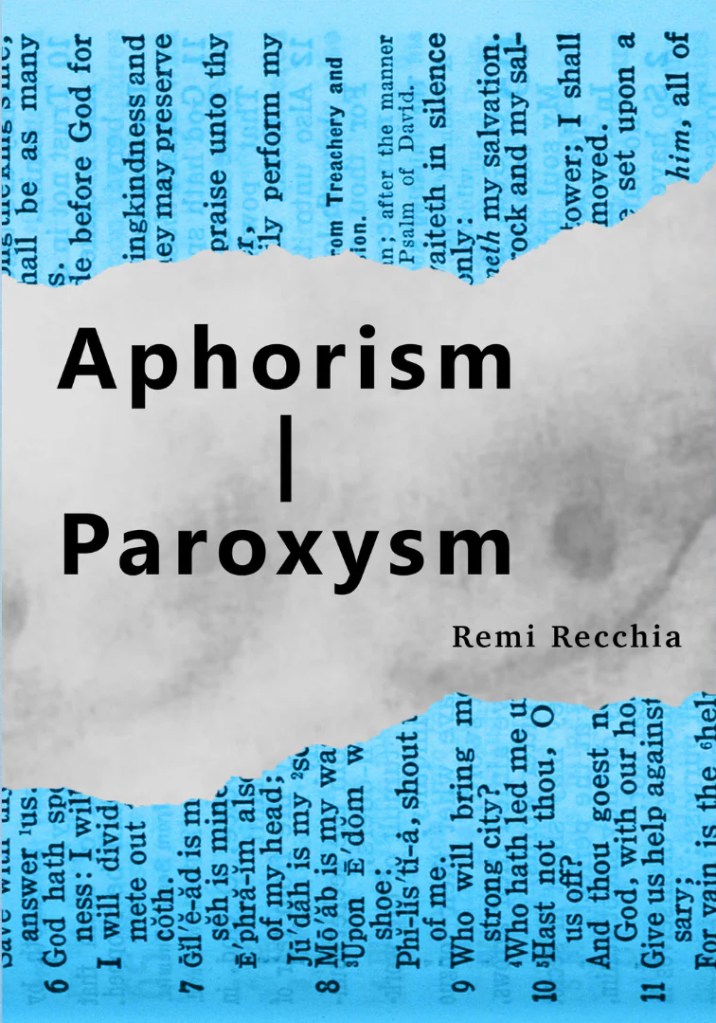
Aphorism  |  Paroxysm by Remi Recchia (fifth wheel press, 2025)

In the opening phrase of “Psalm 111,” an erasure poem titled after its biblical source text, the autobiographical speaker of Aphorism  |  Paroxysm (fifth wheel press, 2025) identifies the chapbook’s personal animating force: “my heart, / upright, // studied.” Author Remi Recchia’s hybrid manuscript, which blends selected free verse compositions with nearly a dozen biblical erasures and over two dozen facsimiles of the transmasc writer’s social media posts from 2022, directly addresses the contested intersection of trans bodies and Christian beliefs. Recchia’s work demonstrates related ideas that transcend poetics and theology: that erasure can be a creative act, and that human creation can be a fulfillment of God’s love.

The decision to reproduce relevant social media posts within the text complicates genre by foregrounding documentary and commentary. Recchia’s 2022 archive includes unabashed statements that lend precise context to his verse, including defining confessions (“The thing about me is I’ll write trans erotica in church and then go out and preach the gospel of Jesus Christ”), self-aware jokes (“As a post-op transmasc, it is simply a Rule that I must wear tank tops whenever it broaches 68° or higher”), and philosophical positions (“Literally the only ‘self-made man’ is a trans man. This is the hill I will die on”). Without the elaboration of an essay or the figuration of verse, many of the character-limited posts might indeed qualify as aphorisms: concise and accessible distillations of truth or sentiment. Instead of attempting to delineate truth from sentiment in a persuasive mode, Recchia’s social media reproductions illuminate and celebrate, affirming the truth of the writer’s authentic perspective.

The levity of Recchia’s posts offers a satisfying complement to the solemn style of his verse. The book’s opening text, “Dead Name” (previously a final selection for the 2021 Best New Poets anthology), is a poignant elegy in tercets that historicizes trans perspectives as more than a passing fad or contemporary symptom. The poem’s epigram identifies “Frank Dubois and other ‘female husbands,’ 1883” as antecedent figures, representatives of a time when “We didn’t have the words” to fully describe trans experiences. Readers are also shown complementing details from Recchia’s own lived experience, such as how “I still turn when I hear my dead / name at the coffee shop, feel etymological / bomb spray shrapnel across the room.” Past and present collide in the poem’s conclusion:

But the only witch now is the hunt I’m dodging
with Frank Dubois. He’s not behind or ahead, he’s with me,
in me, evading this hunt without beagles or guns, French

horn transformed into the echoes of our old names, excess
syllables filling our heads while we strut on the streets
crowded with the girls & deaths we used to look like. 

By linking trans struggles for belonging across disparate frames of history and vocabulary, Recchia advances an understanding of trans identity as a naturally emergent phenomenon, a small but persistent pattern in the variegated fabric of human biology.

A prose poem that substitutes mid-line slashes for line breaks, “Gifts,” explicitly imbues this understanding with a Christian concept of providence, or divine guidance of worldly action. The text sustains its momentum on the anaphoric current of the repeated phrase, “God gave,” interspersed with periodic responses by the speaker. Recchia’s choice of form streamlines the juxtaposition of positive and negative events, such as “God gave me a pet dog / God gave my dog arthritis, twisted joints & inflamed nerve” and “God gave me white spots on the brain / God gave me an MRI.” To this litany of bodily complaints, Recchia adds one that can be read to represent trans identity: “God gave me a body / I said wait it doesn’t fit quite right.” When considered in light of the book’s adjacent social media posts, the overall effect becomes one of interrogation: where do we draw the line between permissibly medical and impermissibly heretical acts of intervention into God-given creation? If accepting God’s providence does not mean embracing complacency, but instead recognizing human action as a constituent element of divine creation, what criteria might we use to discern the Godliness or worthiness of intentions and results?

The book’s erasures of the Bible engage these questions at the level of form. Among the most striking, “Psalm 23,” forges its response using the text of the famous passage which begins, “The Lord is my shepherd,” and details walking through “the valley of the shadow of death.” Recchia selectively erases words from the text to create new verse, a minimalist narrative that connects the traditional “shadow of death” with what can be read as a gender dysphoric experience: “my / want / makes me lie / and / revives / pathways for / shadow death,” claims the speaker, who fears that “my head / is running over / and shall follow me my / for ever.” In contrast to this presentation of misaligned living as a source of pain and suffering, Recchia offers affirmative texts such as “Psalm 84:1–6,” which reads:

How dear to me is
My desire and
my flesh.

The sparrow has found a house
and a nest
by the side of
my God. 

Celebrating the flesh as a house on the side of God, in a text fashioned by erasing scripture, is the poetic complement to another of Recchia’s pointed social media statements: “Trans people are perfect and exactly as God made them (trans).” In this sense, transformative procedures that use excision and creation to save a life from cancerous despair—biopsy, surgery, prosthesis, and more—can be seen as providential acts, or choices of faith that enable God to work through human action.

Aphorism  |  Paroxysm offers a genuine rendition of surprising synthesis, showing readers that the space between queer and Christian communities allows room not only for conventional disagreement, but also for principled alignment. Recchia’s hybrid approach to this task succeeds by channeling a colloquial voice in the American tradition of Whitman: a voice that sings the body electric, in order to illuminate the multitudes contained within the body politic.


Remi Recchia is a Lambda Special Prize-winning poet, essayist, and editor from Kalamazoo, Michigan. A nine-time Pushcart Prize nominee, his work has appeared in World Literature TodayBest New Poets 2021, and Best of the Net 2025, among others. He is the author of two collections of poetry, four poetry chapbooks, two children’s books, and the editor of two contemporary poetry anthologies. Remi has received support from Tin House, PEN America, and the Poetry Foundation. He holds an MFA in poetry and a PhD in English. Remi is currently pursuing an M.Div. at Yale Divinity School, where he serves as poetry editor for LETTERS Journal and lives with his wife, daughter, and two cats.

D.W. Baker is a poet and editor from St. Petersburg, Florida. His poems appear in Identity Theory, fifth wheel press, Sundog Lit, and BRUISER, among others, and have received nominations for Best of the Net and the Pushcart Prize. His reviews appear in Variant Lit, Philly Poetry Chapbook Review, Paraselene, and more. See more of his work at www.dwbakerpoetry.com
“Rapture is a painful thing” by McKinley Johnson

after Louise Bourgeois’s Arch of Hysteria (1993)

It’s no simple vanish, no snap of earth-forming fingers;
when God takes you, it's violent.
Dissonant trumpets, burning chariots,
angels grab you by the belt and yank.

Your clothes are not left, neat and folded,
in your seat. There is no flash of light,
no cooing of doves—you are here and next
you know you are heavenbound, Godspeed,

hips skyward, limbs trailing behind,
shoulder ripped from socket by the drag;
friction makes you burn, a reverse comet,
a smoking censer chain-dragged through the sky,

sprinkle your sulfur down on earth—
that is what hell smells like. There is no
chance for goodbyes, or there wouldn’t be,
if your ascension wasn’t eternal. By the time

you realize there was time, those you left
behind are gone—their journey equally plummet,
you just had the luck to spite gravity, you predestined
devine, you rainbow-clad prophet, father of Methuselah.

Be glad your friends are the ones in the iron box;
be glad as you soar past Saint Peter, that he stamps
your name in the book; be glad the cherubim east
of the garden lowered their swords for you. Be glad

oh golden image of God, that He has made you
and allowed you this ascension, this fire is cleansing,
this journey a lesson. Why would rapture be anything
but painful? Even Jesus had to suffer to get here.

McKinley Johnson (he/him) is a poet from the foothills of Appalachia. He is an MFA candidate in Poetry at George Mason University and a teaching fellow for Poetry Alive! His work can be found in the North Carolina Poetry Society’s Award Anthology Pinesong, Neologism Poetry Journal, and elsewhere.

“I Search the Internet for Evidence to Justify My Melancholy” by Jacqui Zeng

Yes, headlights are 15% brighter now
and plane turbulence is actually worse.

Birds crash into windows,
little yellow packages dropped

onto the sidewalks, announcing
the death of spring and the rise

of brutal summer. Someone
is trying to poison the rats

in my neighborhood, but
the squirrels lay belly-up

instead. Covid rates are spiking,
again. Last week’s death count buried

in a webpage few are reading.
Our city will get 30 days

of dangerous heat next year.
I know 30 people who don’t

have air conditioning. Heat
has a bitter taste. Like asphalt.

Lightning bugs are going extinct.
Little kids don’t understand

what the glowing circles are
in books and movies set in summer.

The U.S. Military is the largest
polluter in the world. 51 million tons

of CO2 per year. Also, our bombs.
Also, dust flumes six stories high.

The official death toll in Palestine is
massively, massively, undercounted.

Any rain big enough, anywhere,
could sweep a house away.

I need to reacquaint myself
with the Earth I actually inhabit.

I keep a pit in my stomach
so I don’t blow away.

Jacqui Zeng’s poems have appeared in Black Warrior Review, Mid-American Review, HAD, and TIMBER, among others. She received her MFA from Southern Illinois University, Carbondale. They are a poetry reader for Tinderbox Poetry Journal and currently live in Chicago.

“Stockton Blvd.” by Nicholas Viglietti


Northward,
On Stockton Blvd.

Cruisin’ under an ocean sky;
It's a sun blazed,
kinda day.

Strollin’ south –
Thickness.

That makes you drop
Your mouth.

On night-club heels.

Beauty is both ways,
All ways & always.

Fuck shade,
Shine anyways.

Nicholas Viglietti is a writer from Sacramento, CA. Katrina ripped the gulf coast, he rebuilt homes there for 2 years. Up in Mon-tucky, he cut trails in the wilderness. He pedaled from Sac-town to S.D. He’s a seventh-life party-hack, attempting to rip chill lines in the madness.

“THE SPEED OF THINGS AT SPRING RUN” by Andy Fogle

A green frog on the bank,
and we just watch.

Everyone knows this
from cartoons and/or

being outside: the leap
is a single, swift, arc

from right there at our feet
to somewhere else

we don’t even know.
It happens when we get

too close. If we’re lucky,
if the water

is clear enough,
if the light is right,

we can see the creature
that lives in both worlds

living in the other now,
and the single kick that

flicks it from one side
of our vision to

the other. Everyone
knows about the land

and water deal,
but amphibian also means

of doubtful nature.
Were we made

for both worlds?
It’s good we started

with just watching, ok
that we’re fuck-all to the frog,

the one that haunts stone,
and a miracle

that we manage to track
its flight through the stream

because—God!—it gets
so far away so fast.

Andy Fogle is poetry editor of Salvation South, and author of Mother Countries, Across From Now, and the forthcoming Telekinesis, collaborations with Hope LeGro (Ghost City). He’s from Virginia Beach, spent years in the D.C. area, and now lives with his family in upstate New York, teaching high school.

Two Poems by Will Diggs

Imma Die Bout My Queer Niggas

ion wanna die bout my queer niggas
cuz i believe we should live.

we all gon die eventually but
if we can keep death waiting
i really think we should.

greedy bitch already out here
taking everyone she can without
second thoughts on the matter.

if she keeps beating at the door,
i think one of us should open it up
& yell her ass back down the driveway
to that raggedy hooptie parked curbside.

but if she just insists someone accompany
her to wherever the fuck death resides
when she not robbing niggas of years

imma jump up & down waving my
hands in the air, screaming the whole time

hollerin’, me me me it must be me!
for my queer niggas.

i know bout five of em gon tell me to go
back in the house & sit my ass down but
them niggas didn’t get the memo. they been

doing this shit for years, pushing to the front
of the front lines. taking all the bullets & none

of the credit for longer than folks have cared
to acknowledge their existence. our existence.

imma die bout my queer niggas cause we
deserve a chance to live fruitfully &
every orchard has its own harvest song &
no one gets to say ours doesn’t sound good
or should end.

I Write Love Poems Too

i borrowed the last cup of sugar 
from next week.
tomorrow is Friday & Tuesday
expects to bake lemon pound cake

so will need me to make good on
my promise of repayment.

pieces of my heart float around rib
cages in homes i have never visited.

you call him my name over dinner
& say he’s just trippin but we both

heard you even though i ain’t spearin’
meatballs or spinnin’ pasta on my plate.

when we talk on the phone i hear you lie
about the way things have gone since we

last spent time together & i identify with
this kind of bullshitting because my life
been hell since we disconnected too.

today i heard a poem by a Brit about
birds & bees but not sex.
it gave me chills, made my heart skip.

watched the new Destin Conrad
music video three times in a row & said
in my head, fuck that man
makes great music & dances his ass off.

one day soon we should talk on the phone so
long we decide to continue the conversation in
person, then fall asleep in each other’s arms.

the world is ending if the rich have their way
which is to say they’ve got plans to be on Mars
once the world dies, so let’s live a little together.


Will Diggs is a Black pothos father residing in North Carolina, where he hikes and loses Scrabble tournaments. His work also appears or is forthcoming with The Rumen, IMPOSTOR Lit, Furrow Magazine, and more. You can reach him at digable.creatives@gmail.com.

“Porosity” by Deirdre Lockwood

Season of salmonberry then	currant
raspberry
thimbleberry cherry almost
blackberry

of ants in the kitchen

of napping while she naps
writing undercover

the blanket naked

(its crimson sleeve
whirling in the wash)

On this morning’s walk with Josie
a dog named Sedona
a thousand whys

Summer’s unboundaries pour us &

I wonder if my neighbor is angry
or worse.

The ants come marching in
the kitchen windows

Out back where Peggy’s ashes
settled at Easter

her pale pink roses
trumpeting.

Will this be how I teach Josie
about death—or when I wipe the ants up
with a sponge?

(We had an unusually wet spring.)

The neighbor’s irritation marches over
the soft pink tones of his wife
and daughter.

(She lived in this house
almost all her life.)

Each day the sun shines, the trees ripple,
I walk all the way to the park,
I am holy

(weeks
I prayed restore my bellows
feared
my life retracted)

so what escapes now is let in
unquestioned,
like a breath

weaving
alveoli i l o v e a l (l)
interstitial i startle in it
heal

rasp
thimb
sal
straw
black


sirens bagpiping up
(imagine Josie furrowing
I hope someone is okay)

to be spared for another rinse
another tumble
tongue bunched with fruit
from her palm


Deirdre Lockwoods debut collection, An Introduction to Error, is forthcoming from Cornerstone Press in September 2025. Her work has appeared in Threepenny Review, Yale Review, Poetry Northwest and elsewhere.

Two Poems by Chris Corlew

I MAY NEVER BE STRAIGHT EDGE BUT IT IS PUNK ROCK TO QUIT DRINKING

in the NOFX song Bob spends 15 years gettin loaded until his liver exploded
saying he wanted to think about nothing

am I made of the same weakness
afraid of checking my mail?

cockroaches & bedbugs my first apartment like Charybdis’ maw of misery
molded paperbacks thanks to a busted ceiling pipe like
cosmic justice for my settler ass like all streams flow
into the sea & yet the sea is never full homie


all becomes dust
it is not a sin to recycle a book


the best conversations happen in a tavern but
the revolution doesn’t happen because you got drunk

the revolution is clear-eyed & callous-handed & joyous in struggle
the revolution is constant as a river & leaves you sore but naturally high
the revolution is dancing with everyone on the floor

in community garden mornings
in the drag punk band hollerin on the street festival north stage
in the public school fundraiser night

it is song you started but only the rest of the band could finish
it is a reliable bus route
it is a shared box of blueberries

WHITE PARENTS OF BIRACIAL CHILDREN

do people ignore you
at the airport
if you’re the parent not holding the kid’s hand?

our kid’s pre-k3 teacher called him a ‘bright light’
which was as adorable as hummingbirds
of course that’s exactly what you are yes it is you are bright light

cut to a couple years later
talking about being half-Black half-white
he asks how much of him is bright light

every part of you is bright light I tell him
but that’s not the point it’s Black History Month
& sun is shining at the park
& my wife teases me he still needs sunscreen you know

one day my son will grow up
& be another Black man
I can screw up a handshake with

Chris Corlew is a writer and musician living in Chicago. His work has appeared in Cotton Xenomorph, Whisk(e)y Tit, PassionFruit Review, Cracked.com, and elsewhere. He can be found at lazyandentitled.org or on Bluesky @thecorlew.

“I Wanted to Tell You about These Geese” by Amorak Huey

I love the work a kiss can do. The way
it leaves language
harmless, temporary.

The way it erases a whole history of distance.

It’s raining in Ohio this morning,
roadside ditches filled to overflowing,
and I don’t have words

for the distance between this morning
and our last kiss.
When I was an editor

I was taught not to write last
when I mean most recent.
What I mean

is we should be kissing even now.
I mean you should see this sky
emptying itself into the day.

So much rain. And
despite the rain, geese anyway.
Torrents of them, flying home.

Amorak Huey is author of five books of poems including Mouth, forthcoming from Cornerstone Press in 2026. Co-founder with Han VanderHart of River River Books, Huey teaches at Bowling Green State University. He is co-author with W. Todd Kaneko of the textbook Poetry: A Writer’s Guide and Anthology (Bloomsbury, 2024).

“Counter-clockwise” by Nico Green

I want you and I want you too.
I want two loves around me. Swirling in a spiral, if possible.
Counter-clockwise.

I want to look up at the sky and see two faces.
Two moons orbiting an alien planet.
We left the old one behind. It couldn’t hold us anymore

I want to look up at the sky and see two faces.
Then I want them to look at each other with all the love in the Universe.
The Universe we created together. The old one couldn’t hold us anymore

I want two dogs and two cats and two lovers and 6 rooms, for when we need to be alone.
I want to collect all the love that loves me back and fill a house with it.
A new species of love that grows when exposed to sunlight.
The old love couldn’t hold us anymore.

Nico Green is a Brazilian-American poet based in Lisbon, Portugal, and the founder of Poems for Strangers, featured in a documentary by Ukrainian filmmaker Anastasiya Bura. His work explores love, sex, and non-monogamy, reflecting his activism in sex-positive and polyamorous communities. He/Him.