I’m not hungry but my mouth is bored (distance) (marriage)

which direction are you from here
kidding I know it’s down

I would be a wretched river
so weary of waiting to be traveled to

my darling westward witch
my east my Eden my every

each of us one single individual water
amid all the many waters

nostalgic for spring & source
before we bend around the first bend

(facing the audience) you know
how long this took us

you think it’s easy to meander
for a thousand years

in a ditch made by melting ice
(back to you) join me

the rocks are slippery
the cold takes the breath

Prompt: Write a poem whose syntax makes you slightly uncomfortable, a poem with an inconsistent but intentional relationship to the sentence, a poem without comma or period but maybe parentheses.


Amorak Huey is the author of four books of poems including Dad Jokes from Late in the Patriarchy (Sundress, 2021). Huey teaches at Bowling Green State University in Ohio and is co-author with W. Todd Kaneko of the textbook Poetry: A Writer’s Guide and Anthology (Bloomsbury, 2024).
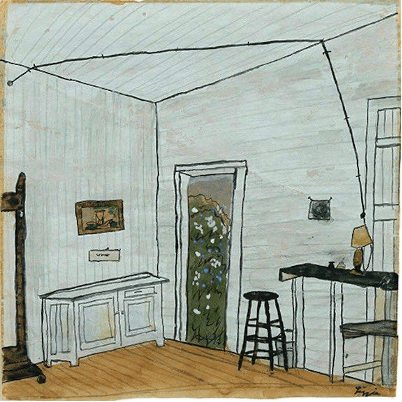
Care Of

A dim glow in the stable from the one light up in the corner whose cord runs down across the ground and into the house. The horses are writing their night philosophies, corrupting the youth of the moon. When the sun, distracted father, returns at morning, they will act no closer to the truth.

Prompt

In the subfield of mathematics called linear algebra, there is a frequently-given homework exercise that looks like this:

TRUE OR FALSE? If A and B are n× n matrices, then ABA-1=B.

A-1, here, is the inverse matrix of A. Leaving aside for a moment the question of whether or not the statement is true, it is easy to see why it might be: surround something with another thing and its opposite, and maybe the first thing will escape unscathed. Maybe.

This prompt is to write a three-sentence prose poem, one sentence of which takes a detail from another work of art—a poem, painting, film, piece of music, anything amenable to the task — and inverts it in some way. My example borrows from this Elizabeth Bishop painting: instead of the cord going up along the ceiling as in Bishop’s original (& therefore being in the house to begin with), in “Care Of” the cord runs down across the ground and into the house.


Tom Snarsky is the author of the poetry collections Light-Up Swan and Reclaimed Water (both from Ornithopter Press). His book A Letter From The Mountain & Other Poems is forthcoming in 2025 from Animal Heart Press.

When Joy Comes to Call, I Invite It In

Notice the red tongues of cannas flowering at the front
of the house, the dog’s slow arthritic rise as he wiggles over
to lick your hand. Ignore the weeds sprouting from between
the paving stones, no matter how often I tug them out.
Come in and kick off your shoes. Or don’t, the floors never
quite clean, littered with pebbles of gravel unlodged
from the soles of my trainers after walking the path around
the lake. We can visit there later, watch the herons wade
majestic, stir the shallows with their legs then dart long beaks
beneath the surface to catch their lunch. But for now, help
yourself to a drink. Never mind the smudges on the refrigerator,
the handle always just a little sticky, the odd dish in the sink.
Sit anywhere—at the kitchen island, edges chipped by
my son rotating back and forth on the metal chairs, or on
the brown chaise that fits perfectly beneath the dining room
window, part of an old sectional I couldn’t bear to discard.
Come sit beside me as the dew burns away and the sun glides
higher over the cottonwoods and pines. The dog will curl
at our feet to warm his slow bones as condensation forms
on our glasses of mint tea clinking with ice. Don’t bother
with a coaster. A mark will remind me you were here .


Writing Prompt

Choose an abstract concept or emotion that might show up to visit, whether it is welcome or unwelcome. Using either second person and/or epistolary form, write a one-sided conversation with that concept/emotion about its visit. Try to incorporate images that illustrate or imply its meaning or feeling and how you are reacting to it. Use at least eight imperative sentences.

[If you hate writing titles (like I do), call your draft “When _______Comes to Call, I _________”]


Donna Vorreyer is the author of To Everything There Is (2020), Every Love Story is an Apocalypse Story (2016) and A House of Many Windows (2013), all from Sundress Publications. She hosts the online reading series A Hundred Pitchers of Honey.

The Softest Kind


Being touched
By a man who cares
About my pleasure

Feels like being the softest kind of tofu—
Hot broth boiling, silky & shivering
Steeped plump with root and
Meat and fungus—

Ready—
When you bite into me—

To burst.


Poetry Prompt: The Body Comestible

Write a poem in which you reimagine your body as a specific food. What does it feel like to be that food? How do you smell and taste? What do you feel like to the touch? Do you want to be consumed, or left on the plate? What sensations might your body experience when it finds itself being eaten, digested, thrown out, put in the fridge?


Francesca Leader is a writer and artist originally from Western Montana. She has poetry published or forthcoming in Hooligan, Broadkill Review, Sho Poetry, Cutbow Quarterly, Door is a Jar, Stanchion, Nixe’s Mate, Bullshit Lit, Streetcake, Literary Mama, Poetry New Zealand, and elsewhere. Learn more about her at inabucketthemoon.wordpress.com.