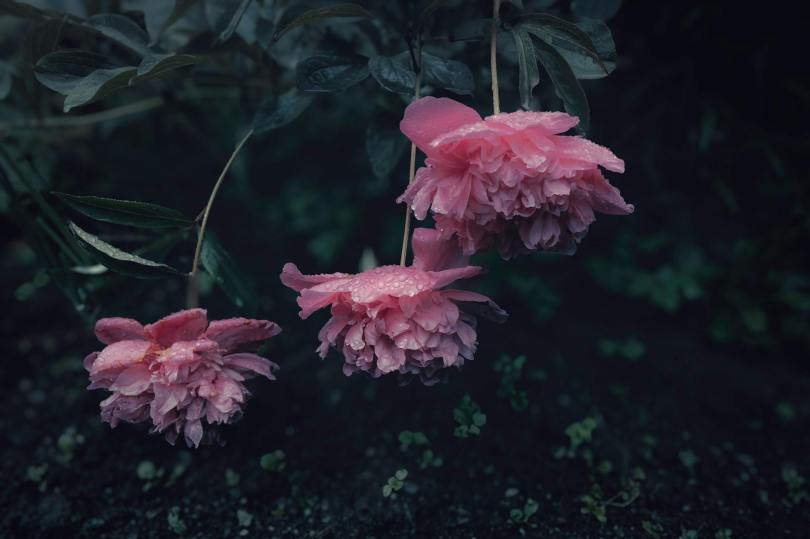
“MERMAIDS EATING OYSTERS” by Stephanie Burt & Mara Hampson

How do they get the things open? If they smashed the closed wholes against rocks, as otters do, the fragments could cut their delicate tongues. Instead they sing. They journey in cliques to the oyster bed, then hum at a resonant frequency, so that the oysters, charmed or fooled into attention, start to open themselves up to their underwater world.

The pearl harvest comes as almost an afterthought: no one needs more than a few, unless for ball bearings and other mechanical uses, where polished pebbles do as well. Fine oysters, once eaten, survive in outline and memory because the mermaids save individual shells, some for ornament, more for construction, building slow shelters, sharp-edged hiding places, for when the trawlers pass overhead.

Good oysters taste creamy and semi-sweet, since the mermaids and their environs are already salty. Other words mermaids might use include tender and wholesome.  Some of us believe that mermaids eating oysters heal their vocal chords, necessarily more powerful than ours, since mermaids’ speech must carry underwater: otherwise they could speak only with their closest neighbors. Young mermaids whose voices will not carry get asked to eat oysters by the half-dozen in order to shape and strengthen their sound.

Except for those cases—rare and vexing ones—most mermaid cliques regard the first oyster as a rite of passage: the first time a young mer sings to open an oyster herself, she gets to display the shell. It’s a sign: you can now use songs for other purposes—tempting sailors, or keeping sailors away; repelling sharks, dolphins or orcas (distinct songs for each); attracting and directing food fish in schools.

New York harbor oysters feel stodgy in the mouth, enormous, nutritious, with strong shells, but not much prized compared the Gulf of Maine. Nonetheless mer populations lamented for decades the apparent extinction of oysters in Long Island Sound. They cheer the replenishment of the oysters beds: one of the few human schemes they approve. Some even sing new songs about the far future, when they will live alongside us again.


Stephanie Burt is Donald and Katherine Loker Professor of English at Harvard. SUPER GAY POEMS, a collection of 51 poems (none by Stephanie) with an essay (by Stephanie) about each one, came out (as it were) in April 2025; her book about Taylor Swift will follow in October.

Mara Hampson is an aspiring artist and jill of all crafts. They live in Boston with their cat Pico. She bites (the cat, not Mara.)

A Review of Ayesha Raees’ COINING A WISHING TOWER

COINING A WISHING TOWER by Ayesha Raees (Radix Co-op, 2024). 72 pages. $17.95

by Burgi Zenhaeusern

COINING A WISHING TOWER BY Ayesha Raees (Radix Co-Op, 2024)

As little as we write in a vacuum, we read in one, and I feel that a reading memory is akin to a body of sounds and images, of wavelengths all in a jumble (like an orchestra before a concert) until the wavelengths of one text hit another’s, producing an accord of sorts. Coining a Wishing Tower rang with collections as seemingly unrelated as Benjamin Niespodziany’s whimsical and poetic one-act plays in Cardboard Clouds, the sparse poetry and rich interiority of Josie Foo’s Tomie’s Chair, or the sharp-eyed portrayal of existing between heritages of Monica Youn’s From From, and Maureen Seaton’s wryly celebratory Sweet World; and of all these, particularly Seaton’s short poem:

I think in spirals;


therefore,


I am infinite.

The numbered sequence of prose poems in Coining a Wishing Tower manifests a spiral formally—by the use of anaphora for example—and thematically. Unlike a circle, a spiral implies direction—inward/outward, up/down, as in the -widening scope of the collection’s narratives. The spiral embodies and symbolizes infinity as recurrence in changing contexts and as continuous motion. Poem number 40 could be read as a metaphorical, mini abstract of the collection’s spiral storytelling while also presenting one of its central themes. I quote it here in its entirety:

Google says: No! Cats have one life just like any other living creature! The fiction of feline immortality is due to how cats function! In awed resilience! Prone to survival! Yet in a fashion that is always barely! To survive and heal and continue, cats strive in chapters, skipping from one existence to the other, from birth to separation to shelter to settlement to abandonment to ravagement to wilderness to car accidents and then to eventual demise. Each chapter becoming a disappearing act from the last, a knowing deeply settled in a body, a knowledge that permanence is a human fantasy, that in the end, living is dying many times in one singular life, to grow and adapt is a technique to survive, to give adherence to a lineage is continued as a mark that we were all once here, occurring in the narratives of the ones that will lead us into the future. (50)

On its own, number 40 may not be a captivating read. Its effectiveness is rooted in its placement deep within the fabric of the poems’ sequence; and all it says—with the concise language and matter-of-fact tone characteristic of the collection—feels necessary: key information thrown in as if an aside and easy to overlook, thus imparting understatement and irony. This poem smiles at itself and at the reader by the time they come to it. There are other moments where the hint of a wry smile shines through the dioramic series of scenes—scenes arranged like lit windows of a building otherwise in the dark, behind which various dramas unfold.

Prose poems especially favor fragmentation, a stop-and-start flow, loose ends, a permeable border between the imaginary or interiority and what counts as empirical reality, and play. The poems in Coining a Wishing Tower do this with ingenious imagery and a combination of memoiristic and myth- or fairytale-like stories, which keep getting recontextualized, underscoring the speculative and ever-shifting nature of all stories—the ones we tell ourselves, the ones we tell each other, and what we hear—depth acquired by offering layers and the freedom to peel them back or not.

The collection begins and ends with House Mouse, who is one of its mythlike figures and undergoes a metamorphosis. It is also an alter-ego of the speaker who left her home in Pakistan for the US, a long-imagined destination:

1.
House Mouse was running to the mountains but nothing came out of its climbs. Every peak held another peak, and every reach held another reach. At the end of all possible height, House Mouse found itself inside a tower. The tower looked like a black, elongated box, sharp at the edges, smooth and silky on the sides.

Behind all there was was just was: a view called beautiful only because it was now distant. (11)

In the course of events, House Mouse dies, House Mouse returns, and nothing is the same, as in all coming-of-age and emigration stories. The tower is House Mouse’s living shrine in both senses of the word: “to be alive” and “to live in.” Its significance overlaps with the Ka’bah’s significance in the speaker’s life. House Mouse’s story with the tower is in part a meditation on faith/trust and religiosity, especially on the tension between wish, prayer, and ritual, and the pervasive question of authenticity. “Coin” and “coining” as verb/noun imply shaping and monetizing simultaneously, as in the minimal statement “A wish a coin” (20)—a softening of distinctions, resulting in fluidity and an interrogation of intentionality.

Godfish, another mythlike figure, “lives in the crystal clear aquarium behind the crystal clear window of a giant wooden house in New London, Connecticut” (13), where it is the focus of both the moon’s and the cat’s unconditional love, while it itself is happily infatuated with an oblivious sun. Their impossible love is trusting as a child’s, and reciprocity is assumed rather than sought. Its story is as sad as it is endearing. An untrodden “Desire Path” leads to the isolated wooden house:

22.
A Desire Path is created through an inevitable erosion by an animal. It is a constant back and forth trod in the same narrow area. It is a natural act that connects two suffering destinations in their lack of constant hold. No one liked coming to the giant wooden house in New London, Connecticut, where the winter had a bad bite, the summer brought strange pesticides, and spring hardly lasted in the rain. There was no path, no trod, and no desire deep enough for any kind of create. (32)

Here, the usage of the infinitive as verb/noun creates tension by blurring the line between in progress/motion and outcome/stasis, foreshadowing a similar blurring of animate/inanimate later on. The wooden house isn’t simply the setting for “windings, convolutions, and unnatural happenings” (26). Unwittingly or not, it impacts the action. Godfish’s story might also be read as a parody of the biblical fall from grace—“Paradise Lost” in a “giant wooden house” in New London, CT.

Maybe the speaker chose New London as an imaginary scene for her quasi-American “dream” because it could well embody small town USA: mostly white, overly tended lawns in summer, cold in winter. She sets New London, CT’s remoteness against one of her first encounters with “America” in the form of Happy Meal toys, pinpointing the ubiquity of US culture everywhere, including in her Pakistani childhood, yet with an added local flair. The localness is what she needs to trust: that something in her heritage remain inviolate and resistant: “These toys are different from the toys American children get. I believe. I believe. I believe.” (42)

Coining a Wishing Tower also reflects on different ways of learning and knowing. At one end of the spectrum is the speaker’s mother, who imparts traditions—knowledge built on experience and relationships over a long time—and at the other, knowledge obtained by way of Google—factoids and an uneasy trust in them. Both meet in the speaker’s imagination. As House Mouse and Godfish, they tell a story of aspiration and discovery, of leaving behind the assuredness of home, of loss which can be a form of liberation, as can adulthood. The prose poems’ multifaceted interiority shifts borders, strews sand, sows doubt, then wonder, and joy about yet another beautiful re-invention of the wheel. Ayesha Raees’ Coining the Wishing Tower has added its clear voice to the chorus on my bookshelf.


Burgi Zenhaeusern (she/her) is the author of the chapbook Behind Normalcy (CityLit Press, 2020). She co-edited the translations of the anthology Knocking on the Door of The White House (zozobra publishing, 2017). Her work appeared, most recently, in Sugar House ReviewJMWWLittle Patuxent ReviewMoist Poetry, and as broadside (Ashland Poetry Press). https://linktr.ee/burgitree

“Field Notes: Worcester County, June (II)” by Carolyn Oliver

A neighbor mows away half his small meadow, and crickets return to unstitch the morning quiet’s seams.

Poison ivy oozes out from sumac shadow. Multiflora rose drips over silver guardrails. Haze creeps down from the north, ours and not ours.

Stormless, sun-welted, day drives us indoors.

Our heads ache. We shut the windows. What use are peonies and fraying poppies?

A rabbit eats white clover as if the neighborhood hawks have taken to their beds with fever.

To save a rhododendron, cut it back two years ago. Burn the spotted leaves.

Behind a cavalcade of robins, a phoebe founders in the grass.

There’s a tactile quality in the croaking of the gray tree frogs in the rain, something curved that asks for my fingers to curl around it, makes me aware of every knucklebone.

[Interlude: what goes on unwitnessed.]

Returning, we find the brick walk purpled by clematis, the leaves of the dock and the beans and the strawberry and the turtlehead beetle-bitten, and beetles big as thumbs dead in the mailbox.

The fields burst green, though chipmunks have eaten all my works.

Author’s Note: I want to love the whole summer. I think I used to, before I knew enough to worry. So lately I’ve been trying to love summer again, one fragment at a time. Writing this series of monthly field notes poems has helped; I’m learning names for plants and creatures, allowing myself to linger over views and sounds. I drafted this poem—nineteenth, I believe, in the series—in June 2023, noting down images and noises encountered in neighborhood walks or short drives around this area of central Massachusetts, then revising and shaping the poem once the month ran out.

Carolyn Oliver is the author of The Alcestis Machine (Acre Books, 2024), Inside the Storm I Want to Touch the Tremble (University of Utah Press, 2022; Agha Shahid Ali Prize for Poetry), and three chapbooks. Born in Buffalo and raised in Ohio, she now lives in Massachusetts. Visit carolynoliver.net for more.

“The Crone Unfound” by Beth Gordon

All that summer we feared the unseen. Jaws in theaters: our canvas rafts like bait for watery monsters. We left them on the sand. Our parents drinking Bloody Marys on the beach house deck while we battled the ocean with nothing but our bodies. Over and over, we tried to swim to France. Over and over, we lost our way. Nobody noticed that we were bruised. Nobody asked why we were trying to escape. Can you see that I don’t know how to tell our story? Something was lost in the salt. Something was lost on the screen: the freckle-faced boy pulled under in a churn of blood. His mother forever changed. We learned that no one could protect us from God.  That we had to save ourselves from stingers: from teeth: from the deception of waves & light. Now I am landlocked & unable to blow wishes across the finite horizon. Searching for answers in the alchemy of nests. Still feeling the ache of what was taken. What was drowned. The mystery of the unreachable shore.


Author’s note: On a literal level this poem is about a formative childhood experience – my brother, parents, grandparents, aunt, uncle, cousins, and I would go to Oak Island, NC every summer. In the context of the Crone poems I’ve been writing since turning 60, this poem is interrogating that memory. What does my 12-year old self have to teach me? What are the things that only she knows? 

Beth Gordon is a poet, mother and grandmother in Asheville, NC. She is the author of several chapbooks including The Water Cycle (Variant Literature) and How to Keep Things Alive (Split Rock Press). Beth is Managing Editor of Feral: A Journal of Poetry and Art. Find Beth on Twitter, Instagram, and BlueSky @bethgordonpoet.

Dear words I do not yet have,

I am writing to you from the heart of the empire, so much the heart it does not see itself for what it is. Who speaks for me from here? Am I nobody, or nobody’s mark? One eye bleeding. Grasping for where the wound came from, where the weapon speaks. There in the dark-not-dark he touches everything he loves, looking for danger, touching fleece and fleece, known and known. Underneath each, a soldier.

after Audre Lorde and Amorak Huey

Prompt

Audre Lorde writes in her essay “The Transformation of Silence into Language and Action,” “What are the words you do not yet have? What do you need to say? What are the tyrannies you swallow day by day and attempt to make your own, until you will sicken and die of them, still in silence?” Write an epistolary poem (a poem in the form of a letter) to the words you do not yet have.


Jeremy Michael Reed has published poems and essays in Still: The Journal, Valparaiso Poetry Review, Western Humanities Review, and elsewhere. He is an assistant professor of English for Westminster College in Missouri.

Care Of

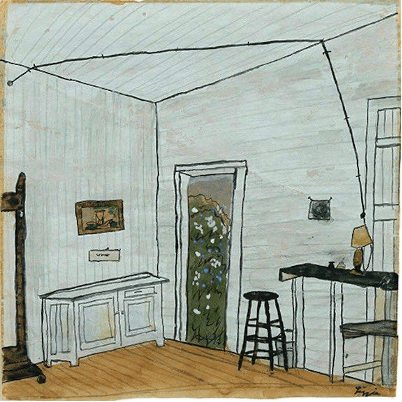
A dim glow in the stable from the one light up in the corner whose cord runs down across the ground and into the house. The horses are writing their night philosophies, corrupting the youth of the moon. When the sun, distracted father, returns at morning, they will act no closer to the truth.

Prompt

In the subfield of mathematics called linear algebra, there is a frequently-given homework exercise that looks like this:

TRUE OR FALSE? If A and B are n× n matrices, then ABA-1=B.

A-1, here, is the inverse matrix of A. Leaving aside for a moment the question of whether or not the statement is true, it is easy to see why it might be: surround something with another thing and its opposite, and maybe the first thing will escape unscathed. Maybe.

This prompt is to write a three-sentence prose poem, one sentence of which takes a detail from another work of art—a poem, painting, film, piece of music, anything amenable to the task — and inverts it in some way. My example borrows from this Elizabeth Bishop painting: instead of the cord going up along the ceiling as in Bishop’s original (& therefore being in the house to begin with), in “Care Of” the cord runs down across the ground and into the house.


Tom Snarsky is the author of the poetry collections Light-Up Swan and Reclaimed Water (both from Ornithopter Press). His book A Letter From The Mountain & Other Poems is forthcoming in 2025 from Animal Heart Press.