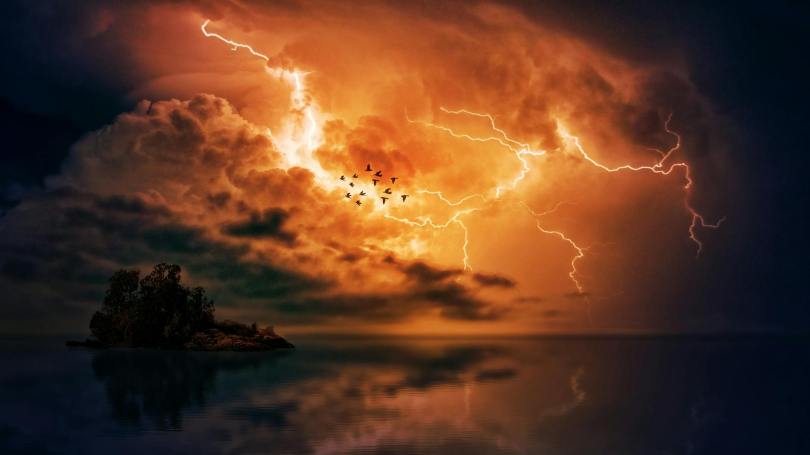
“Rapture is a painful thing” by McKinley Johnson

after Louise Bourgeois’s Arch of Hysteria (1993)

It’s no simple vanish, no snap of earth-forming fingers;
when God takes you, it's violent.
Dissonant trumpets, burning chariots,
angels grab you by the belt and yank.

Your clothes are not left, neat and folded,
in your seat. There is no flash of light,
no cooing of doves—you are here and next
you know you are heavenbound, Godspeed,

hips skyward, limbs trailing behind,
shoulder ripped from socket by the drag;
friction makes you burn, a reverse comet,
a smoking censer chain-dragged through the sky,

sprinkle your sulfur down on earth—
that is what hell smells like. There is no
chance for goodbyes, or there wouldn’t be,
if your ascension wasn’t eternal. By the time

you realize there was time, those you left
behind are gone—their journey equally plummet,
you just had the luck to spite gravity, you predestined
devine, you rainbow-clad prophet, father of Methuselah.

Be glad your friends are the ones in the iron box;
be glad as you soar past Saint Peter, that he stamps
your name in the book; be glad the cherubim east
of the garden lowered their swords for you. Be glad

oh golden image of God, that He has made you
and allowed you this ascension, this fire is cleansing,
this journey a lesson. Why would rapture be anything
but painful? Even Jesus had to suffer to get here.

McKinley Johnson (he/him) is a poet from the foothills of Appalachia. He is an MFA candidate in Poetry at George Mason University and a teaching fellow for Poetry Alive! His work can be found in the North Carolina Poetry Society’s Award Anthology Pinesong, Neologism Poetry Journal, and elsewhere.

Two Poems by Will Diggs

Imma Die Bout My Queer Niggas

ion wanna die bout my queer niggas
cuz i believe we should live.

we all gon die eventually but
if we can keep death waiting
i really think we should.

greedy bitch already out here
taking everyone she can without
second thoughts on the matter.

if she keeps beating at the door,
i think one of us should open it up
& yell her ass back down the driveway
to that raggedy hooptie parked curbside.

but if she just insists someone accompany
her to wherever the fuck death resides
when she not robbing niggas of years

imma jump up & down waving my
hands in the air, screaming the whole time

hollerin’, me me me it must be me!
for my queer niggas.

i know bout five of em gon tell me to go
back in the house & sit my ass down but
them niggas didn’t get the memo. they been

doing this shit for years, pushing to the front
of the front lines. taking all the bullets & none

of the credit for longer than folks have cared
to acknowledge their existence. our existence.

imma die bout my queer niggas cause we
deserve a chance to live fruitfully &
every orchard has its own harvest song &
no one gets to say ours doesn’t sound good
or should end.

I Write Love Poems Too

i borrowed the last cup of sugar 
from next week.
tomorrow is Friday & Tuesday
expects to bake lemon pound cake

so will need me to make good on
my promise of repayment.

pieces of my heart float around rib
cages in homes i have never visited.

you call him my name over dinner
& say he’s just trippin but we both

heard you even though i ain’t spearin’
meatballs or spinnin’ pasta on my plate.

when we talk on the phone i hear you lie
about the way things have gone since we

last spent time together & i identify with
this kind of bullshitting because my life
been hell since we disconnected too.

today i heard a poem by a Brit about
birds & bees but not sex.
it gave me chills, made my heart skip.

watched the new Destin Conrad
music video three times in a row & said
in my head, fuck that man
makes great music & dances his ass off.

one day soon we should talk on the phone so
long we decide to continue the conversation in
person, then fall asleep in each other’s arms.

the world is ending if the rich have their way
which is to say they’ve got plans to be on Mars
once the world dies, so let’s live a little together.


Will Diggs is a Black pothos father residing in North Carolina, where he hikes and loses Scrabble tournaments. His work also appears or is forthcoming with The Rumen, IMPOSTOR Lit, Furrow Magazine, and more. You can reach him at digable.creatives@gmail.com.

Two Poems by Chris Corlew

I MAY NEVER BE STRAIGHT EDGE BUT IT IS PUNK ROCK TO QUIT DRINKING

in the NOFX song Bob spends 15 years gettin loaded until his liver exploded
saying he wanted to think about nothing

am I made of the same weakness
afraid of checking my mail?

cockroaches & bedbugs my first apartment like Charybdis’ maw of misery
molded paperbacks thanks to a busted ceiling pipe like
cosmic justice for my settler ass like all streams flow
into the sea & yet the sea is never full homie


all becomes dust
it is not a sin to recycle a book


the best conversations happen in a tavern but
the revolution doesn’t happen because you got drunk

the revolution is clear-eyed & callous-handed & joyous in struggle
the revolution is constant as a river & leaves you sore but naturally high
the revolution is dancing with everyone on the floor

in community garden mornings
in the drag punk band hollerin on the street festival north stage
in the public school fundraiser night

it is song you started but only the rest of the band could finish
it is a reliable bus route
it is a shared box of blueberries

WHITE PARENTS OF BIRACIAL CHILDREN

do people ignore you
at the airport
if you’re the parent not holding the kid’s hand?

our kid’s pre-k3 teacher called him a ‘bright light’
which was as adorable as hummingbirds
of course that’s exactly what you are yes it is you are bright light

cut to a couple years later
talking about being half-Black half-white
he asks how much of him is bright light

every part of you is bright light I tell him
but that’s not the point it’s Black History Month
& sun is shining at the park
& my wife teases me he still needs sunscreen you know

one day my son will grow up
& be another Black man
I can screw up a handshake with

Chris Corlew is a writer and musician living in Chicago. His work has appeared in Cotton Xenomorph, Whisk(e)y Tit, PassionFruit Review, Cracked.com, and elsewhere. He can be found at lazyandentitled.org or on Bluesky @thecorlew.

“Counter-clockwise” by Nico Green

I want you and I want you too.
I want two loves around me. Swirling in a spiral, if possible.
Counter-clockwise.

I want to look up at the sky and see two faces.
Two moons orbiting an alien planet.
We left the old one behind. It couldn’t hold us anymore

I want to look up at the sky and see two faces.
Then I want them to look at each other with all the love in the Universe.
The Universe we created together. The old one couldn’t hold us anymore

I want two dogs and two cats and two lovers and 6 rooms, for when we need to be alone.
I want to collect all the love that loves me back and fill a house with it.
A new species of love that grows when exposed to sunlight.
The old love couldn’t hold us anymore.

Nico Green is a Brazilian-American poet based in Lisbon, Portugal, and the founder of Poems for Strangers, featured in a documentary by Ukrainian filmmaker Anastasiya Bura. His work explores love, sex, and non-monogamy, reflecting his activism in sex-positive and polyamorous communities. He/Him.

“Missing Parts” by Sam Rasnake

                   – after “It is essential… to undertake
the reconstruction of the primordial Androgyne
that all traditions tell us of… within ourselves.”
André Breton & Androgyne III
(1985, Magdalena Abakanowicz)


as if these definitions –

she and him, she and her,
he and him, they and
her, they and him, they
and them, she, they, him

– weren’t enough, the dark
blurs of who, what, and why

coil their supple excesses
through the night hours
and behind walls – when
the heart only

knows the heart

Sam Rasnake is the author of Fallen Leaves (Ballerini Press, forthcoming), Cinéma Vérité (A-Minor Press) and Like a Thread to Follow (Cyberwit). His works have appeared in Wigleaf, Stone Circle Review, Anti-Heroin Chic, UCity Review, Best of the Web, Southern Poetry Anthology, and Bending Genres Anthology. Follow Sam: Bluesky @samrasnake.bsky.social.

“Shopping Music of the Gods” by Kyla Houbolt

Someone said hurdy gurdy heart
so of course I thought accordion heart,
vuvuzela heart, calliope heart.

Hello, heart, I say as it knocks
on my door. What have you been
up to? Oh nothing much, says
heart, achingly.

We have broken much together,
heart and I, and yet we still
do not know each other
very well. I offer my kazoo.

Heart declines. Pulls out
a blues harp, says,
shut up them damn birds,
I got something to say.

Kyla Houbolt is a poet and gardener living in North Carolina, USA. “Shopping Music for the Gods” will appear in her full-length selected and new poems, Becoming Altar, forthcoming from Subpress in autumn 2025.

“After the Start of Summer” by Kevin Risner

the lake blooms a bright green more vivid than geckos.
When these blooms enter the household, it’s only natural
to collect them, place them in a glass vase, burn eyes
with pollen. Pink and orange petals flutter onto the table.

They say that algae blooms mean an overabundance
of phosphorus. It’s toxic.

We drink up facts, reap the consequences, even when
it’s not our fault. I am a wooden raft headed down
the river after a heavy rain. The water’s thick there.

I hope to make my way out of this sand trap
through storm into sunlight, no longer
hidden by mattress-stuffing clouds in
the endless overcast that is November.

Author’s note: This poem spent a long time percolating and undergoing changes, much like how lakes do each year. In 2014, a severe algal bloom formed on Lake Erie off the coast of Toledo, which led to extreme water restrictions (for drinking, bathing, washing dishes). The result of agricultural runoff, this particular bloom shows vividly how much we, humans, have adversely affected waterways of all sizes and shapes. I try to explore the beauty of such events and how they can become disastrous, and how often they may return. The blooms will be pretty severe this year, but not as bad as the ones a decade ago in 2014. That’s a small sliver of hope. And I hope we can find these slivers from time to time, not just here in the crevices of this poem, but elsewhere in the world.

Kevin A. Risner is from Ohio. He is the author of Do Us a Favor (Variant Literature, 2021); You Thought This Was Just Gonna Be About Cleveland, Didn’t You (Ghost City Press, 2022); and There’s No Future Where We Don’t Have Fire (ELJ Editions, 2025).

“Sacrifices” by Staci Halt

My favorite film has an original script;
is shot, and directed by me—
I’m the star, too, in a cast of three.

Your wife speaks no lines.
The opening scene starts after she dies

painlessly, expectedly, unavoidably—
you were prepared as one can be
for the kindest possible removal

of a sympathetic character,
sadly unprotected

by the plot. My character attends
the graveside service—
notes her stiff hands do not claw

through the rain-black earth in protest
of my presence.
The sun supplants the clouds on cue,

and I hold back
while out-of-focus mourners disappear
off screen conveniently.

Our eyes connect with static shock—
the shot breaks to follow a wet, ripping sound
near the trees

at the far end of the cemetery—
a Cooper’s hawk has caught a vole.

Her talons pierce and quell
the fruitless struggle.

Her banded belly and golden eyes
are striking against the faultless lawn

as she eviscerates her prey.
Nature undeterred and matter-of-fact
requires sacrifices.

The camera leaves the carnage
and we stroll towards your car—
lean back in easy silence

against the immaculate black of the doors.
We pass a flask of bourbon back and forth—
we’ve done this before.

The lens zooms in to capture how your lips
and tongue linger on the flask’s rim.
Time slows, music begins softly,

then swells, heightens
the impression of a quiet, buried longing
which never dissipated

but collected itself;
grew deeper without outlet over years.

I’m collected; controlled: not touching you,
not leaning close—
despite memory of how you used to breathe

in as I exhaled as if I were an antidote,
and you a dying man.
The camera angle shifts to capture your hand

surprising even you
as it finds its way home,

your thumb a gentle knife
on the underside of my jaw—
fingers hardly squeezing
the back of my neck.

The audience holds their breath.
They know what kind of kiss comes next,
and no one

not me, not you, not the hawk,
has done anything
wrong at all.

Author’s note: I have often been asked if I ever write happy poems and or love poems. The answer is, to the first, I think never, and to the second, only if the love poem explores the pain, grief, and hunger that so often accompany love. I recently reread this poem, written a few years ago, wondering if it didn’t need revision so much as the proper title was missing. The annoyingly cliched MFA workshop question rose up to face me, like a spectre: What’s at stake? The speaker of the poem here imagines a world where wanting what they cannot have is not transgressive, but totally acceptable, socially, morally, and emotionally. Issues of conscience are easily and matter-of-factly dealt with, something that is not possible in reality, but in the world of poetry, all one needs is imagination to open doors to possibility that reality locks up with impenetrable finality. I changed the title to reflect what is at the heart of this poem, which, in the imagination of the speaker, is bargaining about a longing that in order to be admitted to and explored, must occur within an ecosystem of morality.

Staci Halt’s work has appeared or is forthcoming in Rattle, december Magazine, Salamander Magazine, The Los Angeles Review, Driftwood Press and others. She parents six rad humans, and a slew of cats, and teachers and writes near Boston, for now.

“River Silt” by J. Turner Masland

in late summer
naked bodies beautiful

we walk sandy trails
willow thickets spit out
sun cliff tower walls
still we go deeper

salt water lips we swim
muskgrass swaying in stream
wet rainbows quiver we glimpse
warm shallow ripples

we roll on dunes curving down
large bodies burnt brown
soft red glinting in river silt
lines that gorge bottom sound

recreational pleasure please
watch us
hard and touch us
gentle

dark forests dive
deep down parted mounds
wood muscle moss
bush silvered gloss
cedar grain aged lines

an imp among
woodland creatures offers
blackberries and beckoning
eyes twinkle

stone worker builds
bodhi brings down
the sky rings truth off
sun cliff tower wall echoes

over golden hour bottom showers
slick soft river silt
late summer naked bodies
wood muscle moss

holding and held
this orbit still spins

Author note: “In writing this poem, my wish is for the reader to share in the spiritual experience of a perfect late summer day spent at a hidden nude beach nestled between a willow grove and a sandbar, deep within an ancient river gorge. It’s a place where you can easily make a new friend while walking the muddy trails naked, and where years of body shame can melt away in the heat of the overhead sun. I hope this poem inspires you to strip down and go find a river to play in.”

J. Turner Masland is a queer land worker, writer and artist. He focuses on a creative practice that explores the intersections of ecology and poetics in the age of climate collapse and rising fascism. Turner lives on the Olympic Peninsula with his husband, dogs and a small herd of goats. His first chapbook of poetry “Hagstones” was published by WinterTexts in the spring of 2023.

“After the All-Star Break” by Claire Taylor

tomatoes 
straight off the vine
sun-ripe and wet as
a lover’s July skin

the day runs its
humid tongue up
my thigh

we are only sweat
and angles—exposed
elbows, bare knees, sharp

anger that hangs
heavy in the still
night air

I read once that on
hotter days
a pitcher is more likely
to hit a batter

remind me in October to apologize
for how I always
pitch it inside

aiming straight for your heart

Author’s Note: In my house, we track the year by the baseball season. Opening Day signals spring. Playoff baseball means fall has arrived. And once the All-Star break has come and gone, we are deep into summer, which in Baltimore means unrelenting heat and humidity. I wanted to capture summer’s specific blend of sensuality and aggression. There’s so much skin and sweat—you can’t help but feel horny!—but it’s also such a stifling, uncomfortable season. I spend all summer bouncing back and forth between desire and rage. I doubt I’m the only one. By October, it’s time for the playoffs and fall, and for me to make amends for all the fights I picked when it was too hot to do anything else.

Claire Taylor is the author of multiple chapbooks, including Mother Nature and One Good Thing (Bottlecap Press). She is the founding editor of Little Thoughts Press. Claire lives with her family in Baltimore, Maryland, in an old stone house where birds love to roost. You can find her online at clairemtaylor.com.