It Keeps Me Like a Garden: A Review of Carla Sofia Ferreira’s Debut A Geography That Does Not Hurt Us

A Geography That Does Not Hurt Us by Carla Sofia Ferreira (River River Books, 2024). 89 pages. $18

by Tom Snarsky

A Geography That Does Not Hurt Us by Carla Sofia Ferreira (River River Books, 2024)

When I was a high school teacher, I always shared one poem with my classes at the beginning of the year: “A Journey” by Nikki Giovanni. I didn’t give my students much context beforehand, we just jumped into the poem’s opening: “It’s a journey . . . that I propose . . . I am not the guide . . . nor technical assistant . . . I will be your fellow passenger . . .” I thought of this poem immediately when I saw the titles in Carla Sofia Ferreira’s A Geography That Does Not Hurt Us that mention students (e.g. “Today My Students Tell Me,” an all-time favorite from the collection re: which more later), or even poems dedicated to them (“In This Poem, Bert & Ernie Are Gay”).

It is, paradoxically, both hard and delicate to be a teacher while also being Giovanni’s “fellow passenger”—when you teach youth in secondary + postsecondary contexts, as Ferreira has and does, you bring your own identity into a room where many others are actively being formed, including by what you say and do. In her article “Invisible Identities,” educator Erin Smith wrestles with the question of how much of her own journey, specifically surrounding mental health, to share with her students: “When I first began teaching, I didn’t divulge anything about my own mental health journey to students. For one, I thought that might delegitimize me as a teacher somehow, even if I was speaking in past tense. I also thought, frankly, that I would scare them.” Ultimately, Smith decides to share parts of her past experience with her students, partially in the hopes of connecting with them when they might feel at their most alone and partially because, “at the end of the day, I am only the teacher I am because of my past, however painful. I want my students to know that I have lived and struggled not for them, but alongside them” (emphasis mine). Even in the face of a hyper-politicized educational climate, which has placed more scrutiny than ever on what teachers say and do, Ferreira’s book unapologetically presents the poet-teacher as a vibrant, several-dimensional, multilingual singer of the many sorrows and joys of life, and in particular of the education it has in store for all of us. The book is a record of many different ways to make sense of the world in verse, and dazzles as much for its pluralism as for the emotional, formal, and imagistic precision of its poems.

***

There are many pieces from the book I could quote at length, but I’d love to spend time with my personal favorite, “Today My Students Tell Me”—in particular, this section:

[...] a student tells me that I seem
like the kind of person who is good at tending plants,
that I seem exactly like someone who would care for
dying plants and maybe even heal them, only I am the one
adding maybe, because they said it with such conviction
and another student agreed with them like this was simple
and true, and I laughed, I told them they were wrong, that I wish
I were more like my grandmother, who was in fact a tender of gardens
and all green things [...]

The first time I read this poem I was drawn to its subtle music: the way it dips into iambs for “is good at tending plants” feels like a perfect sonic parallel for the rhythms of care that phrase postulates, and there are little consonant breadcrumbs that reinforce the different connections between the poem’s characters and concepts/images (“person” and “plants,” “care” and “conviction,” “grandmother” and “garden” and “green”). Ferreira’s poems have a very intimate connection to music, which we’ll unpack a little more in the next section.

Like all great poems, this one has more to reveal than what the ear picks up alone. First is the airy line break on “care for,” which points gently at the fact that even though the object coming in the next line is “dying plants,” the student here sees Ferreira’s speaker as a carer writ large: this speaker clearly cares enough for their students to invite these kinds of ribbing-yet-kind characterizations and comparisons from them. And it is, indeed, them, in both the singular and plural: the line break on “only I am the one / adding maybe” plays with the irony that Ferreira’s speaker’s self-doubt is individual, while the students’ positive assessments are coming from the collective (and with certainty: “they said it with such conviction / and another student agreed with them like this was simple / and true”). This is also a playful inversion of the kind of building-up that is so often the bread and butter of the student-teacher relationship: anyone who has taught adolescents has had at least a hundred versions of the conversation where you not so much convince a student that they can do something, as you reassert it insistently (and necessarily simply, like a fully self-evident fact) until you both believe it.

So much of good teaching happens along the melodic lines of community and conversation that the reader hears in this episode, and there is also a bittersweet note that sounds across the enjambment of “simple / and true.” The reader is reminded that a majority of what students and teachers encounter outside of the context of a classroom community will be neither simple nor true: although Ferreira’s speaker cannot protect their students from this reality, they can share space with them and even bits of their own life story, like the moment with which this episode concludes, when the speaker invokes their grandmother. I love this moment of the poem so dearly because it once again inverts a classic discursive move of the classroom teacher, who can ask a student a question (or offer a small conjecture based on a little bit of data, new haircut, new shoes, how’d the game go yesterday, etc.) and then, by the happy accident of how the student responds, the teacher ends up learning something about the student’s life or their family or their interests—adding a vital shade of humanity to the student/teacher relationship. This moment in Ferreira’s poem shows how this dialectic is fundamentally a two-way street, colored in on both sides of the dividing line by student and teacher alike deciding to share.

In particular, Ferreira’s speaker chooses to tell the students about their grandmother, “a tender of gardens / and all green things.” There is a lovely visual parallel between the line-ending phrases “tending plants” and “tender of gardens,” the former a description of the speaker offered by the students and the latter a description of the speaker’s grandmother offered by the speaker. This extends the building-up beyond the classroom walls and across generational lines in a way that connects the poem up with one of Geography’s grandest motifs: temporal and familial cycles of care. A double meaning of “green,” both in the literal sense of plant color and in the more figurative sense of being new, even naïve, invites us to consider that we all exist at varying stages of vulnerability and imperfection along this timeless continuum of care: just as wisdom passes across generations, and is remembered, youth gives the energy of its indomitable spirit back to teachers and grandparents, with a side of cheek. This back-and-forth ouroboros prepares us beautifully for the poem’s ending: “this tenderness, even just this shared / nodding of heads, that it takes care of me every day, that it keeps me like a garden.”

***

In the foregoing, we have settled into Ferreira’s Geography in one of very, very many ways a reader could enter the text. Teaching high school students is my own personal gateway, but the book teems with further possibilities: in addition to being a book of the teaching and learning that occurs in classrooms and across generations, it is also a collection about ecology and cultivation on a local and global scale: “I am wondering / if I can hold it all like this packet of seeds and also if the earth / here will let them grow” (“In This Garden I Am Growing”). It is no less, too, a collection of love poems, the addressees and objects of which span family, history, and the many different kinds of intimacies that make up a life: “In my thoughts, I call you Grandma / though I never called you that in life. / I keep forgetting what it means to live a life / with you not in it” (“Poem In Which I Can Say Polka Dots, Tenderness, Icicles Without Translation,” one of the other poems in the collection that directly and poignantly addresses “Avó,” the speaker’s grandmother). Furthermore, the book is a compendium of form and of the joys of spoken and written language as only an English teacher can communicate them, made up as it is of poems working across forms (odes, elegies, centones, ghazals, letters, self-portraits, even a ransom note!) and singing the praises of punctuation (one poem opens with the indelible phrase “Plums she gathers like ampersands,” and there is even a poem called “Ode to the Semicolon”!).

Finally, Geography is a carefully crafted parallax along two different, but coincident, cultural lines: Fado, a venerable Portuguese musical tradition encompassing songs of longing and melancholy (which often take as their subject matter life at sea and the struggles of the poor), and The Ironbound, a working-class neighborhood in Newark with a strong Portuguese immigrant community. Ferreira’s first micro-chapbook is entitled Ironbound Fados (Ghost City Press, 2019), and some of the poems included both there and in Geography enact Fado’s complex relationship with sorrow, grief, and love on the subjects of an Ironbound upbringing: family, local flora, even “The playground of concrete and gravel and parking spaces” at St. Lucy’s (a Catholic Church in Newark that is host to the American national shrine for St. Gerard Majella, an Italian saint who grew up in poverty, worked several jobs, and would go on to become the patron saint of expectant mothers). Everywhere in Ferreira’s collection, even on the periphery, there is this intermingling of the work of poetry with the spirit of joy, of wisdom that passes through generations and creates the maps by which we know ourselves, our neighborhoods, and our beloveds. (One of my favorite things about the book is that the Acknowledgements section runs to six pages, in order better to contain “an incomplete catalogue of gratitude,” a riff on Ross Gay that ends the book as warmly and openly as it began.)

***

At the end of the year, I’d share one more poem with my students: “Homeless Heart” by John Ashbery. “When I think of finishing the work, when I think of the finished work, a great sadness overtakes me, a sadness paradoxically like joy.” A Geography That Does Not Hurt Us is imbued to its marrow with this feeling, the joy of a collective work and emergent togetherness, tinged by the sadness essential to song: “I am tired of living alone. I am growing a garden / like my life depends on it because it does” (“In This Garden I Am Growing,” that “depends on” one of the book’s winks to fellow NJ poet William Carlos Williams). This joy shines with the same brightness as a graduating class, while still pulling little threads out of the hearts of educators and family members who can feel the way the passage of time will quickly turn this joy into memory. When I read Carla Sofia Ferreira’s luminous collection I am reminded of two things: first, of the students I had who were bilingual in Portuguese and English, for whom this book would be an unequivocal affirmation that their language and experience is the language and experience of poetry. Second, that time and our transition across generations and from one cohort of students to the next does not have to be all grief, or only grief: that I am instead free to follow Ferreira’s example in order to describe my finitude differently, “to love afternoons turned into morning, and / to love with both hands and eyes closed what is already leaving me.”


Tom Snarsky is a former high school math teacher and the author of the full-length poetry collections Light-Up Swan and Reclaimed Water, both from Ornithopter Press. His book A Letter From The Mountain & Other Poems is forthcoming from Animal Heart Press in summer 2025, and his book MOUNTEBANK is forthcoming from Broken Sleep Books in spring 2026. He lives in the mountains of northwestern Virginia with his wife Kristi and their cats.

A Review of Ayesha Raees’ COINING A WISHING TOWER

COINING A WISHING TOWER by Ayesha Raees (Radix Co-op, 2024). 72 pages. $17.95

by Burgi Zenhaeusern

COINING A WISHING TOWER BY Ayesha Raees (Radix Co-Op, 2024)

As little as we write in a vacuum, we read in one, and I feel that a reading memory is akin to a body of sounds and images, of wavelengths all in a jumble (like an orchestra before a concert) until the wavelengths of one text hit another’s, producing an accord of sorts. Coining a Wishing Tower rang with collections as seemingly unrelated as Benjamin Niespodziany’s whimsical and poetic one-act plays in Cardboard Clouds, the sparse poetry and rich interiority of Josie Foo’s Tomie’s Chair, or the sharp-eyed portrayal of existing between heritages of Monica Youn’s From From, and Maureen Seaton’s wryly celebratory Sweet World; and of all these, particularly Seaton’s short poem:

I think in spirals;


therefore,


I am infinite.

The numbered sequence of prose poems in Coining a Wishing Tower manifests a spiral formally—by the use of anaphora for example—and thematically. Unlike a circle, a spiral implies direction—inward/outward, up/down, as in the -widening scope of the collection’s narratives. The spiral embodies and symbolizes infinity as recurrence in changing contexts and as continuous motion. Poem number 40 could be read as a metaphorical, mini abstract of the collection’s spiral storytelling while also presenting one of its central themes. I quote it here in its entirety:

Google says: No! Cats have one life just like any other living creature! The fiction of feline immortality is due to how cats function! In awed resilience! Prone to survival! Yet in a fashion that is always barely! To survive and heal and continue, cats strive in chapters, skipping from one existence to the other, from birth to separation to shelter to settlement to abandonment to ravagement to wilderness to car accidents and then to eventual demise. Each chapter becoming a disappearing act from the last, a knowing deeply settled in a body, a knowledge that permanence is a human fantasy, that in the end, living is dying many times in one singular life, to grow and adapt is a technique to survive, to give adherence to a lineage is continued as a mark that we were all once here, occurring in the narratives of the ones that will lead us into the future. (50)

On its own, number 40 may not be a captivating read. Its effectiveness is rooted in its placement deep within the fabric of the poems’ sequence; and all it says—with the concise language and matter-of-fact tone characteristic of the collection—feels necessary: key information thrown in as if an aside and easy to overlook, thus imparting understatement and irony. This poem smiles at itself and at the reader by the time they come to it. There are other moments where the hint of a wry smile shines through the dioramic series of scenes—scenes arranged like lit windows of a building otherwise in the dark, behind which various dramas unfold.

Prose poems especially favor fragmentation, a stop-and-start flow, loose ends, a permeable border between the imaginary or interiority and what counts as empirical reality, and play. The poems in Coining a Wishing Tower do this with ingenious imagery and a combination of memoiristic and myth- or fairytale-like stories, which keep getting recontextualized, underscoring the speculative and ever-shifting nature of all stories—the ones we tell ourselves, the ones we tell each other, and what we hear—depth acquired by offering layers and the freedom to peel them back or not.

The collection begins and ends with House Mouse, who is one of its mythlike figures and undergoes a metamorphosis. It is also an alter-ego of the speaker who left her home in Pakistan for the US, a long-imagined destination:

1.
House Mouse was running to the mountains but nothing came out of its climbs. Every peak held another peak, and every reach held another reach. At the end of all possible height, House Mouse found itself inside a tower. The tower looked like a black, elongated box, sharp at the edges, smooth and silky on the sides.

Behind all there was was just was: a view called beautiful only because it was now distant. (11)

In the course of events, House Mouse dies, House Mouse returns, and nothing is the same, as in all coming-of-age and emigration stories. The tower is House Mouse’s living shrine in both senses of the word: “to be alive” and “to live in.” Its significance overlaps with the Ka’bah’s significance in the speaker’s life. House Mouse’s story with the tower is in part a meditation on faith/trust and religiosity, especially on the tension between wish, prayer, and ritual, and the pervasive question of authenticity. “Coin” and “coining” as verb/noun imply shaping and monetizing simultaneously, as in the minimal statement “A wish a coin” (20)—a softening of distinctions, resulting in fluidity and an interrogation of intentionality.

Godfish, another mythlike figure, “lives in the crystal clear aquarium behind the crystal clear window of a giant wooden house in New London, Connecticut” (13), where it is the focus of both the moon’s and the cat’s unconditional love, while it itself is happily infatuated with an oblivious sun. Their impossible love is trusting as a child’s, and reciprocity is assumed rather than sought. Its story is as sad as it is endearing. An untrodden “Desire Path” leads to the isolated wooden house:

22.
A Desire Path is created through an inevitable erosion by an animal. It is a constant back and forth trod in the same narrow area. It is a natural act that connects two suffering destinations in their lack of constant hold. No one liked coming to the giant wooden house in New London, Connecticut, where the winter had a bad bite, the summer brought strange pesticides, and spring hardly lasted in the rain. There was no path, no trod, and no desire deep enough for any kind of create. (32)

Here, the usage of the infinitive as verb/noun creates tension by blurring the line between in progress/motion and outcome/stasis, foreshadowing a similar blurring of animate/inanimate later on. The wooden house isn’t simply the setting for “windings, convolutions, and unnatural happenings” (26). Unwittingly or not, it impacts the action. Godfish’s story might also be read as a parody of the biblical fall from grace—“Paradise Lost” in a “giant wooden house” in New London, CT.

Maybe the speaker chose New London as an imaginary scene for her quasi-American “dream” because it could well embody small town USA: mostly white, overly tended lawns in summer, cold in winter. She sets New London, CT’s remoteness against one of her first encounters with “America” in the form of Happy Meal toys, pinpointing the ubiquity of US culture everywhere, including in her Pakistani childhood, yet with an added local flair. The localness is what she needs to trust: that something in her heritage remain inviolate and resistant: “These toys are different from the toys American children get. I believe. I believe. I believe.” (42)

Coining a Wishing Tower also reflects on different ways of learning and knowing. At one end of the spectrum is the speaker’s mother, who imparts traditions—knowledge built on experience and relationships over a long time—and at the other, knowledge obtained by way of Google—factoids and an uneasy trust in them. Both meet in the speaker’s imagination. As House Mouse and Godfish, they tell a story of aspiration and discovery, of leaving behind the assuredness of home, of loss which can be a form of liberation, as can adulthood. The prose poems’ multifaceted interiority shifts borders, strews sand, sows doubt, then wonder, and joy about yet another beautiful re-invention of the wheel. Ayesha Raees’ Coining the Wishing Tower has added its clear voice to the chorus on my bookshelf.


Burgi Zenhaeusern (she/her) is the author of the chapbook Behind Normalcy (CityLit Press, 2020). She co-edited the translations of the anthology Knocking on the Door of The White House (zozobra publishing, 2017). Her work appeared, most recently, in Sugar House ReviewJMWWLittle Patuxent ReviewMoist Poetry, and as broadside (Ashland Poetry Press). https://linktr.ee/burgitree

The Lyric Borderlands: A Review of Sundry Abductions by Maria Dylan Himmelman

by Kyla Houbolt

We each have our own way into the lands beyond death, but it strikes me, reading these poems, that sometimes we can share our paths, or discover a footing from observing the path of another. Maria Dylan Himmelman’s poems occupy a borderland, standing at the edge of the quotidian and looking out over other realms—a homely and sometimes comforting surrealism floats her words into forms capable of being witnessed. Throughout, the music of Dylan Himmelman’s language enriches the view.

Sundry Abductions by Maria Dylan Himmelman. Hanging Loose Press, 2023. 76 pages. $18
I long for a house in the Biglands
or wherever it is

that the best burning craters are found

I want every windowsill filled
with wishbones

I wish to believe that
what I already have

is enough (18)

Does that sound like fun? Given the fact that we all die and that death surrounds us while we like to deny its ubiquity, finding fun in this context is a prophetic and highly artistic skill. Sundry Abductions takes the reader on a journey that begins somewhat tentatively to explore that borderland where surrealism is the only true way to express dimensions shifting and shifting again. By the later poems in the book, the poet’s footing at that slippery edge has become profoundly sure. A certainty arises in the presence of all the questions.

But, well, what do I mean by fun? The mood here is more like a long, unfolding tragic disaster, but told with all its jewels flashing, its hot scarves revealing and concealing by turns. Fun for this reader, at any rate, to follow the turns of the dance: “The goats make a racket while the wind / blows the dirt back in your eyes” (45).  The section titled A Careless Cosmic Mistake offers vignettes of a family who live a dramatic and tragic life wherein

...the landscape outside my skull
is a wilted field pocked with small clucking birds
in search of tiny kernels of corn,
none of them the least bit concerned
with the sky or its falling (44)

And then in the final section, On This Lost Planet, the poet makes known her concern and apparent intention not to let darkness take her down: “….The hound starts to dig. The brass / raise their horns. I cross // to the other side of the street” from “The Unspeakable Illness Speaks” (54). And, in “Like the Stars”: “Lord, let them dig, let them dig // and then with my rust / let them paint the barns red” (56). Dylan Himmelman gives us a taste of humor too: “I can’t help but think it has something to do with / that ridiculous hat” (57).

Sundry Abductions is a journey, through stages of awakening, perhaps, or passages of wry darkness—taking heart somehow from the artful view of the endlessly tragic events we’re all witness to, if not mired in ourselves. “The dying star is always left on the floor / to smolder like yesterday’s headline” (15).

that when this is over we merit continued joy
a glass of hot tea, a spoonful of muskmelon jam
and all of our departed beloveds, together
on a plush carpet in God’s finest tent (59)

Be it so.


Kyla Houbolt has work in Sublunary Review, Barren, Janus, Juke Joint, Moist, Neologism, Ghost City Review, Stone Circle Review, and elsewhere. Her most recent chapbook, But Then I Thought, is now available from above/ground press.

A Review of LIKE NOW by J-T Kelly

by Kyla Houbolt

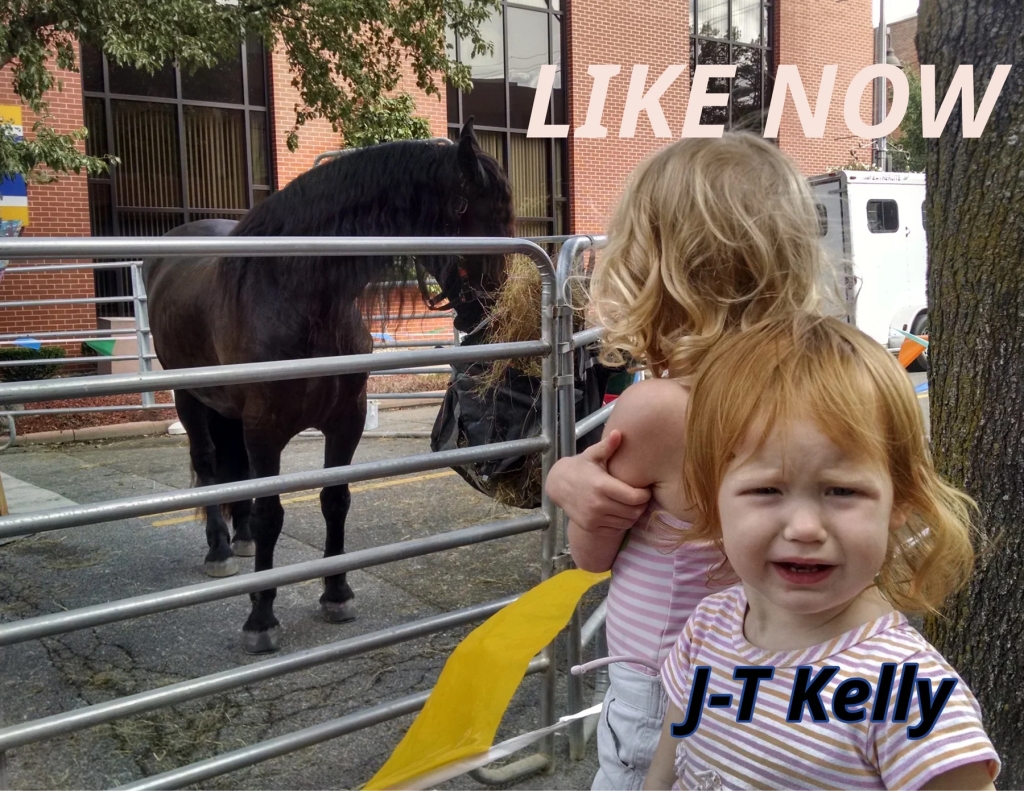
by J-T Kelly, book cover featuring a photograph of two children in pink striped tops, one crying and looking towards the camera, one looking away. A dark brown horse behind a livestock gate eats hay from a bag.
LIKE NOW by J-T Kelly. Subpress/CCCP, 2023. 32 pages. $10.

Here are poems that invite you in with details of a life, and omit just enough of the narrative to drop you into a space of reflection. The implied stories in J-T Kelly’s new chapbook LIKE NOW are intriguing enough that the doors left open are impossible to avoid. We walk through them to ask: are we talking about betrayal? Lost love? Redemption? Perhaps all three.

       I can’t afford to bring any love with me on the bus.
       Just look at me like that again and you’ll see.
       We line up as if.
       We sit quietly as if.

       (from “This Life is Eating Me Alive”)

Pithy, pungent, and direct, J-T Kelly’s poems deliver a view into the profound as it is found in the quotidian, even the banal. House painters are compared to Caravaggio, in “Art History,” a poem mostly about the art of house painting and the mystery of drunkenness—as well as the appropriate saints.

In Kelly’s chapbook, vignettes about college life are interspersed with love poems and stories of a marriage, of griefs, travels, formative experiences, and strong opinions—all crafted with a deft touch and alive on the page, and told with humor – “I have turned the machine that babbles / to face the machine that archives everything” (“Keeping House”) – and a ferocious understated severity – “…Seventeen / seconds–that’s how much time / a driver should get between a sign / and the thing signified. Ideally. / Often it is less” (“Crossing”).

Mid-collection, two gorgeous sonnets face each other. The first,  “Christmas Village,” evokes the scalding pain of a holy day turned plastic with consumer displays to the point of sickness and identification of one’s own well-being with the ability to purchase… what? Implied is the question: who would want what’s on offer in that world? On the facing page, “Squall,” by contrast, reveals a potently tender exchange that bears a loving kindness so abundant it spills over into anguish – the sonnet’s lines conveyed in homely detail, death an unavoided presence. I’d go so far as to say the pairing of these two poems is the heart of the collection. We are visiting that contrast between the falsehoods forced on us by the world and the felt realities of the human soul, the fleshly heart. Fear and its overcoming, generosity and withholding, lasting love and lasting anger all make their voices known.

Another of Kelly’s sonnets, “Strata,” demonstrates direct and uncompromised metaphysics, showing the large and small layers of a fallen world. (Amusingly, this poem faces the previously mentioned “Art History”.)

A sweet delight in Like Now is the generous sprinkling of very short poems. Of these tiny gems the shortest two are only nine words each; the longest is 22. I count eight of these, leaving out two or three that are maybe ten words longer. These micro bites cover much ground, and include at least three love poems (it’s a vague boundary; there are a couple more that might be considered love poems.) Here’s one of those micro love poems, “Love Song From a Marriage”:

       I hope you know
       I love you even though.
       And I hope you
       love me even though too.

This is a great example of how leaving out the details can make a poem more powerful by orders of magnitude. Implied here is the thought, “even though… whatever! Anything!” which carries a greater weight than any list of marital grievances. The slight awkwardness in the final line break is sweet, like a bashful person digging a toe into the ground (“gosh”) but, you know, saying the thing anyway.

I think, though, that my favorite micro is the opening poem of the collection, “Unsolicited”:

       I don’t like to give advice,
       but if I have to tell you something, it’s this:
       Don’t tell me what to do.

I’m not going to go into the poem behind the book’s title. I’ll leave that to you to discover and have opinions about, which I hope you will.


Kyla Houbolt has work in Sublunary Review, Barren, Janus, Juke Joint, Moist, Neologism, Ghost City Review, Stone Circle Review, and elsewhere. Her most recent chapbook, But Then I Thought, is now available from Above / Ground Press.

Chorus: J.D. Ho Reviews Ophelia by V.C. Myers

Ophelia by V.C. Myers (Femme Salve Press, 2023). 100 pages. $20

One of the themes in V.C. Myers’ work is the connectedness of human experience: what happens in Appalachia ripples outward to connect with the experiences of people all over the world. In this new collection, Ophelia, Myers adds temporal and narrative connections between past and present, myth and lived experience, by interspersing erasure poems created out of text from Hamlet (all titled “Ophelia”) with non-erasure poems that take on the experience of sexual predation. Throughout this collection, a horrifying chorus forms: Cassandra, Medusa, Philomela, Ophelia, Lavinia, and others. Every character and speaker adds a me too to the refrain. It doesn’t matter whether these characters are fictional, mythical, or real; their stories reflect a world in which women are punished for the actions of men, and then silenced through often violent means. Before I go any further, I’d like to reiterate my first point, which is that the poems are still widely resonant despite their sharply focused lens. They speak for all manner of beings who can’t speak for themselves: the poor, the disenfranchised, the colonized, the hunted, the marginalized, or the Earth itself. 

As in Myers’ previous collection, Give the Bard a Tetanus Shot (Vegetarian Alcoholic Press), the poems mix dead seriousness with a dark sense of humor, and by doing so, slice deep. “Labor of Love” puts this trait on full display:

These lines shift from a simple rethinking of a worn-out myth, and then come in with a punchline that seems funny until you realize it’s what many of the perpetrators in this collection of poems would say—She got herself into that mess—as Apollo might have said of Cassandra when she promised herself to him, then reneged. In fact, in many of these stories, mythical and not, a man’s actions bring blame and punishment upon the woman. Women are figuratively turned into rocks, unable to speak or testify. This collection tells their stories.

The erasures in Ophelia’s voice take words spoken by others and appropriate them, erasing Shakespeare and all the characters but Ophelia. Since I follow Myers on social media, I recall some of the compositional journey of this book, and the decision to integrate the Ophelia poems with the other poems. And I am reminded of something Louise Glück said of two of my very different poems during a workshop: They came from the same mind. That seems apt here. I was surprised by how seamlessly many of the erasure poems flowed into and out of the non-erasure poems. 

Writers often say that they can’t write about a traumatic event right away–that their voices were taken away by the act of violence, and must be regained. Ophelia is considered to have gone mad when it’s perhaps more accurate to say that no coherent words can convey her experience. If we imagine being in that position, we can also imagine the resonance of lines in another text, when they are about a character who has suffered some of the same slings and arrows of outrageous fortune. Erasure poems convey how their author reads and identifies with a text. Erasure is what flares out at us when we’re reading. Erasure is a way to have a voice because no speaking is involved. The silences tell the story.

The first non-Ophelia poem, “Papier-mâché,” sounds, in voice and content, as though it could have been spoken by Ophelia. It begins, “I befriended the red paper wasps / flying around my garden. I sang / as they circled me” (17). By the poem’s end, the book’s central trauma emerges: 

                                                                                                         The nest 

                                                        cocooned my throat so I couldn’t 

                                                        breathe, sealed my mouth so I couldn’t 

                                                        scream, covered my eyes so I couldn’t

                                                        see what too much trust made of me.       

This is Myers wielding sound and line break with devastating accuracy, the couldn’ts yanking on the reader’s throat to force them to feel what the speaker feels. couldn’t couldn’t couldn’t. 

I appreciate Myers’ tendency to alternate between heady linguistic acrobatics and blunt, plain-spoken confessionalism. The pattern reminds us that this poet, capable of elevated language, also has waded through some dirt in life. Yet these moments, too, contain the incantatory, as in these lines from “greenhouse, glasshouse, it’s all the same & broken,” a poem about the ways past trauma manifests as present-day issues in the body: 

Ophelia’s poetic mode is a departure from the modes of the last collection, Give the Bard a Tetanus Shot, though both collections deal in the autobiographical and confessional. There is more formal reach and attention to line break in Ophelia, a development perhaps brought on by working with erasure, which has so much to do with how words appear on the page. 

Despite its inherent limitations, Myers manages to wrest erasure into the incantatory rhythms of the non-Ophelia poems, while also retaining the atmosphere of the original text. The Ophelia poem on p. 24 begins:

and a moment later: “enter ghost,” which, in this collection, serves as a metaphor for the appearance of traumatic memory. Enter ghost.

But then the poem builds to:

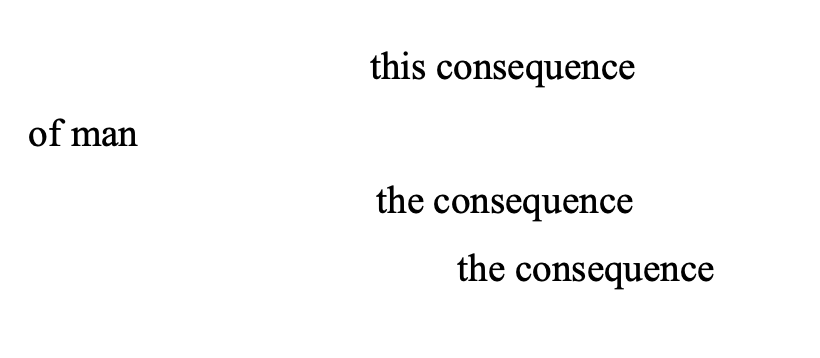
The last four lines can be read left to right, then down (your fate this body called) or downward first (your fate called this body), giving two different but accurate meanings. Erasure convention is to preserve the words where they were on the page in the original text, but with a text like Hamlet there is no standardized page layout, or even a definitive text, so Myers’ layout doesn’t need to adhere to any “original.” Instead, it can be flexible to accommodate different readings.

Myers’ erasures also emphasize the repetitions that are buried when the full text of the play is present, as in the Ophelia poem on p. 48:

These poems, Ophelias and not, capture the experience of women, how their voices are unheard, and how their lives are fraught with constant and daily dangers that the women themselves do not invite. 

In Greek drama, the chorus comments on the action with a unified voice, rather than as individual voices. Myers has created a collection of poems that is both a chorus, speaking in unison, but also individual voices telling their stories. The function is the same as in a theatrical production: the chorus warns, makes sense of, reacts. It also serves as a reflection of the world—in this case a world of many, many women who have been objectified, used as pawns, or subjugated to male desire. Relationships with men are portrayed as dangerous in their unpredictability, the way they can turn to madness, as Hamlet does in the play. 

In Ophelia, Myers has reworked the idea of the chorus, giving each voice its moment, using repetition and incantation to force the world to hear—or, finally, to listen. 


J.D. Ho holds an MFA from the Michener Center at the University of Texas in Austin. J.D.’s work has appeared in the Georgia Review, Missouri ReviewShenandoah, and elsewhere.