Punctum

Sometimes pain hits and I think
soon I’ll arise and go back
to those dark rows of pine
between the old house and its street.

That little depleted wood
with its road-bank of starveling brambles.

What was I like as a child?

My mother says easy, my father says “I don’t know.”
My mother says, on your tenth birthday
I remember you climbed a tree
to escape your own party.

Bark under palm-callous.
Sap lurking in every inch.

I was fast, and rude.
Another -- girl -- followed me up
got a twig in her eye.

Vast blood smothered it.

Everything obvious needed words then. And long after.

Prompt: What scenes from your own life might be simultaneously banal and uncanny? What were some of your routines, your unarticulated habits, as a young person?  Did they involve moving through particular spaces? Making particular arrangements of items that were important to you? Repeating or writing certain words? What’s the unmapped habitual territory of where you began to become a person you recognize – most of the time – today?

Write down something you used to do all the time when you were younger but haven’t done or thought about for years now. Be very detailed. You could even write it down as a “how-to” list for someone seeking to recreate this remembered set of actions. Once you have the ritual or habit written out, consider: where does it resemble a myth, a fairytale, a ghost-story?

Rewrite your ritual, your habit, and add vocabulary from the weird, the magical, even the apocalyptic. Play with scale. Maybe the objects and events you remember can be represented as much bigger or much smaller now? Maybe they’re ready to burst into cool flame. Maybe some of them have developed voices.

Don’t however allow your recovered scene to be pulled fully into a specific genre of non-realistic storytelling.  Use the first-draft written version of your own habit/ritual to draw those genres toward you — toward what you did and who you were becoming.  


Catherine Rockwood (she/they) lives in Massachusetts. She reads and edits for Reckoning Magazine and reviews books for Strange Horizons. Their poetry chapbooks, And We Are Far From Shore: Poems for Our Flag Means Death, and Endeavors To Obtain Perpetual Motion, are available from the Ethel Zine Press.
I’m not hungry but my mouth is bored (distance) (marriage)

which direction are you from here
kidding I know it’s down

I would be a wretched river
so weary of waiting to be traveled to

my darling westward witch
my east my Eden my every

each of us one single individual water
amid all the many waters

nostalgic for spring & source
before we bend around the first bend

(facing the audience) you know
how long this took us

you think it’s easy to meander
for a thousand years

in a ditch made by melting ice
(back to you) join me

the rocks are slippery
the cold takes the breath

Prompt: Write a poem whose syntax makes you slightly uncomfortable, a poem with an inconsistent but intentional relationship to the sentence, a poem without comma or period but maybe parentheses.


Amorak Huey is the author of four books of poems including Dad Jokes from Late in the Patriarchy (Sundress, 2021). Huey teaches at Bowling Green State University in Ohio and is co-author with W. Todd Kaneko of the textbook Poetry: A Writer’s Guide and Anthology (Bloomsbury, 2024).

Farmhouse Catechism, After a Year of Absence

At first when we return, the animals
do not know us. It’s as if they’ve forgotten

humanness—our noise, our cars
and guns. At dusk, the deer

press close to screened windows,
and their breath trembles

the emptiness suspended
between those fine wires. The musk

of skunks leaks beneath the door
like stripes of light

from clouds in a Constable study: silken pour
of rose-pink over yellow, a hue that refuses

to long for God. The first
day back, I stand beneath

the felled boxelder’s ghost. Now my shadow
will no longer merge

with its shadow, then detach itself
as noon unfurls its hot,

bright shawl. Soon the woods
will rise from their knees

to enfold rabbit and bear
back into their larger dark. Rain

will come sudden and hard, vanishing
instantly into the porous earth. And then

the day will be blue again, blue
and ruined, and the animals

will remember us
and know to be afraid.

Prompt: Write into the loss or death of a more-than-human being, and how this loss has changed things for you. The being could be one you felt intimate with, or one that seemed more distant. How is this absence felt in your everyday life?


Kasey Jueds is the author of two collections of poetry, both from the University of Pittsburgh Press: Keeper, which won the 2012 Agnes Lynch Starrett Prize, and The Thicket. She lives on ancestral Lenape land in a small town in the mountains of New York State.

River Fable

                   The river does 

not prattle.
It churns and
roils and swirls
toward the sea.

The river flows

over
all
in its path
making smooth the jagged rock

and changing
course as it wills.

The river has grown full
even dwindled
down to streams.
Yet

it can still push through bedrock

and produce thunderous

waterfalls. The river knows

that there will always
be more salmon

and that one day rivers will flow

no more.

The course will then be set.

And the rocks,

well, they can be jagged again
if they wish.

Prompt: Poem as Fable
Write your poem as a modern-day fable. Choose two objects (animals, articles of clothing, household goods…anything) and personify them. Then tell your tale. Do you characters argue? Are they friends?Strangers? Allow the interactions between the objects to do the work for you. OR Use the fable template to start a deep rewrite of one of your poems.


Yvette R. Murray is an award-winning poet and writer. She has been published in Chestnut ReviewEmrys Journal, Litmosphere, A Gathering Together, and others.  She is the 2022 Susan Laughter Meyers Poetry Fellow, a 2021 Best New Poet selection, a Watering Hole Fellow, and a Pushcart Prize nominee. She is a board member of the South Carolina Writer’s Association and the Poetry Society of South Carolina, and a member of the Society of Children’s Book Writers & Illustrators. Find her on Twitter @MissYvettewrites.

Care Of

A dim glow in the stable from the one light up in the corner whose cord runs down across the ground and into the house. The horses are writing their night philosophies, corrupting the youth of the moon. When the sun, distracted father, returns at morning, they will act no closer to the truth.

Prompt

In the subfield of mathematics called linear algebra, there is a frequently-given homework exercise that looks like this:

TRUE OR FALSE? If A and B are n× n matrices, then ABA-1=B.

A-1, here, is the inverse matrix of A. Leaving aside for a moment the question of whether or not the statement is true, it is easy to see why it might be: surround something with another thing and its opposite, and maybe the first thing will escape unscathed. Maybe.

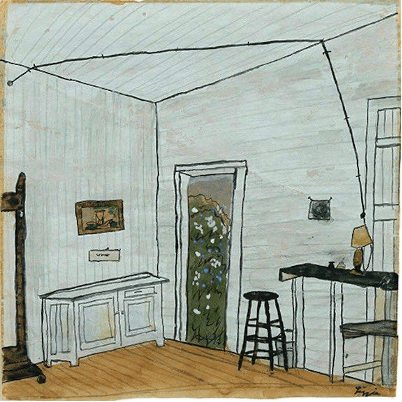
This prompt is to write a three-sentence prose poem, one sentence of which takes a detail from another work of art—a poem, painting, film, piece of music, anything amenable to the task — and inverts it in some way. My example borrows from this Elizabeth Bishop painting: instead of the cord going up along the ceiling as in Bishop’s original (& therefore being in the house to begin with), in “Care Of” the cord runs down across the ground and into the house.


Tom Snarsky is the author of the poetry collections Light-Up Swan and Reclaimed Water (both from Ornithopter Press). His book A Letter From The Mountain & Other Poems is forthcoming in 2025 from Animal Heart Press.

When Joy Comes to Call, I Invite It In

Notice the red tongues of cannas flowering at the front
of the house, the dog’s slow arthritic rise as he wiggles over
to lick your hand. Ignore the weeds sprouting from between
the paving stones, no matter how often I tug them out.
Come in and kick off your shoes. Or don’t, the floors never
quite clean, littered with pebbles of gravel unlodged
from the soles of my trainers after walking the path around
the lake. We can visit there later, watch the herons wade
majestic, stir the shallows with their legs then dart long beaks
beneath the surface to catch their lunch. But for now, help
yourself to a drink. Never mind the smudges on the refrigerator,
the handle always just a little sticky, the odd dish in the sink.
Sit anywhere—at the kitchen island, edges chipped by
my son rotating back and forth on the metal chairs, or on
the brown chaise that fits perfectly beneath the dining room
window, part of an old sectional I couldn’t bear to discard.
Come sit beside me as the dew burns away and the sun glides
higher over the cottonwoods and pines. The dog will curl
at our feet to warm his slow bones as condensation forms
on our glasses of mint tea clinking with ice. Don’t bother
with a coaster. A mark will remind me you were here .


Writing Prompt

Choose an abstract concept or emotion that might show up to visit, whether it is welcome or unwelcome. Using either second person and/or epistolary form, write a one-sided conversation with that concept/emotion about its visit. Try to incorporate images that illustrate or imply its meaning or feeling and how you are reacting to it. Use at least eight imperative sentences.

[If you hate writing titles (like I do), call your draft “When _______Comes to Call, I _________”]


Donna Vorreyer is the author of To Everything There Is (2020), Every Love Story is an Apocalypse Story (2016) and A House of Many Windows (2013), all from Sundress Publications. She hosts the online reading series A Hundred Pitchers of Honey.

The Softest Kind


Being touched
By a man who cares
About my pleasure

Feels like being the softest kind of tofu—
Hot broth boiling, silky & shivering
Steeped plump with root and
Meat and fungus—

Ready—
When you bite into me—

To burst.


Poetry Prompt: The Body Comestible

Write a poem in which you reimagine your body as a specific food. What does it feel like to be that food? How do you smell and taste? What do you feel like to the touch? Do you want to be consumed, or left on the plate? What sensations might your body experience when it finds itself being eaten, digested, thrown out, put in the fridge?


Francesca Leader is a writer and artist originally from Western Montana. She has poetry published or forthcoming in Hooligan, Broadkill Review, Sho Poetry, Cutbow Quarterly, Door is a Jar, Stanchion, Nixe’s Mate, Bullshit Lit, Streetcake, Literary Mama, Poetry New Zealand, and elsewhere. Learn more about her at inabucketthemoon.wordpress.com.

A Review of LIKE NOW by J-T Kelly

by Kyla Houbolt

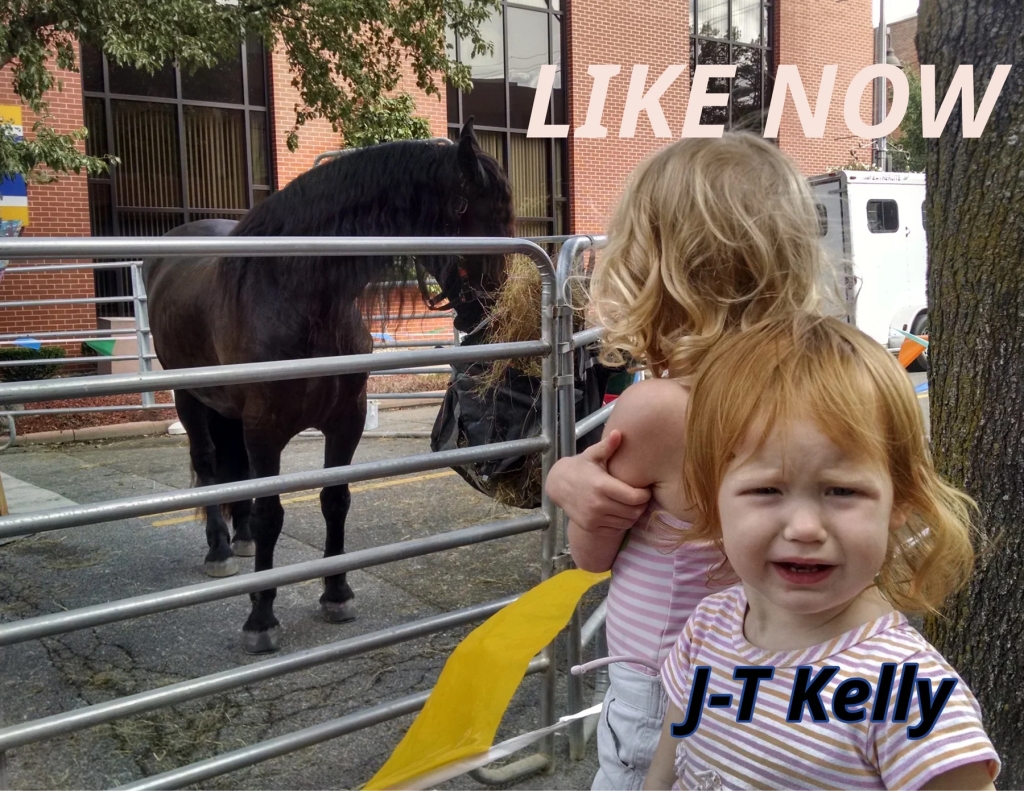
by J-T Kelly, book cover featuring a photograph of two children in pink striped tops, one crying and looking towards the camera, one looking away. A dark brown horse behind a livestock gate eats hay from a bag.
LIKE NOW by J-T Kelly. Subpress/CCCP, 2023. 32 pages. $10.

Here are poems that invite you in with details of a life, and omit just enough of the narrative to drop you into a space of reflection. The implied stories in J-T Kelly’s new chapbook LIKE NOW are intriguing enough that the doors left open are impossible to avoid. We walk through them to ask: are we talking about betrayal? Lost love? Redemption? Perhaps all three.

       I can’t afford to bring any love with me on the bus.
       Just look at me like that again and you’ll see.
       We line up as if.
       We sit quietly as if.

       (from “This Life is Eating Me Alive”)

Pithy, pungent, and direct, J-T Kelly’s poems deliver a view into the profound as it is found in the quotidian, even the banal. House painters are compared to Caravaggio, in “Art History,” a poem mostly about the art of house painting and the mystery of drunkenness—as well as the appropriate saints.

In Kelly’s chapbook, vignettes about college life are interspersed with love poems and stories of a marriage, of griefs, travels, formative experiences, and strong opinions—all crafted with a deft touch and alive on the page, and told with humor – “I have turned the machine that babbles / to face the machine that archives everything” (“Keeping House”) – and a ferocious understated severity – “…Seventeen / seconds–that’s how much time / a driver should get between a sign / and the thing signified. Ideally. / Often it is less” (“Crossing”).

Mid-collection, two gorgeous sonnets face each other. The first,  “Christmas Village,” evokes the scalding pain of a holy day turned plastic with consumer displays to the point of sickness and identification of one’s own well-being with the ability to purchase… what? Implied is the question: who would want what’s on offer in that world? On the facing page, “Squall,” by contrast, reveals a potently tender exchange that bears a loving kindness so abundant it spills over into anguish – the sonnet’s lines conveyed in homely detail, death an unavoided presence. I’d go so far as to say the pairing of these two poems is the heart of the collection. We are visiting that contrast between the falsehoods forced on us by the world and the felt realities of the human soul, the fleshly heart. Fear and its overcoming, generosity and withholding, lasting love and lasting anger all make their voices known.

Another of Kelly’s sonnets, “Strata,” demonstrates direct and uncompromised metaphysics, showing the large and small layers of a fallen world. (Amusingly, this poem faces the previously mentioned “Art History”.)

A sweet delight in Like Now is the generous sprinkling of very short poems. Of these tiny gems the shortest two are only nine words each; the longest is 22. I count eight of these, leaving out two or three that are maybe ten words longer. These micro bites cover much ground, and include at least three love poems (it’s a vague boundary; there are a couple more that might be considered love poems.) Here’s one of those micro love poems, “Love Song From a Marriage”:

       I hope you know
       I love you even though.
       And I hope you
       love me even though too.

This is a great example of how leaving out the details can make a poem more powerful by orders of magnitude. Implied here is the thought, “even though… whatever! Anything!” which carries a greater weight than any list of marital grievances. The slight awkwardness in the final line break is sweet, like a bashful person digging a toe into the ground (“gosh”) but, you know, saying the thing anyway.

I think, though, that my favorite micro is the opening poem of the collection, “Unsolicited”:

       I don’t like to give advice,
       but if I have to tell you something, it’s this:
       Don’t tell me what to do.

I’m not going to go into the poem behind the book’s title. I’ll leave that to you to discover and have opinions about, which I hope you will.


Kyla Houbolt has work in Sublunary Review, Barren, Janus, Juke Joint, Moist, Neologism, Ghost City Review, Stone Circle Review, and elsewhere. Her most recent chapbook, But Then I Thought, is now available from Above / Ground Press.

Jessica Q. Stark: “Hungry Poem” and “Impact Sport”

HUNGRY POEM


My mother prides herself on being a Good American 
expresses anger when I dismiss myself for five years 

first to South Korea, then to Spain; Korea is full of assholes
she says—references a long layover and a fistful of

cashiers that hated her face like I hate my face; you’ll see—
I didn’t see, but I did come back and I did come back to her strong

arm tracing around the kitchen island, a 
secret in her pocket most of the time we aren’t sick with

what wouldn’t have been 
there is a decrease in white 

frontal brain matter in most diagnosed kleptomaniacs, meaning what—
meaning impulse control, meaning behavioral medicine for undone things

white lilies popping up in every yard, blooming refuse to refuse
and how else should I categorize my particular brand of cruelty?

Most of my time is spent thinking up different scenarios that 
aren’t sensual, don’t feel sensual, and in every other episode

I’m only here because of that stupid war—insert unknown relatives’ faces
across the airplane’s aisle, my head resting on someone else’s backrest

pointing towards the Atlantic, pointed in any direction other than home
 
IMPACT SPORT


By age 15 I was a hungry, red wolf.
I worked at JoAnn Fabrics one
summer—scowling women forming

lines at the back of my hangover and a 
terrible crush that kept blooming over
floral-patterned fabric beneath my palms.

I scanned coupons and resisted knowing 
the definition of a window valance. So 
many sighs from women in search

of a texture, a measurement, some small
tool that I could never afford. After I 
learned the cameras were decoys,

it was over: stickers, hot-glue guns,
a bounty of expensive scissors I never used.
Most nights I brought sneakers and ran 

the four miles back to my childhood home, 
happy to be moving in the dark from white light.
It was worse than McDonald’s, which in truth

was fun: working the butt of 
every parent’s joke in the ‘90s, living the
worst-case-scenario at 16. Kind of 

punk rock the way MJ and I figured out
how to deliver unrecorded beverages
in the drive-thru and pocket the

complicated math. Though it was here 
where I found the limitations of my face,
where the fry guy would hold me 

by the shoulders in the walk-in freezer
and plant a greasy mouth on mine. And
what else could you do but laugh about it

later with MJ in the same freezer
sitting next to the chilled cookie dough 
with a fistful of nuggets, each of you

taking too long of a break, taking
mouthfuls of soft serve and the feeling
that we could never, ever truly die.

Fast-forward to college and I’m at the
campus bookstore, I’m at the library, 
I’m cleaning professors’ offices and 

watching their sick cats. But worst of all
I’m telemarketing, which was an unknown
quantity of death, a bait-and-switch

operation for selling car listings
with a scripted, ghost’s voice
though the phone. Later,

I’d be back alive and against
the clock trying to find a thrifted
shift that would everlast dancing

in New York City all night. The 
origins of the phrase “go-go dancing”
derives from the French a gogo 

meaning abundance, meaning galore,
which links to the word la gogue, or a 
French word for joy. I don’t know if 

I ever found happiness, shaking my
ass over glass cups and faces going
gloss. But most nights in that

mechanical suture I felt like air, 
maybe freer than a walk-in freezer,
my time and movement in abundance,

like no one could ever clock me in,

like no one ever could touch me again—
not my face, not my hand, not my teeth,

my, what big—
my, what sharp—

like I’d never eat that red hunger again.

Jessica Q. Stark is the author of Buffalo Girl (BOA Editions, 2023), Savage Pageant (Birds, LLC, 2020) and four poetry chapbooks, including INNANET (The Offending Adam, 2021). She is a Poetry Editor at AGNI and is an Assistant Professor of Creative Writing at the University of North Florida. She co-organizes the Dreamboat Reading Series in Jacksonville, Florida.

You Said We Sat By Water

So remind me: 
how did the companionable silence 
flow between us? Describe,
if you can, the way the current 
burnished the sharp rocks, settled 
the roiling sediment 
onto the stream bed. That gentleness 
escapes me.
So many things written down
never happened, so many tides never turned 
to wash away words 
scratched in sand
and memory.
 

Jeannie Prinsen lives with her husband, daughter, and son in Kingston, Ontario, where she teaches an online course in essay writing at Queen’s University. Her writing has appeared in Reckon Review, Relief, Juniper Poetry, and elsewhere.