“We may think Bede” by Catherine Rockwood

did or could not say what true speed was1  
without impossible foreknowledge of
jet-bombers, lasers, a crouched F1 car.
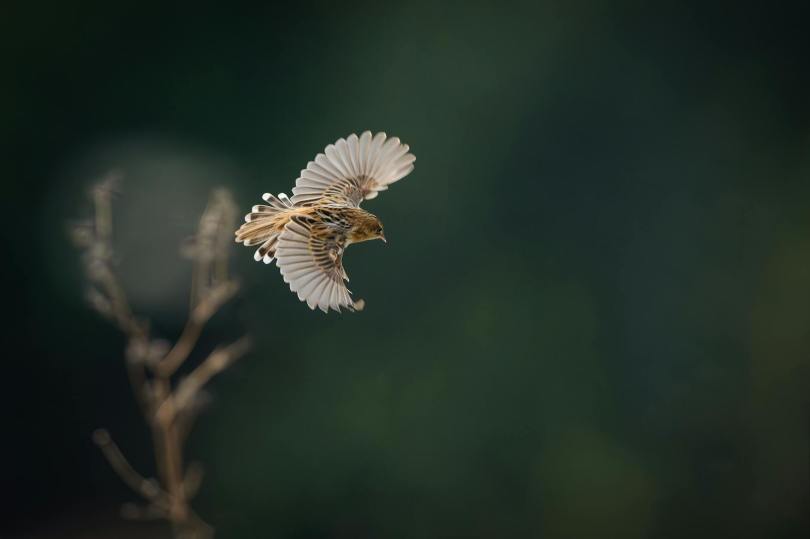
But this morning two sparring sparrows flashed
past my dull head into a wet azalea
and in that wing-touched moment of departure
my soul spoke, Oh.

1 Viz. Bede, Historia Ecclesiastica II.13 “The present life of man, O king, seems to me, in comparison of that time which is unknown to us, like to the swift flight of a sparrow through the room wherein you sit at supper in winter…”


Catherine Rockwood (she/they) reads and edits for Reckoning Magazine. Two chapbooks of their poetry, Endeavors to Obtain Perpetual Motion and And We Are Far From Shore, are available from The Ethel Zine Press. A third chapbook, Dogwitch, is forthcoming from Bottlecap Press.

“Midrash on Judges 15:4” by Reyzl Grace

I don’t know why I always imagined
the fields in dusk—the little flame-
tailed foxes dragging their torches
behind. Do you think, as they rushed from their doors,
the Philistines saw how beautiful it was?

It must have been: the purple twilight
crushed against the grain like the velvet
of a noblewoman in adultery, her robe slumped
to a mosaic floor; the breeze slipping
through the guard hairs of the foxes like a quiet kiss.

God, how we love what is in pain—how it reminds
us of youth. You know that the sun was created
setting on a Tuesday? I think Samson
knew . . . but where was I? Yes,
looking out on the fields, on stalks become candles,

on foxes, coats rusting in the gloom
against the golden crop. The rabbis
hunt every letter of Torah
for sport, shoot each with a thousand arrows,
yet the Talmud glosses this only once,

when R. Bar Abba tells us the fox
was a symbol of renegation—the only creature
that runs in reverse. But don’t we all?
Don’t we run from the Ark and the Tabernacle
still turning toward them, enraptured? Yes.

We are on fire, but still must breathe—
little kits gulping air
as we twist and writhe around each other.
In a moment, all will be desolation and burnt
hair, but for now, it is lights gay

as summer bonfires, bobbing up
and down the rows of the vineyards and the oliveyards,
the rigid ranks of wheat and barley,
the tangled foxes snarling as they spin
and snap like firecrackers. How I wish

I could make you see it as I did—a child
who had lost nothing, felt nothing,
never asked what happened to the foxes.
Sometimes I wish I had never asked.
Sometimes I think that the rabbis were wise.

Reyzl Grace (reyzlgrace.com / @reyzlgrace) is a poet/librarian with work in Room, Rust & Moth, So to Speak, and other magazines, as well as an editor for Psaltery & Lyre. She lives in Minneapolis with her novelist girlfriend, arguing over which of them is the better writer. (It’s her girlfriend.)

“Once, Offhandedly, An Ex-Boyfriend Said He Hoped I Could Find Someone Who’d Be OK With Me Working on Sundays.” by Megan McDermott

after Adélaïde Labille-Guiard’s Self-Portrait with Two Pupils, Marie Gabrielle Capet and Marie Marguerite Carreaux de Rosemond, 1785

I teach you to look head-on at those looking at you, to not, in returning

gazes, drop your palette or your work. Surely men will look at you

with hopes of causing pause, so wear your daring dresses and your hats

with feathers and look at them right back, with a look that tells everything:

there is no me without this canvas or those who will learn over my shoulder.

Megan McDermott is the author of Jesus Merch: A Catalog in Poems and chapbooks Woman as Communion and Prayer Book for Contemporary Dating. Her poetry has appeared in various journals, including Amsterdam Review, the Maine Review, the Christian Century, and more. She is an Episcopal priest in Massachusetts.

“Apocalypse Love Poem” by Wendy Wisner

This week, as I watched the sky turn ash orange,
saw the air quality ticker go red, purple, maroon,

glimpsed two construction workers exchanging soft blue masks
under the dusky morning moon,

witnessed my children sink into the couch—
“Not this again!” my son raged, hazel eyes hot with tears—

I wondered if I’d loved enough, risked enough for this earth,
which is clearly raging back at us all,

how my son would sit under the desk during remote learning,
fists red as beets, biting his nails till they bled.

Last night, I dreamt again about losing my kids in a surge
of stormy black water, the levees failing again, again.

I dreamt and dreamt until I had to push myself out of the dream
so I could walk through the dense summer morning

with you, the two of us catching our breaths
as the sky swelled, finally, with rain—

oh the blue blue sky in all its merciful radiance.

Wendy Wisner is the author of three books of poems, most recently The New Life (Cornerstone Press/University of Wisconsin Stevens-Point). Her essays and poems have appeared in Prairie Schooner, Spoon River Review, The Washington Post, Lilith Magazine, and elsewhere.

“Missing Parts” by Sam Rasnake

                   – after “It is essential… to undertake
the reconstruction of the primordial Androgyne
that all traditions tell us of… within ourselves.”
André Breton & Androgyne III
(1985, Magdalena Abakanowicz)


as if these definitions –

she and him, she and her,
he and him, they and
her, they and him, they
and them, she, they, him

– weren’t enough, the dark
blurs of who, what, and why

coil their supple excesses
through the night hours
and behind walls – when
the heart only

knows the heart

Sam Rasnake is the author of Fallen Leaves (Ballerini Press, forthcoming), Cinéma Vérité (A-Minor Press) and Like a Thread to Follow (Cyberwit). His works have appeared in Wigleaf, Stone Circle Review, Anti-Heroin Chic, UCity Review, Best of the Web, Southern Poetry Anthology, and Bending Genres Anthology. Follow Sam: Bluesky @samrasnake.bsky.social.

“Shopping Music of the Gods” by Kyla Houbolt

Someone said hurdy gurdy heart
so of course I thought accordion heart,
vuvuzela heart, calliope heart.

Hello, heart, I say as it knocks
on my door. What have you been
up to? Oh nothing much, says
heart, achingly.

We have broken much together,
heart and I, and yet we still
do not know each other
very well. I offer my kazoo.

Heart declines. Pulls out
a blues harp, says,
shut up them damn birds,
I got something to say.

Kyla Houbolt is a poet and gardener living in North Carolina, USA. “Shopping Music for the Gods” will appear in her full-length selected and new poems, Becoming Altar, forthcoming from Subpress in autumn 2025.

“One Year After Release From the Behavioral Health Unit” by Brittney Skye

The sun setting over the Wellsville mountains and the clouds roaring pink.
Tulips unclenching in the bedroom vase.
A hot bowl of cheesy shrimp-n-grits, a taste I almost missed.
The wretched face of the beautiful man who called 9-1-1.
A beaver dam overflowing with winter run-off.
A surprise bridge in the path.

This is how I fall in love with the hard of my life:
With words and a pen. With neither fist raised.
Even if there’s no one to share a poem with, I am saved
By writing it in the first place.
We only ever talk about “taking your life”
When someone’s taking it away,

But have you ever thought of taking your life on a date?

Sometimes surviving is beautiful
And sometimes it’s a phantom limb’s ache.
I have punished myself enough for trying
To go away. The body will pick up its pieces
Whether you want it to or not; your body will love
Being alive, whether you want it to or not.
But the soul takes longer to come home.

Sometimes she runs up to me with her childish fists scratched,
Full of sunrises and my first nephew laughing,
Our best friend’s wedding in the woods,
The bed where, for a year, I’ll wake with a dog under each arm.
With her freckled nose and busted lip,
She holds up the places in life
Where there would be a vacuum without me,
Not just an absence but a life-sized ache.
Knowing what I do not about living again.

Brittney Skye is a poet from Cache Valley, Utah. She graduated with her Master’s of Arts degree from Utah State University in 2020. In 2021, her first chapbook, titled Harvest, was published by Finishing Line Press.

“CALLIMACHUS AGAINST HIMSELF” by Stephanie Burt

Whatever our era needs, it isn’t you,
all erudition and pointlessness. Go block a tarmac.
Get to a travelers’ dorm and stand in the doorway
when the sons of Ares arrive. Make your latest hardback
(nobody’s buying it anyway) into your shield.
Stick around here. Speak plainly. Don’t pursue
conjunctions and conjugations, the way you used to do,
down switchback trails, through vines and thickets of grammar,
past setts, through every epiphyte and eave.
It’s not like they’re coming after you first: you’ve concealed
your rage all your life behind curtains of time, place and manner.
On the other hand, it’s still your nation.
It’s not like they’ll let you back in, if you choose to leave.


(Greek Anthology 11:321)

Stephanie Burt is Donald and Katherine Loker Professor of English at Harvard. SUPER GAY POEMS, a collection of 51 poems (none by Stephanie) with an essay (by Stephanie) about each one, came out (as it were) in April 2025; her book about Taylor Swift will follow in October.

A Review of Ayesha Raees’ COINING A WISHING TOWER

COINING A WISHING TOWER by Ayesha Raees (Radix Co-op, 2024). 72 pages. $17.95

by Burgi Zenhaeusern

COINING A WISHING TOWER BY Ayesha Raees (Radix Co-Op, 2024)

As little as we write in a vacuum, we read in one, and I feel that a reading memory is akin to a body of sounds and images, of wavelengths all in a jumble (like an orchestra before a concert) until the wavelengths of one text hit another’s, producing an accord of sorts. Coining a Wishing Tower rang with collections as seemingly unrelated as Benjamin Niespodziany’s whimsical and poetic one-act plays in Cardboard Clouds, the sparse poetry and rich interiority of Josie Foo’s Tomie’s Chair, or the sharp-eyed portrayal of existing between heritages of Monica Youn’s From From, and Maureen Seaton’s wryly celebratory Sweet World; and of all these, particularly Seaton’s short poem:

I think in spirals;


therefore,


I am infinite.

The numbered sequence of prose poems in Coining a Wishing Tower manifests a spiral formally—by the use of anaphora for example—and thematically. Unlike a circle, a spiral implies direction—inward/outward, up/down, as in the -widening scope of the collection’s narratives. The spiral embodies and symbolizes infinity as recurrence in changing contexts and as continuous motion. Poem number 40 could be read as a metaphorical, mini abstract of the collection’s spiral storytelling while also presenting one of its central themes. I quote it here in its entirety:

Google says: No! Cats have one life just like any other living creature! The fiction of feline immortality is due to how cats function! In awed resilience! Prone to survival! Yet in a fashion that is always barely! To survive and heal and continue, cats strive in chapters, skipping from one existence to the other, from birth to separation to shelter to settlement to abandonment to ravagement to wilderness to car accidents and then to eventual demise. Each chapter becoming a disappearing act from the last, a knowing deeply settled in a body, a knowledge that permanence is a human fantasy, that in the end, living is dying many times in one singular life, to grow and adapt is a technique to survive, to give adherence to a lineage is continued as a mark that we were all once here, occurring in the narratives of the ones that will lead us into the future. (50)

On its own, number 40 may not be a captivating read. Its effectiveness is rooted in its placement deep within the fabric of the poems’ sequence; and all it says—with the concise language and matter-of-fact tone characteristic of the collection—feels necessary: key information thrown in as if an aside and easy to overlook, thus imparting understatement and irony. This poem smiles at itself and at the reader by the time they come to it. There are other moments where the hint of a wry smile shines through the dioramic series of scenes—scenes arranged like lit windows of a building otherwise in the dark, behind which various dramas unfold.

Prose poems especially favor fragmentation, a stop-and-start flow, loose ends, a permeable border between the imaginary or interiority and what counts as empirical reality, and play. The poems in Coining a Wishing Tower do this with ingenious imagery and a combination of memoiristic and myth- or fairytale-like stories, which keep getting recontextualized, underscoring the speculative and ever-shifting nature of all stories—the ones we tell ourselves, the ones we tell each other, and what we hear—depth acquired by offering layers and the freedom to peel them back or not.

The collection begins and ends with House Mouse, who is one of its mythlike figures and undergoes a metamorphosis. It is also an alter-ego of the speaker who left her home in Pakistan for the US, a long-imagined destination:

1.
House Mouse was running to the mountains but nothing came out of its climbs. Every peak held another peak, and every reach held another reach. At the end of all possible height, House Mouse found itself inside a tower. The tower looked like a black, elongated box, sharp at the edges, smooth and silky on the sides.

Behind all there was was just was: a view called beautiful only because it was now distant. (11)

In the course of events, House Mouse dies, House Mouse returns, and nothing is the same, as in all coming-of-age and emigration stories. The tower is House Mouse’s living shrine in both senses of the word: “to be alive” and “to live in.” Its significance overlaps with the Ka’bah’s significance in the speaker’s life. House Mouse’s story with the tower is in part a meditation on faith/trust and religiosity, especially on the tension between wish, prayer, and ritual, and the pervasive question of authenticity. “Coin” and “coining” as verb/noun imply shaping and monetizing simultaneously, as in the minimal statement “A wish a coin” (20)—a softening of distinctions, resulting in fluidity and an interrogation of intentionality.

Godfish, another mythlike figure, “lives in the crystal clear aquarium behind the crystal clear window of a giant wooden house in New London, Connecticut” (13), where it is the focus of both the moon’s and the cat’s unconditional love, while it itself is happily infatuated with an oblivious sun. Their impossible love is trusting as a child’s, and reciprocity is assumed rather than sought. Its story is as sad as it is endearing. An untrodden “Desire Path” leads to the isolated wooden house:

22.
A Desire Path is created through an inevitable erosion by an animal. It is a constant back and forth trod in the same narrow area. It is a natural act that connects two suffering destinations in their lack of constant hold. No one liked coming to the giant wooden house in New London, Connecticut, where the winter had a bad bite, the summer brought strange pesticides, and spring hardly lasted in the rain. There was no path, no trod, and no desire deep enough for any kind of create. (32)

Here, the usage of the infinitive as verb/noun creates tension by blurring the line between in progress/motion and outcome/stasis, foreshadowing a similar blurring of animate/inanimate later on. The wooden house isn’t simply the setting for “windings, convolutions, and unnatural happenings” (26). Unwittingly or not, it impacts the action. Godfish’s story might also be read as a parody of the biblical fall from grace—“Paradise Lost” in a “giant wooden house” in New London, CT.

Maybe the speaker chose New London as an imaginary scene for her quasi-American “dream” because it could well embody small town USA: mostly white, overly tended lawns in summer, cold in winter. She sets New London, CT’s remoteness against one of her first encounters with “America” in the form of Happy Meal toys, pinpointing the ubiquity of US culture everywhere, including in her Pakistani childhood, yet with an added local flair. The localness is what she needs to trust: that something in her heritage remain inviolate and resistant: “These toys are different from the toys American children get. I believe. I believe. I believe.” (42)

Coining a Wishing Tower also reflects on different ways of learning and knowing. At one end of the spectrum is the speaker’s mother, who imparts traditions—knowledge built on experience and relationships over a long time—and at the other, knowledge obtained by way of Google—factoids and an uneasy trust in them. Both meet in the speaker’s imagination. As House Mouse and Godfish, they tell a story of aspiration and discovery, of leaving behind the assuredness of home, of loss which can be a form of liberation, as can adulthood. The prose poems’ multifaceted interiority shifts borders, strews sand, sows doubt, then wonder, and joy about yet another beautiful re-invention of the wheel. Ayesha Raees’ Coining the Wishing Tower has added its clear voice to the chorus on my bookshelf.


Burgi Zenhaeusern (she/her) is the author of the chapbook Behind Normalcy (CityLit Press, 2020). She co-edited the translations of the anthology Knocking on the Door of The White House (zozobra publishing, 2017). Her work appeared, most recently, in Sugar House ReviewJMWWLittle Patuxent ReviewMoist Poetry, and as broadside (Ashland Poetry Press). https://linktr.ee/burgitree