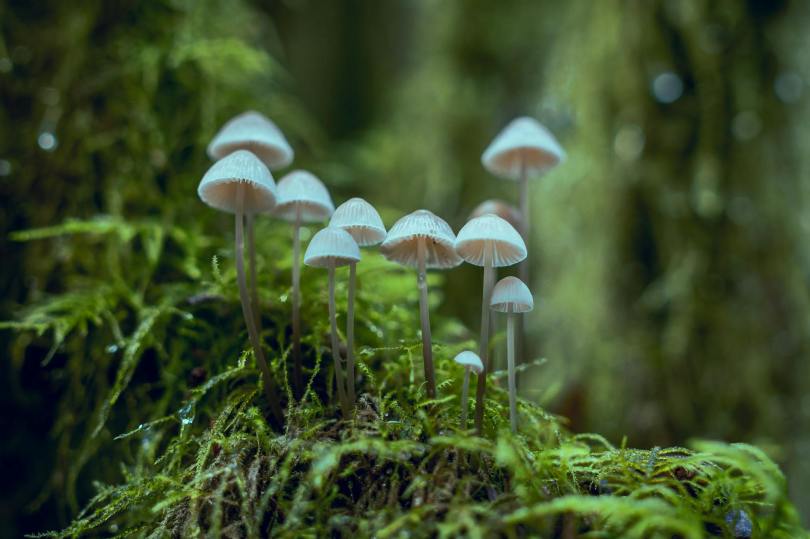
“Blades” by Matthew Murrey

Outside, the season’s thick sound 
of mowing: that rising, falling drone
of combustion, steel, and resistance.

Persistence of green as this half
of earth turns tilted sunward
so the grass thrives and rises up.

Countless machines are taking on
sprawls of lawns. In noise and fumes
they crop it short; they keep it down.

The mower I hear whines, sputters,
almost stalls. The grass remains
silent, though it smells moist and lush.

Tonight mowers, damp blades stained,
will sit cool in the dark while the grass
endures—healing its cuts and breathless.

Author’s note: I’m used to hearing people mowing grass during the summer, especially if there’s a mild day after several hot ones or a clear day after several rainy ones. A number of years ago I opened a window, and for some reason was really struck by the sound of one person out mowing their grass. It felt good to just stop and listen. I thought about my own experiences cutting grass and ruminated on us humans, our machines, and the living things around us. I had to hand it to grass; it gets cut and cut and cut, but just keeps coming back. In these grim times, I want to think there’s some hope in that.

Matthew Murreys the author of Bulletproof (Jacar Press, 2019) and the forthcoming collection, Little Joy (Cornerstone Press, 2026). Recent poems are in Roanoke Review, ballast and elsewhere. He was a school librarian for 21 years. His website’s at https://www.matthewmurrey.net/, and he’s on Twitter & Instagram @mytwords.

“Genuflect” by Jen Rouse

Her body is not my body--
this woman wrapped in steam her legs
of melting wax and soft sea foam.

That woman of the interior the hissing
bees of gaslight and brilliant

hanging beads

And what if on this night
she kneels by the window.

The diamond black snake
of her braid
d
ripping
down between her breasts as
she folds into herself
like a swan.

What if on this night she thinks of sirens
and desire. She thinks of blood and bone
as it's pummeled against rock. What if half
the moon collapses and she turns her face
to my face, there beneath
the window, cresting above
a newly-formed wave.

What will she do with a skin of scales and salt?
What will she do as her mouth floods with pearls?

Author’s note: I feel a sense of untamed wildness in summer, and I think this poem represents that unbridled desire for transformation, to be magic, to be myth, to be the fabulous creature we sometimes repress for the day-to-day monotony of it all. And there is certainly a sense of questioning there. If we are to change places with the divine, we must ask, at what cost? Having recently undergone a dramatic change in my own physical body, I’ve been working with mermaid stories, as in “Genuflect,” to grapple with what it means to be home inside someone entirely new.

Jen Rouse lives in Iowa City with her partner and two rambunctious wheaten terriers. Her work can be found in Sweet Literary, Always Crashing, Lavender Review, and elsewhere. Fragments of V, her forthcoming chapbook, will be available Fall 2024 through Small Harbor Press.

“River Silt” by J. Turner Masland

in late summer
naked bodies beautiful

we walk sandy trails
willow thickets spit out
sun cliff tower walls
still we go deeper

salt water lips we swim
muskgrass swaying in stream
wet rainbows quiver we glimpse
warm shallow ripples

we roll on dunes curving down
large bodies burnt brown
soft red glinting in river silt
lines that gorge bottom sound

recreational pleasure please
watch us
hard and touch us
gentle

dark forests dive
deep down parted mounds
wood muscle moss
bush silvered gloss
cedar grain aged lines

an imp among
woodland creatures offers
blackberries and beckoning
eyes twinkle

stone worker builds
bodhi brings down
the sky rings truth off
sun cliff tower wall echoes

over golden hour bottom showers
slick soft river silt
late summer naked bodies
wood muscle moss

holding and held
this orbit still spins

Author note: “In writing this poem, my wish is for the reader to share in the spiritual experience of a perfect late summer day spent at a hidden nude beach nestled between a willow grove and a sandbar, deep within an ancient river gorge. It’s a place where you can easily make a new friend while walking the muddy trails naked, and where years of body shame can melt away in the heat of the overhead sun. I hope this poem inspires you to strip down and go find a river to play in.”

J. Turner Masland is a queer land worker, writer and artist. He focuses on a creative practice that explores the intersections of ecology and poetics in the age of climate collapse and rising fascism. Turner lives on the Olympic Peninsula with his husband, dogs and a small herd of goats. His first chapbook of poetry “Hagstones” was published by WinterTexts in the spring of 2023.

“Towelled. Turtled. Flowered.” by Marjorie Moorhead

Hold hands with me as we gallop through
a velvet field of summer.
All the popping-up-flowers, in crayon colors.
Periwinkle, cornflower, or dusty blue
is chicory, the daisy of sidewalk’s edge.
Purple are clover, and vetch,
growing in bunches in the verges.
Yellow buttercup shows up too,
and pale pink bindweed, morning glories
of neon plum, climb trellises, telling their story
of courtship with the sun.

By midday, we are wet with sweating
and must keep drinking water for hydration.
Nighttime is soggy. Heavy with the day’s heat
and humidity. Fan will be whirring at bedside,
blankets kicked off, maybe a towel laid down
over the pillow.
Caresses are sticky. Dreams hazy, taking us
kayaking through lily pads in turtled emerald ponds.

Author’s note: I wanted to get the feeling of thickness and richness that is the lush heaviness of hot summer days. I have a daily walking route, so am very aware of season’s plants-of-the-moment. Loving the shade of chicory took me to those particular crayons I loved as a child—cornflower, magenta, bronze, silver, gold, pine green. My second stanza quite literally describes this heat wave we’re in but then ends back in the hazy dreamy feeling of floating through thick water, rich with life both on its surface, and below.

Marjorie Moorhead’s books are What I Ask, and Every Small Breeze. Chapbooks, In My Locket, Survival: Tees, Tides, Song and Survival Part 2: Trees, Birds, Ocean, Bees. Forthcoming, Into the Thrum (2025). Her poems have appeared in numerous journals as well as sixteen anthologies to date. Marjorie writes from NH/VT.

“in which the houses don’t change” by Nat Raum

After “400 Lux” by Lorde


i should have been driving east
this whole time, lavender shadows
and guava highlights emerging
from the landscape as i barrel, hollow
but brave, through suburbia in my civic
and flimsy pink sunglasses. i used to
glide north or south through lush
greens swaying to the prelude
of an evening storm, pressing on
faster than i should to stay beneath blue,
beneath the blending of bisexual lighting
before my very eyes. i should have
seen the sunset like this, driving
further from an active horizon through
a smattering of vinylclad houses
set on crew-cut lawns, stoic
and imposing. i could never call it
my life, model homes fabricated
to be spread out across an old farmstead.
i could only envy its idylls, flamingo
and lilac spots in the sky shifting as i find
a new gear on the road winding east
from my parents’. the quiet roars around me
and i wonder where else i can find this.

Author note: This poem is inspired by a specific stretch of road in Baltimore County, Maryland and the way the houses and trees look when the sun is setting in the summer. I imagined what it would be like to photograph the light and feed it through these pastel-toned Lightroom filters I downloaded a while back, and then it became this piece.

nat raum is a disabled artist, writer, and genderless disaster based on unceded Piscataway and Susquehannock land in Baltimore. They’re the editor-in-chief of fifth wheel press and the author of the abyss is staring back, random access memory, camera indomita, and others. Find them online at natraum.com.

Two Poems by Kyla Houbolt

Weed Lore 2

Not long ago, all flowers
were wildflowers. Thus, to be
a weed is to be history.

We are beneath each other's notice.
How does that work? you might ask.
Cosmically.

Two planets
occupy the same space,
entirely unaware of each other

except when, occasionally,
something bothersome happens
and we need to assign blame.

Weeds are handy for that. So
is history.
Pastime

On the backs of rocks
I feel my archetypes
and how they bloom in summer,
especially the one that
I might call the
Wise-ass Small Time
Criminal. That character
who takes a funny kind
of pride in avoiding rules.

Hot weather seems
to encourage this one.
I think of her as being
related to the kinds of moss
that very slowly make
soil out of boulders. She
makes the rigidities of life
into a growing medium
for whatever wants to grow.

Which is often not wanted
by polite society. There’s
the laughter of straps falling
off shoulders, of a touch of
sunburn. A scent of
permissiveness. We don’t
need to go to the beach,
let’s just laze on this here
warm rock, thinking
of nothing at all.

 A Note About Summer

The more years I work in gardens, the more I value weeds. Summer is weedland, and they give more to humans than we yet fully know, if ever we will. My love for rocks, especially warm ones, is a year-round love. There was one garden I worked in that had a gigantic boulder at the top of its highest hill. That rock magnetized me and I probably spent more time touching and sitting on that rock than I spent on my work. I could no more avoid going to it than an iron shaving can avoid a magnet. I guess that’s kind of like the way summer calls up the green surge from the roots of things. I myself prefer spring.

–Kyla Houbolt


Kyla Houbolt writes poems and occasional reviews. She also gardens. More to be found here: https://kylahoubolt.us/

“Love Can Be a Fungus” by Francesca Leader

toxoplasmosis feels like	    love
to a mouse, you say, but it’s a fungus

that makes mice think they love
cats, so as to, ingested, help fungus make fungus.

infected cicadas fuck without rest,
driven mad, ‘til they drop, by a genital fungus.

but don’t mushroom networks
bear tender tree warnings? so what if they’re fungus?

all we know of love
is it rubs the right hub in a brain, shaped like fungus.

we two, naked roots in this bed,
my damp on your tongue, slippery-sweet as a fungus,

your cum in my wet—
oh, that sly, savory fungus.

Author’s note: I grew up in the northwest, and used to thrive in winter. But after a decade living in Virginia, I’ve adapted so completely to the humid, scorching summers that I shiver in temperatures below 70 degrees. I’d rather sleep naked beneath a ceiling fan than wear longjohns and burrow under layers of quilts. They say some like it hot – I, now, am one of them.

Francesca Leader‘s poetry and CNF have been or will be published in Abyss & Apex, Broadkill Review, Hooligan, Club Plum, Identity Theory, Door is a Jar, Stanchion, Literary Mama, Poetry Aotearoa, and elsewhere. Her debut poetry chapbook, Like Wine or Like Pain, is available from Bottlecap Press.

“After the All-Star Break” by Claire Taylor

tomatoes 
straight off the vine
sun-ripe and wet as
a lover’s July skin

the day runs its
humid tongue up
my thigh

we are only sweat
and angles—exposed
elbows, bare knees, sharp

anger that hangs
heavy in the still
night air

I read once that on
hotter days
a pitcher is more likely
to hit a batter

remind me in October to apologize
for how I always
pitch it inside

aiming straight for your heart

Author’s Note: In my house, we track the year by the baseball season. Opening Day signals spring. Playoff baseball means fall has arrived. And once the All-Star break has come and gone, we are deep into summer, which in Baltimore means unrelenting heat and humidity. I wanted to capture summer’s specific blend of sensuality and aggression. There’s so much skin and sweat—you can’t help but feel horny!—but it’s also such a stifling, uncomfortable season. I spend all summer bouncing back and forth between desire and rage. I doubt I’m the only one. By October, it’s time for the playoffs and fall, and for me to make amends for all the fights I picked when it was too hot to do anything else.

Claire Taylor is the author of multiple chapbooks, including Mother Nature and One Good Thing (Bottlecap Press). She is the founding editor of Little Thoughts Press. Claire lives with her family in Baltimore, Maryland, in an old stone house where birds love to roost. You can find her online at clairemtaylor.com.

Three Poems by C.M. Green

Some Things are Inextricable

The rush of June returns and
once more it’s time
things of beauty spill out of my
mouth like pebbles like teeth
tiny and perfect and I’m only
three years removed from
psychiatric
hospitalization

but I want a prettier word, a neater phrase, something like

revivification
or
the continental divide

Two years ago the first anniversary coincided with my first
dyke march and I peeled away from the crowd to buy
myself pizza and think how it felt to be a dyke and be alive.
In the hospital I read brideshead revisited and it brought
me to life when little else would. I had recently shorn my
head of hair and kissed a girl for the first time and I was
still a woman but I was not very good at being one. Oh well

June will soon cease to signify
madness for me, I’m sure,
give it a year, two, three—
I once thought I’d never look at
my niece without remembering
how I lay on a hospital cot
for her first days, but
now she’s a person all her own.

From the Amtrak between Ashland and Richmond

Virginia is for lovers, a truth that stretches
from the appalachian corner to the peninsula
where I went mad and saved myself from madness.

You can tell me other states have trees, but
I don’t think they have trees like this—on the amtrak
to richmond I remembered what capacious love is,

and to spit truth in my hands and rub it together
I would have to say that this is home in a way
that boston can’t be.

On the james river I leapt from rock to rock
with my best friend who has asked me to
perform her wedding. Capacity, as a quality

of being capacious. The mountains here are
just better, sorry, than any others, because
they remind me of truth as love, as vast

as any ocean—and we have that too,
on the other side, chesapeake bay and atlantic
saltwater, and I grew up knowing that

this is where my bones will be buried.
The Last Summer I Believe We Will Ever Have

Kiera tells me the humidity in Boston is like
being inside a mouth and that
their IMPORTANT PAPERS are DISSOLVING!
And, I read about becoming a citizen archivist
because soon the boot will come for the face
of anyone whose art expands possibility.
And, Vickie says we should go to the beach soon.
And, I have central air in my new apartment
which I feel a tiny amount of shame about.
And, my mother talks about the supreme court
while my senator calls for court packing
while others claim victory and threaten revolution.
And, revolution doesn’t sound so bad at this point,
but not the one they’re talking about.
And, I miss Virginia like a lover.
And, Meadow and I went swimming
in the james river, just two
trans kids enjoying the rapids.
And, I want to move
to Richmond every time I visit.
And, summer makes me remember strawberries—
in childhood dusted with sugar, in adulthood soaked in vodka.
And, forty-thousand people have been murdered in Palestine because
the thing I won’t call my country will not stop sending bombs.
And, I don’t know how to keep writing.

Author’s note: I wrote these poems in the summer of 2024, which to me feels like the very last summer before something. I don’t know what. I spent the first week of July traveling between Massachusetts and New York and Pennsylvania and Virginia, seeing family and beauty at every stop, and as I travelled I wrote about the place of art in the face of rising fascism and genocide. The Supreme Court made some bad decisions. My three-year-old niece became my best friend for two days. I saw every one of my four siblings, and I saw my high school best friend for the first time since 2019. The news talked about the rise of the right in Europe. I visited my 95-year-old grandmother and brought her farm-grown plums. My mom watched a lot of MSNBC. And always, since October, Palestinian people are being murdered by Israeli forces and American weapons. How to write in the face of all this? How to reconcile the love in my life with the hatred in the world? Poetry is the place I have turned to to work through these questions, and these poems are the result.

C.M. Green is a Boston-based writer with a focus on history, memory, gender, and religion. Their work has appeared in Full House Literary, beestung, and elsewhere. They stand for a free Palestine, and encourage you to find tangible ways to do the same. You can find their work at cmgreenwrites.com.

“Be Careful” by Tom Snarsky

for Kristi


The smoke grows, & it gets harder
to see past. In the dream I am wearing

your ring on my right hand, only now
it’s inscribed with something, one

word
too small to see. It is getting darker

crows are having whole conversations
& I’m following you

who lead me
from just ahead

a phone light on the mountainside

Author’s note: Spinoza had a ring inscribed with one word, a constant reminder to himself that can be rendered in English as this poem’s title.

Tom Snarsky is the author of Light-Up Swan and Reclaimed Water, both from Ornithopter Press. His new book A Letter From The Mountain & Other Poems is forthcoming from Animal Heart Press in 2025.