A Review of Ayesha Raees’ COINING A WISHING TOWER

COINING A WISHING TOWER by Ayesha Raees (Radix Co-op, 2024). 72 pages. $17.95

by Burgi Zenhaeusern

COINING A WISHING TOWER BY Ayesha Raees (Radix Co-Op, 2024)

As little as we write in a vacuum, we read in one, and I feel that a reading memory is akin to a body of sounds and images, of wavelengths all in a jumble (like an orchestra before a concert) until the wavelengths of one text hit another’s, producing an accord of sorts. Coining a Wishing Tower rang with collections as seemingly unrelated as Benjamin Niespodziany’s whimsical and poetic one-act plays in Cardboard Clouds, the sparse poetry and rich interiority of Josie Foo’s Tomie’s Chair, or the sharp-eyed portrayal of existing between heritages of Monica Youn’s From From, and Maureen Seaton’s wryly celebratory Sweet World; and of all these, particularly Seaton’s short poem:

I think in spirals;


therefore,


I am infinite.

The numbered sequence of prose poems in Coining a Wishing Tower manifests a spiral formally—by the use of anaphora for example—and thematically. Unlike a circle, a spiral implies direction—inward/outward, up/down, as in the -widening scope of the collection’s narratives. The spiral embodies and symbolizes infinity as recurrence in changing contexts and as continuous motion. Poem number 40 could be read as a metaphorical, mini abstract of the collection’s spiral storytelling while also presenting one of its central themes. I quote it here in its entirety:

Google says: No! Cats have one life just like any other living creature! The fiction of feline immortality is due to how cats function! In awed resilience! Prone to survival! Yet in a fashion that is always barely! To survive and heal and continue, cats strive in chapters, skipping from one existence to the other, from birth to separation to shelter to settlement to abandonment to ravagement to wilderness to car accidents and then to eventual demise. Each chapter becoming a disappearing act from the last, a knowing deeply settled in a body, a knowledge that permanence is a human fantasy, that in the end, living is dying many times in one singular life, to grow and adapt is a technique to survive, to give adherence to a lineage is continued as a mark that we were all once here, occurring in the narratives of the ones that will lead us into the future. (50)

On its own, number 40 may not be a captivating read. Its effectiveness is rooted in its placement deep within the fabric of the poems’ sequence; and all it says—with the concise language and matter-of-fact tone characteristic of the collection—feels necessary: key information thrown in as if an aside and easy to overlook, thus imparting understatement and irony. This poem smiles at itself and at the reader by the time they come to it. There are other moments where the hint of a wry smile shines through the dioramic series of scenes—scenes arranged like lit windows of a building otherwise in the dark, behind which various dramas unfold.

Prose poems especially favor fragmentation, a stop-and-start flow, loose ends, a permeable border between the imaginary or interiority and what counts as empirical reality, and play. The poems in Coining a Wishing Tower do this with ingenious imagery and a combination of memoiristic and myth- or fairytale-like stories, which keep getting recontextualized, underscoring the speculative and ever-shifting nature of all stories—the ones we tell ourselves, the ones we tell each other, and what we hear—depth acquired by offering layers and the freedom to peel them back or not.

The collection begins and ends with House Mouse, who is one of its mythlike figures and undergoes a metamorphosis. It is also an alter-ego of the speaker who left her home in Pakistan for the US, a long-imagined destination:

1.
House Mouse was running to the mountains but nothing came out of its climbs. Every peak held another peak, and every reach held another reach. At the end of all possible height, House Mouse found itself inside a tower. The tower looked like a black, elongated box, sharp at the edges, smooth and silky on the sides.

Behind all there was was just was: a view called beautiful only because it was now distant. (11)

In the course of events, House Mouse dies, House Mouse returns, and nothing is the same, as in all coming-of-age and emigration stories. The tower is House Mouse’s living shrine in both senses of the word: “to be alive” and “to live in.” Its significance overlaps with the Ka’bah’s significance in the speaker’s life. House Mouse’s story with the tower is in part a meditation on faith/trust and religiosity, especially on the tension between wish, prayer, and ritual, and the pervasive question of authenticity. “Coin” and “coining” as verb/noun imply shaping and monetizing simultaneously, as in the minimal statement “A wish a coin” (20)—a softening of distinctions, resulting in fluidity and an interrogation of intentionality.

Godfish, another mythlike figure, “lives in the crystal clear aquarium behind the crystal clear window of a giant wooden house in New London, Connecticut” (13), where it is the focus of both the moon’s and the cat’s unconditional love, while it itself is happily infatuated with an oblivious sun. Their impossible love is trusting as a child’s, and reciprocity is assumed rather than sought. Its story is as sad as it is endearing. An untrodden “Desire Path” leads to the isolated wooden house:

22.
A Desire Path is created through an inevitable erosion by an animal. It is a constant back and forth trod in the same narrow area. It is a natural act that connects two suffering destinations in their lack of constant hold. No one liked coming to the giant wooden house in New London, Connecticut, where the winter had a bad bite, the summer brought strange pesticides, and spring hardly lasted in the rain. There was no path, no trod, and no desire deep enough for any kind of create. (32)

Here, the usage of the infinitive as verb/noun creates tension by blurring the line between in progress/motion and outcome/stasis, foreshadowing a similar blurring of animate/inanimate later on. The wooden house isn’t simply the setting for “windings, convolutions, and unnatural happenings” (26). Unwittingly or not, it impacts the action. Godfish’s story might also be read as a parody of the biblical fall from grace—“Paradise Lost” in a “giant wooden house” in New London, CT.

Maybe the speaker chose New London as an imaginary scene for her quasi-American “dream” because it could well embody small town USA: mostly white, overly tended lawns in summer, cold in winter. She sets New London, CT’s remoteness against one of her first encounters with “America” in the form of Happy Meal toys, pinpointing the ubiquity of US culture everywhere, including in her Pakistani childhood, yet with an added local flair. The localness is what she needs to trust: that something in her heritage remain inviolate and resistant: “These toys are different from the toys American children get. I believe. I believe. I believe.” (42)

Coining a Wishing Tower also reflects on different ways of learning and knowing. At one end of the spectrum is the speaker’s mother, who imparts traditions—knowledge built on experience and relationships over a long time—and at the other, knowledge obtained by way of Google—factoids and an uneasy trust in them. Both meet in the speaker’s imagination. As House Mouse and Godfish, they tell a story of aspiration and discovery, of leaving behind the assuredness of home, of loss which can be a form of liberation, as can adulthood. The prose poems’ multifaceted interiority shifts borders, strews sand, sows doubt, then wonder, and joy about yet another beautiful re-invention of the wheel. Ayesha Raees’ Coining the Wishing Tower has added its clear voice to the chorus on my bookshelf.


Burgi Zenhaeusern (she/her) is the author of the chapbook Behind Normalcy (CityLit Press, 2020). She co-edited the translations of the anthology Knocking on the Door of The White House (zozobra publishing, 2017). Her work appeared, most recently, in Sugar House ReviewJMWWLittle Patuxent ReviewMoist Poetry, and as broadside (Ashland Poetry Press). https://linktr.ee/burgitree
Two Poems by Catherine Rockwood

Inverie, Knoydart, June 2024

By the harbor again and once again low daylight.

When the mountains are illuminated
we receive them.

Somewhere uncoastal, southward,
teens

are keeping themselves alive
as they can in little towns

where hairdresser shops
outnumber other business.

No. Strike that.
Even here

where robins land
on sustainable pub-tables

to receive a peanut, shelled:

here
in these isolated

regenerating districts
with their managed woodlands

and fences,
their reiterated

statements of difference
from the mainland

here too
teens

are keeping themselves alive
as they can

in low light
near breathless June waters.
Boston Seaport, July 2024

Where the unpredictability of the body
meets weather
is the world.

To weather is to survive
and fall apart.
Like this.

I am weathering, every day
and laughing sometimes:

loving my children
according to their specific ways

even as cloud comes right down to the water
and summer loses its sum

becomes mer

a salty fog we swim in, having missed

the sea.

Author’s Note: I guess what I found by Loch Nevis and Boston Harbor was a surprising commonality of quiet gray haze and overcast skies. That’s a more frequent phase of summer now, when it isn’t bright/scorching or cloudy/scorching. * I also found a surprising but to me sustaining commonality of care. Wherever I was I ended up thinking about kids, both my own and the children of others. The work children do to live their lives. The quotidian deprivations and difficulties that are, even in a best-case scenario, part of growing up. The way this present time is different, yes, but not cut off from how kids have lived in the past and will live in the future. The way we must and will go with them.I placed myself next to the sea a lot, this summer.  It’s much on my mind, the sea, and what our relationship with it will be in the coming decades of climate instability.

*(fuck Exxon, fuck Shell, fuck BP, etc., and their enablers) 

Catherine Rockwood lives fairly close to Boston. She/they reads and edits for Reckoning Magazine, and reviews books for Strange Horizons. Two chapbooks of her/their poetry, Endeavors to Obtain Perpetual Motion and And We Are Far From Shore, are available from the Ethel Zine Press.

Two Poems by Chris Corlew

WINDY MORNING KAYAKING PRATT BEACH

today I take
only what the Lake gives me

what oceanographer can measure the height of swells
on sight? no conquest only quagga mussel infestation

today the Lake wants me like a pawing overeager lover
& I sprawl myself on top of its welcome

today is white-capped & the first time
swells knock me off my kayak shoulder missing lake bottom rocks

humble thyself homie
in the sight of the Lake

northwestern winds & no room for ego
do you want to go home? do you want your arms to yearn to

nag in neglect until before bed when you do push-ups?
or do you want to have fun?

no concern for horizons no pondering time in these swells
only the water in front of you

paddle droplets on a life jacket
puddles in the boat

ribs in the sand after & pluck
a hair from the back of my thumb
THE TREES MY DUDES THE TREES

headbanging kelp forests the sea-cats
of Chile’s beaten coast hunt with agility implying they
could probably guard Kevin Durant one-on-one (in the dark

the stoned horror writer
makes a note of vampire bats on screen)
evergreen rainforests where I

would maybe melt out of reverence can I kiss the mapungauri’s hand?

ambush is easy enough when you
look like a leaf
the narrator says about frogs

reincarnate me as a dew drop above the Valdivian Forest
seems a million times more
purposeful & fulfilling than 21st century USA

the trees the trees are so many can you
see the trees & not praise the trees my comrades-in-leaves?
can you see the Chilean palm trees mix with Valdivian species & not worship the earth?

the trees the trees marvel at the trees
& cacti grow in the clearings

the trees depend on monito del monte
to swallow their seeds whole & shit out germinating pods in sticky residue
this animal is 40 million years old we’re talking first mammal old

that should be sacred the trees should be
considered a holy site

& the monkey puzzle tree resistant
to volcanic ash can you even believe
how big the world is? how tall the trees?

can you even believe how impossibly small
even a 20-story apartment building is? & yet each life contained within a treasure? even thousands of miles from these sacred trees? what a treat
to be alive to be stoned & up late
& watching a streaming service I only have
so my son can watch Mickey & Bluey & Spider-Man (& I can watch Star Wars)

& no there’s more there’s the divine
dewey & shaggy with cacti in the clearing
the trees my dudes the trees

we end as we began
water-bound
confronted with wave battering

Author’s Note: Summer—and by extension kayaking season—is fleeting. Yet the water is eternal if we manage it properly. There should always be a Lake Michigan and therefore should always be summer days I can spend cradled and held atop its currents, one of millions of grateful water passengers. I’ve never personally seen the beauty of Chile’s landscape or wildlife or people or culture, but I really hope to one day, and it bums me out how much climate change could affect all of that. So these poems, to borrow an idea from my friend and co-host Bob Sykora, are attempting to freeze two marvelous moments in time: a day I went kayaking and a night I spent watching a nature documentary. With hopes that this act of reverence through art can honor such sublime connection with the wider world and inspire more.

Chris Corlew is a writer and musician living in Chicago. His work has appeared in Cotton Xenomorph, Whisk(e)y Tit, The Rumen, Cracked.com, and elsewhere. He can be found blogging at shipwreckedsailor.substack.com or on Bluesky @thecorlew.

“Band Camp” by Millie Tullis

There were jokes.
When I put my clarinet reed
in my mouth (fourteen
and C-cupped) I was told
I had a cute sucking face.
But Band Camp was clean.
Mostly Mormon kids.
Mostly nerds. Almost half
never-been-kissed-kids.
Not literally clean.
Across from the football
field the college dorms
we slept in stank.
Boys’ apartments north
of the parking lot.
Girls’ south. Four
to a room two
to a bed. We braided
each girl’s hair into
increasingly complex
patterns. We sweated.
The baby hairs curled
against our foreheads.
Volunteer parents cooked
family reunion meals
in the parking lot where
our two genders met and filled
paper plates. We ate
along the lot’s edges.
We perched on concrete
curbs. I played the clarinet.
I marched. Then
I played the tenor
saxophone and marched.
I liked being the only
girl carrying a sax.
I carried the reed
with just my bottom lip
and a little teeth. At fourteen
I liked being called girl.
I liked sleeping by a girl
in the dorm of girls.
I offered to turn her hair
into a chestnut crown.
I did not like playing
the clarinet or the sax.
I liked being in it.
I worked to keep
my small piece
of wood wet
play some notes right.
My job was to not
disappoint.
I liked marching.
I liked being a point
of the straight line.
I could almost step
without sound.
I knew where to
stand and I knew
where I was.

Author’s Note: I attended my younger sister’s viola recital early this summer. While listening to her perform, I thought about the role music played in my life when I was younger and jotted down the start of this poem. When I was a teenager in marching band, my relationship to music was simultaneously quotidian and erotic, a chore and a gift. For me, the marching band’s body-heavy work revolved around a week-long summer band camp, where we communally ate, slept, practiced, played, sweated, marched.

Millie Tullis (she/her) is a writer, teacher, folklorist, and researcher. Her work has been published in Sugar House Review, Rock & Sling, Cimarron Review, Ninth Letter, and elsewhere. Millie is EIC of Psaltery & Lyre, an online literary journal. Raised in northern Utah, she lives in upstate South Carolina.

“Summer Song” by Sophie Farthing

I have decided to be fat.
I am going to eat a snickerdoodle,
two snickerdoodles, and after
the last crumb's swallowed I
will not run until my knees twist.
I will walk slowly through the heat
and drink up birdsong.

I have decided to be fat.
Butter and cheese belong with grits,
and if you do not fry the hash browns,
are you really living? I will
sweeten my iced tea with honey, roll
the broccoli and Brussel sprouts
in olive oil, split dark cherries with
my tongue and
suck out the scarlet.

Saturday scones and strawberry preserves,
Cat's cradle stir-fry in the wok, and I
have decided to be fat.
I will float in soft dresses,
wave my inked arms, sing
when they are silent,
nourish the blood bursting
from my red pulsing heart.

Author’s Note: This poem plays with food words, swings its stanzas around, celebrates. This poem is on the move! This poem is a toddler bouncing around with their hands full of birthday cake.

Sophie Farthing (she/her) is a queer poet and artist living in South Carolina in the USA. Her work has appeared in outlets including Right Hand Pointing, Beyond Queer Words, Impossible Archetype, and Anti-Heroin Chic. She is the 2024 recipient of the Elizabeth Boatwright Coker Fellowship in Poetry from the SCAA.

“Field Notes: Worcester County, June (II)” by Carolyn Oliver

A neighbor mows away half his small meadow, and crickets return to unstitch the morning quiet’s seams.

Poison ivy oozes out from sumac shadow. Multiflora rose drips over silver guardrails. Haze creeps down from the north, ours and not ours.

Stormless, sun-welted, day drives us indoors.

Our heads ache. We shut the windows. What use are peonies and fraying poppies?

A rabbit eats white clover as if the neighborhood hawks have taken to their beds with fever.

To save a rhododendron, cut it back two years ago. Burn the spotted leaves.

Behind a cavalcade of robins, a phoebe founders in the grass.

There’s a tactile quality in the croaking of the gray tree frogs in the rain, something curved that asks for my fingers to curl around it, makes me aware of every knucklebone.

[Interlude: what goes on unwitnessed.]

Returning, we find the brick walk purpled by clematis, the leaves of the dock and the beans and the strawberry and the turtlehead beetle-bitten, and beetles big as thumbs dead in the mailbox.

The fields burst green, though chipmunks have eaten all my works.

Author’s Note: I want to love the whole summer. I think I used to, before I knew enough to worry. So lately I’ve been trying to love summer again, one fragment at a time. Writing this series of monthly field notes poems has helped; I’m learning names for plants and creatures, allowing myself to linger over views and sounds. I drafted this poem—nineteenth, I believe, in the series—in June 2023, noting down images and noises encountered in neighborhood walks or short drives around this area of central Massachusetts, then revising and shaping the poem once the month ran out.

Carolyn Oliver is the author of The Alcestis Machine (Acre Books, 2024), Inside the Storm I Want to Touch the Tremble (University of Utah Press, 2022; Agha Shahid Ali Prize for Poetry), and three chapbooks. Born in Buffalo and raised in Ohio, she now lives in Massachusetts. Visit carolynoliver.net for more.

Three Poems by Sarah J. Sloat

see it
Ponds
Summer

Author’s note: Who doesn’t feel a few ways at once about Thoreau? Pure of purpose, yet kind of a know-it-all. But he puts his heart into his experiment, and when I wander off to work on my poems, I feel affinity with him in that I am also conducting an exercise in solitude, undertaking a project that maybe only I find worthwhile, much of which might come out crooked.

Sarah J. Sloat splits her time between Frankfurt and Barcelona, where she works as a news editor. Her book of visual poetry, Hotel Almighty, was recently published by Sarabande Books. You can keep up with her at sarahjsloat.com.

Citation: Thoreau, Henry David. (1854) Walden. Reprint, Princeton, NJ: Princeton University Press, 1971.

“After the Start of Summer” by Kevin Risner

the lake blooms a bright green more vivid than geckos.
When these blooms enter the household, it’s only natural
to collect them, place them in a glass vase, burn eyes
with pollen. Pink and orange petals flutter onto the table.

They say that algae blooms mean an overabundance
of phosphorus. It’s toxic.

We drink up facts, reap the consequences, even when
it’s not our fault. I am a wooden raft headed down
the river after a heavy rain. The water’s thick there.

I hope to make my way out of this sand trap
through storm into sunlight, no longer
hidden by mattress-stuffing clouds in
the endless overcast that is November.

Author’s note: This poem spent a long time percolating and undergoing changes, much like how lakes do each year. In 2014, a severe algal bloom formed on Lake Erie off the coast of Toledo, which led to extreme water restrictions (for drinking, bathing, washing dishes). The result of agricultural runoff, this particular bloom shows vividly how much we, humans, have adversely affected waterways of all sizes and shapes. I try to explore the beauty of such events and how they can become disastrous, and how often they may return. The blooms will be pretty severe this year, but not as bad as the ones a decade ago in 2014. That’s a small sliver of hope. And I hope we can find these slivers from time to time, not just here in the crevices of this poem, but elsewhere in the world.

Kevin A. Risner is from Ohio. He is the author of Do Us a Favor (Variant Literature, 2021); You Thought This Was Just Gonna Be About Cleveland, Didn’t You (Ghost City Press, 2022); and There’s No Future Where We Don’t Have Fire (ELJ Editions, 2025).

“Sacrifices” by Staci Halt

My favorite film has an original script;
is shot, and directed by me—
I’m the star, too, in a cast of three.

Your wife speaks no lines.
The opening scene starts after she dies

painlessly, expectedly, unavoidably—
you were prepared as one can be
for the kindest possible removal

of a sympathetic character,
sadly unprotected

by the plot. My character attends
the graveside service—
notes her stiff hands do not claw

through the rain-black earth in protest
of my presence.
The sun supplants the clouds on cue,

and I hold back
while out-of-focus mourners disappear
off screen conveniently.

Our eyes connect with static shock—
the shot breaks to follow a wet, ripping sound
near the trees

at the far end of the cemetery—
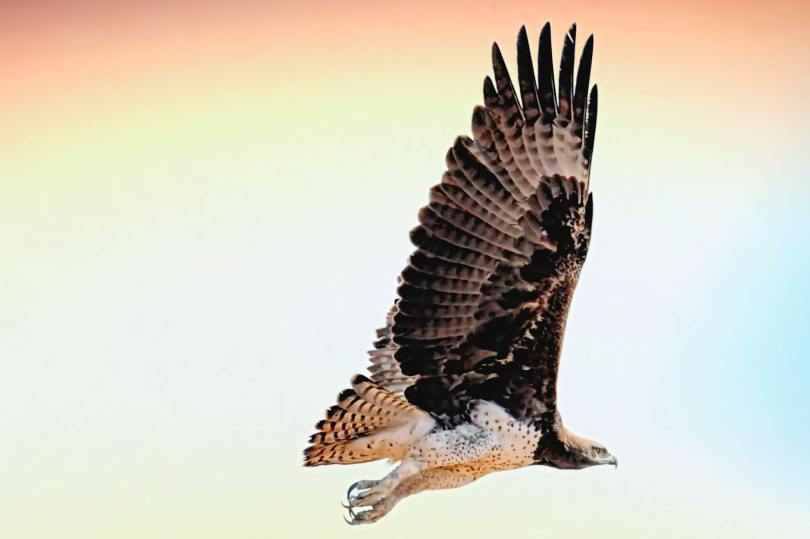
a Cooper’s hawk has caught a vole.

Her talons pierce and quell
the fruitless struggle.

Her banded belly and golden eyes
are striking against the faultless lawn

as she eviscerates her prey.
Nature undeterred and matter-of-fact
requires sacrifices.

The camera leaves the carnage
and we stroll towards your car—
lean back in easy silence

against the immaculate black of the doors.
We pass a flask of bourbon back and forth—
we’ve done this before.

The lens zooms in to capture how your lips
and tongue linger on the flask’s rim.
Time slows, music begins softly,

then swells, heightens
the impression of a quiet, buried longing
which never dissipated

but collected itself;
grew deeper without outlet over years.

I’m collected; controlled: not touching you,
not leaning close—
despite memory of how you used to breathe

in as I exhaled as if I were an antidote,
and you a dying man.
The camera angle shifts to capture your hand

surprising even you
as it finds its way home,

your thumb a gentle knife
on the underside of my jaw—
fingers hardly squeezing
the back of my neck.

The audience holds their breath.
They know what kind of kiss comes next,
and no one

not me, not you, not the hawk,
has done anything
wrong at all.

Author’s note: I have often been asked if I ever write happy poems and or love poems. The answer is, to the first, I think never, and to the second, only if the love poem explores the pain, grief, and hunger that so often accompany love. I recently reread this poem, written a few years ago, wondering if it didn’t need revision so much as the proper title was missing. The annoyingly cliched MFA workshop question rose up to face me, like a spectre: What’s at stake? The speaker of the poem here imagines a world where wanting what they cannot have is not transgressive, but totally acceptable, socially, morally, and emotionally. Issues of conscience are easily and matter-of-factly dealt with, something that is not possible in reality, but in the world of poetry, all one needs is imagination to open doors to possibility that reality locks up with impenetrable finality. I changed the title to reflect what is at the heart of this poem, which, in the imagination of the speaker, is bargaining about a longing that in order to be admitted to and explored, must occur within an ecosystem of morality.

Staci Halt’s work has appeared or is forthcoming in Rattle, december Magazine, Salamander Magazine, The Los Angeles Review, Driftwood Press and others. She parents six rad humans, and a slew of cats, and teachers and writes near Boston, for now.

“Ten Minutes Before Closing” by Shannon K. Winston

       Inspired by “The scent of the archive” website, City of London

An archive smells like licorice, a faint cigar,
bergamot. Some might think of a butcher shop or
cat urine when leafing through yellowed papers.
Dust is skin, is horsehair, is struggle, is stymied desire.
Even almond-like odors linger in parchment.
Faint embers nestle into unsuspecting letters.
Goji berry? Rose? Reader, what do you smell? Tired leather,
hints of cocoa and earth. The breakdown of
iron gall ink is burnt and sugary sweet.
Just how many odors does an archive contain?
Kneel in an aisle, if only for a minute, lean in,
listen— do you feel the tingle of the archive within the archive?
Make room for taste, touch, smell swelling in, around, within the records.
No one told you, guest, patron of this place.
Open the book before you. Walk through wild mushrooms,
patches of tomatoes, and wet grasses. Stop taking notes.
Quiet overtakes you again and you smell an odor you can’t quite name
rippling between your hands. Yes, yes—you’re a child in the kitchen,
sourdough starter sticks to your hands. You want to shake it off.
Try as you might, it clings to you. The scents of the archive are like this.
Uncertain, you linger. You’ve forgotten why you’re there.
Vixen, confidant, hoarder—the archive slips under your skin.
Without a word, a woman in a picture book holds out a suitcase to you:
xylophones, violins, flutes. Beautiful music, she says. You can’t hear it.
Yes, yes, she insists. Listen harder, every smell has a sound.
Zinnias swell like yeast in the dark. The librarian has turned off the lights.

Author’s note: Archives have always fascinated me—they hold so many wonderful stories and mysteries. In writing this poem, I was inspired by the article “The scent of the archive” published by the City of London, which discusses the different types of smells one might encounter in an archive. I fleshed out some of those details in this poem by imagining myself into that space. The abecedarian form (where the first line of the poem begins with the letter “A” and each line thereafter begins with successive letters of alphabet) allowed me to explore the expansiveness of my imagined archive formally, as well.   

Shannon K. Winston is the author of The Girl Who Talked to Paintings (Glass Lyre Press, 2021) and The Worry Doll (Glass Lyre Press, forthcoming). Her individual poems have appeared in Bracken, Cider Press Review, On the Seawall, RHINO Poetry, and elsewhere. She lives in Bloomington, IN.