“We may think Bede” by Catherine Rockwood

did or could not say what true speed was1  
without impossible foreknowledge of
jet-bombers, lasers, a crouched F1 car.
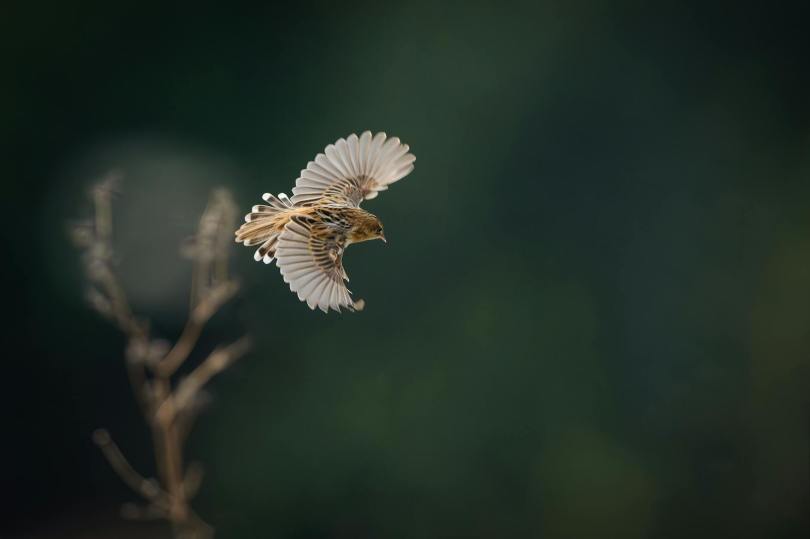
But this morning two sparring sparrows flashed
past my dull head into a wet azalea
and in that wing-touched moment of departure
my soul spoke, Oh.

1 Viz. Bede, Historia Ecclesiastica II.13 “The present life of man, O king, seems to me, in comparison of that time which is unknown to us, like to the swift flight of a sparrow through the room wherein you sit at supper in winter…”


Catherine Rockwood (she/they) reads and edits for Reckoning Magazine. Two chapbooks of their poetry, Endeavors to Obtain Perpetual Motion and And We Are Far From Shore, are available from The Ethel Zine Press. A third chapbook, Dogwitch, is forthcoming from Bottlecap Press.

“Midrash on Judges 15:4” by Reyzl Grace

I don’t know why I always imagined
the fields in dusk—the little flame-
tailed foxes dragging their torches
behind. Do you think, as they rushed from their doors,
the Philistines saw how beautiful it was?

It must have been: the purple twilight
crushed against the grain like the velvet
of a noblewoman in adultery, her robe slumped
to a mosaic floor; the breeze slipping
through the guard hairs of the foxes like a quiet kiss.

God, how we love what is in pain—how it reminds
us of youth. You know that the sun was created
setting on a Tuesday? I think Samson
knew . . . but where was I? Yes,
looking out on the fields, on stalks become candles,

on foxes, coats rusting in the gloom
against the golden crop. The rabbis
hunt every letter of Torah
for sport, shoot each with a thousand arrows,
yet the Talmud glosses this only once,

when R. Bar Abba tells us the fox
was a symbol of renegation—the only creature
that runs in reverse. But don’t we all?
Don’t we run from the Ark and the Tabernacle
still turning toward them, enraptured? Yes.

We are on fire, but still must breathe—
little kits gulping air
as we twist and writhe around each other.
In a moment, all will be desolation and burnt
hair, but for now, it is lights gay

as summer bonfires, bobbing up
and down the rows of the vineyards and the oliveyards,
the rigid ranks of wheat and barley,
the tangled foxes snarling as they spin
and snap like firecrackers. How I wish

I could make you see it as I did—a child
who had lost nothing, felt nothing,
never asked what happened to the foxes.
Sometimes I wish I had never asked.
Sometimes I think that the rabbis were wise.

Reyzl Grace (reyzlgrace.com / @reyzlgrace) is a poet/librarian with work in Room, Rust & Moth, So to Speak, and other magazines, as well as an editor for Psaltery & Lyre. She lives in Minneapolis with her novelist girlfriend, arguing over which of them is the better writer. (It’s her girlfriend.)

“Once, Offhandedly, An Ex-Boyfriend Said He Hoped I Could Find Someone Who’d Be OK With Me Working on Sundays.” by Megan McDermott

after Adélaïde Labille-Guiard’s Self-Portrait with Two Pupils, Marie Gabrielle Capet and Marie Marguerite Carreaux de Rosemond, 1785

I teach you to look head-on at those looking at you, to not, in returning

gazes, drop your palette or your work. Surely men will look at you

with hopes of causing pause, so wear your daring dresses and your hats

with feathers and look at them right back, with a look that tells everything:

there is no me without this canvas or those who will learn over my shoulder.

Megan McDermott is the author of Jesus Merch: A Catalog in Poems and chapbooks Woman as Communion and Prayer Book for Contemporary Dating. Her poetry has appeared in various journals, including Amsterdam Review, the Maine Review, the Christian Century, and more. She is an Episcopal priest in Massachusetts.

“Apocalypse Love Poem” by Wendy Wisner

This week, as I watched the sky turn ash orange,
saw the air quality ticker go red, purple, maroon,

glimpsed two construction workers exchanging soft blue masks
under the dusky morning moon,

witnessed my children sink into the couch—
“Not this again!” my son raged, hazel eyes hot with tears—

I wondered if I’d loved enough, risked enough for this earth,
which is clearly raging back at us all,

how my son would sit under the desk during remote learning,
fists red as beets, biting his nails till they bled.

Last night, I dreamt again about losing my kids in a surge
of stormy black water, the levees failing again, again.

I dreamt and dreamt until I had to push myself out of the dream
so I could walk through the dense summer morning

with you, the two of us catching our breaths
as the sky swelled, finally, with rain—

oh the blue blue sky in all its merciful radiance.

Wendy Wisner is the author of three books of poems, most recently The New Life (Cornerstone Press/University of Wisconsin Stevens-Point). Her essays and poems have appeared in Prairie Schooner, Spoon River Review, The Washington Post, Lilith Magazine, and elsewhere.

“One Year After Release From the Behavioral Health Unit” by Brittney Skye

The sun setting over the Wellsville mountains and the clouds roaring pink.
Tulips unclenching in the bedroom vase.
A hot bowl of cheesy shrimp-n-grits, a taste I almost missed.
The wretched face of the beautiful man who called 9-1-1.
A beaver dam overflowing with winter run-off.
A surprise bridge in the path.

This is how I fall in love with the hard of my life:
With words and a pen. With neither fist raised.
Even if there’s no one to share a poem with, I am saved
By writing it in the first place.
We only ever talk about “taking your life”
When someone’s taking it away,

But have you ever thought of taking your life on a date?

Sometimes surviving is beautiful
And sometimes it’s a phantom limb’s ache.
I have punished myself enough for trying
To go away. The body will pick up its pieces
Whether you want it to or not; your body will love
Being alive, whether you want it to or not.
But the soul takes longer to come home.

Sometimes she runs up to me with her childish fists scratched,
Full of sunrises and my first nephew laughing,
Our best friend’s wedding in the woods,
The bed where, for a year, I’ll wake with a dog under each arm.
With her freckled nose and busted lip,
She holds up the places in life
Where there would be a vacuum without me,
Not just an absence but a life-sized ache.
Knowing what I do not about living again.

Brittney Skye is a poet from Cache Valley, Utah. She graduated with her Master’s of Arts degree from Utah State University in 2020. In 2021, her first chapbook, titled Harvest, was published by Finishing Line Press.

“REALLY THIS IS A POEM ABOUT CLIMATE CHANGE” by Emily M Goldsmith

When this hurricane comes, I am all candles, all reverence,
All wafts waving lavender up the walls of each room in the house.

I feel the cool ridges of tourmaline bite my palm. As I squeeze,
They mark me. All my plants have diseases; I can’t keep them alive.

The leaves stop reaching for the sun. Wilting, speckling,
discoloring, unusual curling. Even the aloe vera drying up into itself.

I remember when, my mother with the green thumb, watched me break
A lamp and declared, everything you touch, you ruin.

This was not a prophecy. That same mother made cookies, cautiously folded
In chocolate chips. When I receive an Oomancy reading about the plants,

I am told my ancestors protect me. I am told Persephone wants my attention.
I do not take chances: I set up my altar, I finish the protection wreath and salt

Every window. Living across from a cemetery is enough to know we don’t
Tempt the beyond. I wait out the storm, I light more candles,

I wear the crescent on my neck. I flash my tits to the moon for good measure.
I wait to see if my plants survive this storm and the next.

We are all waiting. My husband is ready to start a film, his thumb resting
On play. I am waiting for the cake in the oven when vanilla meets my nose.

My friend from New Orleans paces, wondering when they can return
To their apartment so they might salvage what remains of the wreckage.

In small ways, each of us waits for the world to end.
Some days it feels sooner: like when the thunder rumbles,

When the house shakes, when I wade through water waist deep
On the streets where I grew up—when the trees crush roof to rubble.


Emily M Goldsmith (they/them) is a queer, non-binary Louisiana Creole poet. Emily received their MFA from the University of Kentucky and PhD from the University of Southern Mississippi. Their creative work can be found in or forthcoming from Midway Journal, Gnashing Teeth, Zaum, The Penn Review, and elsewhere.

“MERMAIDS EATING OYSTERS” by Stephanie Burt & Mara Hampson

How do they get the things open? If they smashed the closed wholes against rocks, as otters do, the fragments could cut their delicate tongues. Instead they sing. They journey in cliques to the oyster bed, then hum at a resonant frequency, so that the oysters, charmed or fooled into attention, start to open themselves up to their underwater world.

The pearl harvest comes as almost an afterthought: no one needs more than a few, unless for ball bearings and other mechanical uses, where polished pebbles do as well. Fine oysters, once eaten, survive in outline and memory because the mermaids save individual shells, some for ornament, more for construction, building slow shelters, sharp-edged hiding places, for when the trawlers pass overhead.

Good oysters taste creamy and semi-sweet, since the mermaids and their environs are already salty. Other words mermaids might use include tender and wholesome.  Some of us believe that mermaids eating oysters heal their vocal chords, necessarily more powerful than ours, since mermaids’ speech must carry underwater: otherwise they could speak only with their closest neighbors. Young mermaids whose voices will not carry get asked to eat oysters by the half-dozen in order to shape and strengthen their sound.

Except for those cases—rare and vexing ones—most mermaid cliques regard the first oyster as a rite of passage: the first time a young mer sings to open an oyster herself, she gets to display the shell. It’s a sign: you can now use songs for other purposes—tempting sailors, or keeping sailors away; repelling sharks, dolphins or orcas (distinct songs for each); attracting and directing food fish in schools.

New York harbor oysters feel stodgy in the mouth, enormous, nutritious, with strong shells, but not much prized compared the Gulf of Maine. Nonetheless mer populations lamented for decades the apparent extinction of oysters in Long Island Sound. They cheer the replenishment of the oysters beds: one of the few human schemes they approve. Some even sing new songs about the far future, when they will live alongside us again.


Stephanie Burt is Donald and Katherine Loker Professor of English at Harvard. SUPER GAY POEMS, a collection of 51 poems (none by Stephanie) with an essay (by Stephanie) about each one, came out (as it were) in April 2025; her book about Taylor Swift will follow in October.

Mara Hampson is an aspiring artist and jill of all crafts. They live in Boston with their cat Pico. She bites (the cat, not Mara.)

“Fantasy with Christopher Plummer’s Captain Von Trapp” by Violeta Garcia-Mendoza

Tonight, yes to the boatswain’s whistle,
yes to the scold that won’t reach your eyes
& yes to that eye contact

while you pull off your gloves
& pin my arms back when we’re dancing
the Laendler. Yes to the clap of us

in the courtyard, yes to the path
of guitar-callused fingertips: neck,
collarbone, back… Yes to your lips

at my ear crooning Edelweiss.
O homeland of saltwater bodies
coming undone.

Violeta Garcia-Mendoza is a Spanish-American poet, teacher, and suburban wildlife photographer. Her debut poetry collection, SONGS FOR THE LAND-BOUND, was published by June Road Press in 2024. Violeta lives with her husband, teenage children, and pack of rescue dogs on a small certified wildlife habitat in western Pennsylvania.

“CALLIMACHUS AGAINST HIMSELF” by Stephanie Burt

Whatever our era needs, it isn’t you,
all erudition and pointlessness. Go block a tarmac.
Get to a travelers’ dorm and stand in the doorway
when the sons of Ares arrive. Make your latest hardback
(nobody’s buying it anyway) into your shield.
Stick around here. Speak plainly. Don’t pursue
conjunctions and conjugations, the way you used to do,
down switchback trails, through vines and thickets of grammar,
past setts, through every epiphyte and eave.
It’s not like they’re coming after you first: you’ve concealed
your rage all your life behind curtains of time, place and manner.
On the other hand, it’s still your nation.
It’s not like they’ll let you back in, if you choose to leave.


(Greek Anthology 11:321)

Stephanie Burt is Donald and Katherine Loker Professor of English at Harvard. SUPER GAY POEMS, a collection of 51 poems (none by Stephanie) with an essay (by Stephanie) about each one, came out (as it were) in April 2025; her book about Taylor Swift will follow in October.

It Keeps Me Like a Garden: A Review of Carla Sofia Ferreira’s Debut A Geography That Does Not Hurt Us

A Geography That Does Not Hurt Us by Carla Sofia Ferreira (River River Books, 2024). 89 pages. $18

by Tom Snarsky

A Geography That Does Not Hurt Us by Carla Sofia Ferreira (River River Books, 2024)

When I was a high school teacher, I always shared one poem with my classes at the beginning of the year: “A Journey” by Nikki Giovanni. I didn’t give my students much context beforehand, we just jumped into the poem’s opening: “It’s a journey . . . that I propose . . . I am not the guide . . . nor technical assistant . . . I will be your fellow passenger . . .” I thought of this poem immediately when I saw the titles in Carla Sofia Ferreira’s A Geography That Does Not Hurt Us that mention students (e.g. “Today My Students Tell Me,” an all-time favorite from the collection re: which more later), or even poems dedicated to them (“In This Poem, Bert & Ernie Are Gay”).

It is, paradoxically, both hard and delicate to be a teacher while also being Giovanni’s “fellow passenger”—when you teach youth in secondary + postsecondary contexts, as Ferreira has and does, you bring your own identity into a room where many others are actively being formed, including by what you say and do. In her article “Invisible Identities,” educator Erin Smith wrestles with the question of how much of her own journey, specifically surrounding mental health, to share with her students: “When I first began teaching, I didn’t divulge anything about my own mental health journey to students. For one, I thought that might delegitimize me as a teacher somehow, even if I was speaking in past tense. I also thought, frankly, that I would scare them.” Ultimately, Smith decides to share parts of her past experience with her students, partially in the hopes of connecting with them when they might feel at their most alone and partially because, “at the end of the day, I am only the teacher I am because of my past, however painful. I want my students to know that I have lived and struggled not for them, but alongside them” (emphasis mine). Even in the face of a hyper-politicized educational climate, which has placed more scrutiny than ever on what teachers say and do, Ferreira’s book unapologetically presents the poet-teacher as a vibrant, several-dimensional, multilingual singer of the many sorrows and joys of life, and in particular of the education it has in store for all of us. The book is a record of many different ways to make sense of the world in verse, and dazzles as much for its pluralism as for the emotional, formal, and imagistic precision of its poems.

***

There are many pieces from the book I could quote at length, but I’d love to spend time with my personal favorite, “Today My Students Tell Me”—in particular, this section:

[...] a student tells me that I seem
like the kind of person who is good at tending plants,
that I seem exactly like someone who would care for
dying plants and maybe even heal them, only I am the one
adding maybe, because they said it with such conviction
and another student agreed with them like this was simple
and true, and I laughed, I told them they were wrong, that I wish
I were more like my grandmother, who was in fact a tender of gardens
and all green things [...]

The first time I read this poem I was drawn to its subtle music: the way it dips into iambs for “is good at tending plants” feels like a perfect sonic parallel for the rhythms of care that phrase postulates, and there are little consonant breadcrumbs that reinforce the different connections between the poem’s characters and concepts/images (“person” and “plants,” “care” and “conviction,” “grandmother” and “garden” and “green”). Ferreira’s poems have a very intimate connection to music, which we’ll unpack a little more in the next section.

Like all great poems, this one has more to reveal than what the ear picks up alone. First is the airy line break on “care for,” which points gently at the fact that even though the object coming in the next line is “dying plants,” the student here sees Ferreira’s speaker as a carer writ large: this speaker clearly cares enough for their students to invite these kinds of ribbing-yet-kind characterizations and comparisons from them. And it is, indeed, them, in both the singular and plural: the line break on “only I am the one / adding maybe” plays with the irony that Ferreira’s speaker’s self-doubt is individual, while the students’ positive assessments are coming from the collective (and with certainty: “they said it with such conviction / and another student agreed with them like this was simple / and true”). This is also a playful inversion of the kind of building-up that is so often the bread and butter of the student-teacher relationship: anyone who has taught adolescents has had at least a hundred versions of the conversation where you not so much convince a student that they can do something, as you reassert it insistently (and necessarily simply, like a fully self-evident fact) until you both believe it.

So much of good teaching happens along the melodic lines of community and conversation that the reader hears in this episode, and there is also a bittersweet note that sounds across the enjambment of “simple / and true.” The reader is reminded that a majority of what students and teachers encounter outside of the context of a classroom community will be neither simple nor true: although Ferreira’s speaker cannot protect their students from this reality, they can share space with them and even bits of their own life story, like the moment with which this episode concludes, when the speaker invokes their grandmother. I love this moment of the poem so dearly because it once again inverts a classic discursive move of the classroom teacher, who can ask a student a question (or offer a small conjecture based on a little bit of data, new haircut, new shoes, how’d the game go yesterday, etc.) and then, by the happy accident of how the student responds, the teacher ends up learning something about the student’s life or their family or their interests—adding a vital shade of humanity to the student/teacher relationship. This moment in Ferreira’s poem shows how this dialectic is fundamentally a two-way street, colored in on both sides of the dividing line by student and teacher alike deciding to share.

In particular, Ferreira’s speaker chooses to tell the students about their grandmother, “a tender of gardens / and all green things.” There is a lovely visual parallel between the line-ending phrases “tending plants” and “tender of gardens,” the former a description of the speaker offered by the students and the latter a description of the speaker’s grandmother offered by the speaker. This extends the building-up beyond the classroom walls and across generational lines in a way that connects the poem up with one of Geography’s grandest motifs: temporal and familial cycles of care. A double meaning of “green,” both in the literal sense of plant color and in the more figurative sense of being new, even naïve, invites us to consider that we all exist at varying stages of vulnerability and imperfection along this timeless continuum of care: just as wisdom passes across generations, and is remembered, youth gives the energy of its indomitable spirit back to teachers and grandparents, with a side of cheek. This back-and-forth ouroboros prepares us beautifully for the poem’s ending: “this tenderness, even just this shared / nodding of heads, that it takes care of me every day, that it keeps me like a garden.”

***

In the foregoing, we have settled into Ferreira’s Geography in one of very, very many ways a reader could enter the text. Teaching high school students is my own personal gateway, but the book teems with further possibilities: in addition to being a book of the teaching and learning that occurs in classrooms and across generations, it is also a collection about ecology and cultivation on a local and global scale: “I am wondering / if I can hold it all like this packet of seeds and also if the earth / here will let them grow” (“In This Garden I Am Growing”). It is no less, too, a collection of love poems, the addressees and objects of which span family, history, and the many different kinds of intimacies that make up a life: “In my thoughts, I call you Grandma / though I never called you that in life. / I keep forgetting what it means to live a life / with you not in it” (“Poem In Which I Can Say Polka Dots, Tenderness, Icicles Without Translation,” one of the other poems in the collection that directly and poignantly addresses “Avó,” the speaker’s grandmother). Furthermore, the book is a compendium of form and of the joys of spoken and written language as only an English teacher can communicate them, made up as it is of poems working across forms (odes, elegies, centones, ghazals, letters, self-portraits, even a ransom note!) and singing the praises of punctuation (one poem opens with the indelible phrase “Plums she gathers like ampersands,” and there is even a poem called “Ode to the Semicolon”!).

Finally, Geography is a carefully crafted parallax along two different, but coincident, cultural lines: Fado, a venerable Portuguese musical tradition encompassing songs of longing and melancholy (which often take as their subject matter life at sea and the struggles of the poor), and The Ironbound, a working-class neighborhood in Newark with a strong Portuguese immigrant community. Ferreira’s first micro-chapbook is entitled Ironbound Fados (Ghost City Press, 2019), and some of the poems included both there and in Geography enact Fado’s complex relationship with sorrow, grief, and love on the subjects of an Ironbound upbringing: family, local flora, even “The playground of concrete and gravel and parking spaces” at St. Lucy’s (a Catholic Church in Newark that is host to the American national shrine for St. Gerard Majella, an Italian saint who grew up in poverty, worked several jobs, and would go on to become the patron saint of expectant mothers). Everywhere in Ferreira’s collection, even on the periphery, there is this intermingling of the work of poetry with the spirit of joy, of wisdom that passes through generations and creates the maps by which we know ourselves, our neighborhoods, and our beloveds. (One of my favorite things about the book is that the Acknowledgements section runs to six pages, in order better to contain “an incomplete catalogue of gratitude,” a riff on Ross Gay that ends the book as warmly and openly as it began.)

***

At the end of the year, I’d share one more poem with my students: “Homeless Heart” by John Ashbery. “When I think of finishing the work, when I think of the finished work, a great sadness overtakes me, a sadness paradoxically like joy.” A Geography That Does Not Hurt Us is imbued to its marrow with this feeling, the joy of a collective work and emergent togetherness, tinged by the sadness essential to song: “I am tired of living alone. I am growing a garden / like my life depends on it because it does” (“In This Garden I Am Growing,” that “depends on” one of the book’s winks to fellow NJ poet William Carlos Williams). This joy shines with the same brightness as a graduating class, while still pulling little threads out of the hearts of educators and family members who can feel the way the passage of time will quickly turn this joy into memory. When I read Carla Sofia Ferreira’s luminous collection I am reminded of two things: first, of the students I had who were bilingual in Portuguese and English, for whom this book would be an unequivocal affirmation that their language and experience is the language and experience of poetry. Second, that time and our transition across generations and from one cohort of students to the next does not have to be all grief, or only grief: that I am instead free to follow Ferreira’s example in order to describe my finitude differently, “to love afternoons turned into morning, and / to love with both hands and eyes closed what is already leaving me.”


Tom Snarsky is a former high school math teacher and the author of the full-length poetry collections Light-Up Swan and Reclaimed Water, both from Ornithopter Press. His book A Letter From The Mountain & Other Poems is forthcoming from Animal Heart Press in summer 2025, and his book MOUNTEBANK is forthcoming from Broken Sleep Books in spring 2026. He lives in the mountains of northwestern Virginia with his wife Kristi and their cats.