“One Year After Release From the Behavioral Health Unit” by Brittney Skye

The sun setting over the Wellsville mountains and the clouds roaring pink.
Tulips unclenching in the bedroom vase.
A hot bowl of cheesy shrimp-n-grits, a taste I almost missed.
The wretched face of the beautiful man who called 9-1-1.
A beaver dam overflowing with winter run-off.
A surprise bridge in the path.

This is how I fall in love with the hard of my life:
With words and a pen. With neither fist raised.
Even if there’s no one to share a poem with, I am saved
By writing it in the first place.
We only ever talk about “taking your life”
When someone’s taking it away,

But have you ever thought of taking your life on a date?

Sometimes surviving is beautiful
And sometimes it’s a phantom limb’s ache.
I have punished myself enough for trying
To go away. The body will pick up its pieces
Whether you want it to or not; your body will love
Being alive, whether you want it to or not.
But the soul takes longer to come home.

Sometimes she runs up to me with her childish fists scratched,
Full of sunrises and my first nephew laughing,
Our best friend’s wedding in the woods,
The bed where, for a year, I’ll wake with a dog under each arm.
With her freckled nose and busted lip,
She holds up the places in life
Where there would be a vacuum without me,
Not just an absence but a life-sized ache.
Knowing what I do not about living again.

Brittney Skye is a poet from Cache Valley, Utah. She graduated with her Master’s of Arts degree from Utah State University in 2020. In 2021, her first chapbook, titled Harvest, was published by Finishing Line Press.

“Fantasy with Christopher Plummer’s Captain Von Trapp” by Violeta Garcia-Mendoza

Tonight, yes to the boatswain’s whistle,
yes to the scold that won’t reach your eyes
& yes to that eye contact

while you pull off your gloves
& pin my arms back when we’re dancing
the Laendler. Yes to the clap of us

in the courtyard, yes to the path
of guitar-callused fingertips: neck,
collarbone, back… Yes to your lips

at my ear crooning Edelweiss.
O homeland of saltwater bodies
coming undone.

Violeta Garcia-Mendoza is a Spanish-American poet, teacher, and suburban wildlife photographer. Her debut poetry collection, SONGS FOR THE LAND-BOUND, was published by June Road Press in 2024. Violeta lives with her husband, teenage children, and pack of rescue dogs on a small certified wildlife habitat in western Pennsylvania.

“CALLIMACHUS AGAINST HIMSELF” by Stephanie Burt

Whatever our era needs, it isn’t you,
all erudition and pointlessness. Go block a tarmac.
Get to a travelers’ dorm and stand in the doorway
when the sons of Ares arrive. Make your latest hardback
(nobody’s buying it anyway) into your shield.
Stick around here. Speak plainly. Don’t pursue
conjunctions and conjugations, the way you used to do,
down switchback trails, through vines and thickets of grammar,
past setts, through every epiphyte and eave.
It’s not like they’re coming after you first: you’ve concealed
your rage all your life behind curtains of time, place and manner.
On the other hand, it’s still your nation.
It’s not like they’ll let you back in, if you choose to leave.


(Greek Anthology 11:321)

Stephanie Burt is Donald and Katherine Loker Professor of English at Harvard. SUPER GAY POEMS, a collection of 51 poems (none by Stephanie) with an essay (by Stephanie) about each one, came out (as it were) in April 2025; her book about Taylor Swift will follow in October.

Two Poems by Catherine Rockwood

Inverie, Knoydart, June 2024

By the harbor again and once again low daylight.

When the mountains are illuminated
we receive them.

Somewhere uncoastal, southward,
teens

are keeping themselves alive
as they can in little towns

where hairdresser shops
outnumber other business.

No. Strike that.
Even here

where robins land
on sustainable pub-tables

to receive a peanut, shelled:

here
in these isolated

regenerating districts
with their managed woodlands

and fences,
their reiterated

statements of difference
from the mainland

here too
teens

are keeping themselves alive
as they can

in low light
near breathless June waters.
Boston Seaport, July 2024

Where the unpredictability of the body
meets weather
is the world.

To weather is to survive
and fall apart.
Like this.

I am weathering, every day
and laughing sometimes:

loving my children
according to their specific ways

even as cloud comes right down to the water
and summer loses its sum

becomes mer

a salty fog we swim in, having missed

the sea.

Author’s Note: I guess what I found by Loch Nevis and Boston Harbor was a surprising commonality of quiet gray haze and overcast skies. That’s a more frequent phase of summer now, when it isn’t bright/scorching or cloudy/scorching. * I also found a surprising but to me sustaining commonality of care. Wherever I was I ended up thinking about kids, both my own and the children of others. The work children do to live their lives. The quotidian deprivations and difficulties that are, even in a best-case scenario, part of growing up. The way this present time is different, yes, but not cut off from how kids have lived in the past and will live in the future. The way we must and will go with them.I placed myself next to the sea a lot, this summer.  It’s much on my mind, the sea, and what our relationship with it will be in the coming decades of climate instability.

*(fuck Exxon, fuck Shell, fuck BP, etc., and their enablers) 

Catherine Rockwood lives fairly close to Boston. She/they reads and edits for Reckoning Magazine, and reviews books for Strange Horizons. Two chapbooks of her/their poetry, Endeavors to Obtain Perpetual Motion and And We Are Far From Shore, are available from the Ethel Zine Press.

Two Poems by Chris Corlew

WINDY MORNING KAYAKING PRATT BEACH

today I take
only what the Lake gives me

what oceanographer can measure the height of swells
on sight? no conquest only quagga mussel infestation

today the Lake wants me like a pawing overeager lover
& I sprawl myself on top of its welcome

today is white-capped & the first time
swells knock me off my kayak shoulder missing lake bottom rocks

humble thyself homie
in the sight of the Lake

northwestern winds & no room for ego
do you want to go home? do you want your arms to yearn to

nag in neglect until before bed when you do push-ups?
or do you want to have fun?

no concern for horizons no pondering time in these swells
only the water in front of you

paddle droplets on a life jacket
puddles in the boat

ribs in the sand after & pluck
a hair from the back of my thumb
THE TREES MY DUDES THE TREES

headbanging kelp forests the sea-cats
of Chile’s beaten coast hunt with agility implying they
could probably guard Kevin Durant one-on-one (in the dark

the stoned horror writer
makes a note of vampire bats on screen)
evergreen rainforests where I

would maybe melt out of reverence can I kiss the mapungauri’s hand?

ambush is easy enough when you
look like a leaf
the narrator says about frogs

reincarnate me as a dew drop above the Valdivian Forest
seems a million times more
purposeful & fulfilling than 21st century USA

the trees the trees are so many can you
see the trees & not praise the trees my comrades-in-leaves?
can you see the Chilean palm trees mix with Valdivian species & not worship the earth?

the trees the trees marvel at the trees
& cacti grow in the clearings

the trees depend on monito del monte
to swallow their seeds whole & shit out germinating pods in sticky residue
this animal is 40 million years old we’re talking first mammal old

that should be sacred the trees should be
considered a holy site

& the monkey puzzle tree resistant
to volcanic ash can you even believe
how big the world is? how tall the trees?

can you even believe how impossibly small
even a 20-story apartment building is? & yet each life contained within a treasure? even thousands of miles from these sacred trees? what a treat
to be alive to be stoned & up late
& watching a streaming service I only have
so my son can watch Mickey & Bluey & Spider-Man (& I can watch Star Wars)

& no there’s more there’s the divine
dewey & shaggy with cacti in the clearing
the trees my dudes the trees

we end as we began
water-bound
confronted with wave battering

Author’s Note: Summer—and by extension kayaking season—is fleeting. Yet the water is eternal if we manage it properly. There should always be a Lake Michigan and therefore should always be summer days I can spend cradled and held atop its currents, one of millions of grateful water passengers. I’ve never personally seen the beauty of Chile’s landscape or wildlife or people or culture, but I really hope to one day, and it bums me out how much climate change could affect all of that. So these poems, to borrow an idea from my friend and co-host Bob Sykora, are attempting to freeze two marvelous moments in time: a day I went kayaking and a night I spent watching a nature documentary. With hopes that this act of reverence through art can honor such sublime connection with the wider world and inspire more.

Chris Corlew is a writer and musician living in Chicago. His work has appeared in Cotton Xenomorph, Whisk(e)y Tit, The Rumen, Cracked.com, and elsewhere. He can be found blogging at shipwreckedsailor.substack.com or on Bluesky @thecorlew.

“Summer Song” by Sophie Farthing

I have decided to be fat.
I am going to eat a snickerdoodle,
two snickerdoodles, and after
the last crumb's swallowed I
will not run until my knees twist.
I will walk slowly through the heat
and drink up birdsong.

I have decided to be fat.
Butter and cheese belong with grits,
and if you do not fry the hash browns,
are you really living? I will
sweeten my iced tea with honey, roll
the broccoli and Brussel sprouts
in olive oil, split dark cherries with
my tongue and
suck out the scarlet.

Saturday scones and strawberry preserves,
Cat's cradle stir-fry in the wok, and I
have decided to be fat.
I will float in soft dresses,
wave my inked arms, sing
when they are silent,
nourish the blood bursting
from my red pulsing heart.

Author’s Note: This poem plays with food words, swings its stanzas around, celebrates. This poem is on the move! This poem is a toddler bouncing around with their hands full of birthday cake.

Sophie Farthing (she/her) is a queer poet and artist living in South Carolina in the USA. Her work has appeared in outlets including Right Hand Pointing, Beyond Queer Words, Impossible Archetype, and Anti-Heroin Chic. She is the 2024 recipient of the Elizabeth Boatwright Coker Fellowship in Poetry from the SCAA.

“After the Start of Summer” by Kevin Risner

the lake blooms a bright green more vivid than geckos.
When these blooms enter the household, it’s only natural
to collect them, place them in a glass vase, burn eyes
with pollen. Pink and orange petals flutter onto the table.

They say that algae blooms mean an overabundance
of phosphorus. It’s toxic.

We drink up facts, reap the consequences, even when
it’s not our fault. I am a wooden raft headed down
the river after a heavy rain. The water’s thick there.

I hope to make my way out of this sand trap
through storm into sunlight, no longer
hidden by mattress-stuffing clouds in
the endless overcast that is November.

Author’s note: This poem spent a long time percolating and undergoing changes, much like how lakes do each year. In 2014, a severe algal bloom formed on Lake Erie off the coast of Toledo, which led to extreme water restrictions (for drinking, bathing, washing dishes). The result of agricultural runoff, this particular bloom shows vividly how much we, humans, have adversely affected waterways of all sizes and shapes. I try to explore the beauty of such events and how they can become disastrous, and how often they may return. The blooms will be pretty severe this year, but not as bad as the ones a decade ago in 2014. That’s a small sliver of hope. And I hope we can find these slivers from time to time, not just here in the crevices of this poem, but elsewhere in the world.

Kevin A. Risner is from Ohio. He is the author of Do Us a Favor (Variant Literature, 2021); You Thought This Was Just Gonna Be About Cleveland, Didn’t You (Ghost City Press, 2022); and There’s No Future Where We Don’t Have Fire (ELJ Editions, 2025).

“Sacrifices” by Staci Halt

My favorite film has an original script;
is shot, and directed by me—
I’m the star, too, in a cast of three.

Your wife speaks no lines.
The opening scene starts after she dies

painlessly, expectedly, unavoidably—
you were prepared as one can be
for the kindest possible removal

of a sympathetic character,
sadly unprotected

by the plot. My character attends
the graveside service—
notes her stiff hands do not claw

through the rain-black earth in protest
of my presence.
The sun supplants the clouds on cue,

and I hold back
while out-of-focus mourners disappear
off screen conveniently.

Our eyes connect with static shock—
the shot breaks to follow a wet, ripping sound
near the trees

at the far end of the cemetery—
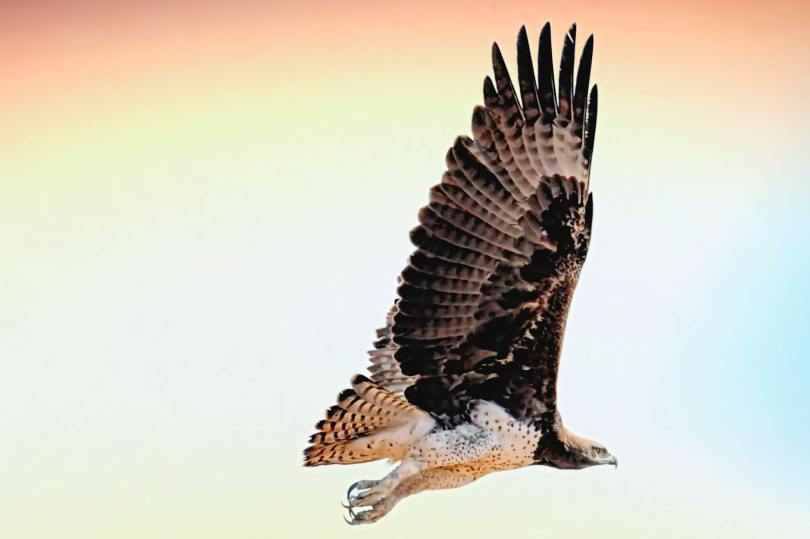
a Cooper’s hawk has caught a vole.

Her talons pierce and quell
the fruitless struggle.

Her banded belly and golden eyes
are striking against the faultless lawn

as she eviscerates her prey.
Nature undeterred and matter-of-fact
requires sacrifices.

The camera leaves the carnage
and we stroll towards your car—
lean back in easy silence

against the immaculate black of the doors.
We pass a flask of bourbon back and forth—
we’ve done this before.

The lens zooms in to capture how your lips
and tongue linger on the flask’s rim.
Time slows, music begins softly,

then swells, heightens
the impression of a quiet, buried longing
which never dissipated

but collected itself;
grew deeper without outlet over years.

I’m collected; controlled: not touching you,
not leaning close—
despite memory of how you used to breathe

in as I exhaled as if I were an antidote,
and you a dying man.
The camera angle shifts to capture your hand

surprising even you
as it finds its way home,

your thumb a gentle knife
on the underside of my jaw—
fingers hardly squeezing
the back of my neck.

The audience holds their breath.
They know what kind of kiss comes next,
and no one

not me, not you, not the hawk,
has done anything
wrong at all.

Author’s note: I have often been asked if I ever write happy poems and or love poems. The answer is, to the first, I think never, and to the second, only if the love poem explores the pain, grief, and hunger that so often accompany love. I recently reread this poem, written a few years ago, wondering if it didn’t need revision so much as the proper title was missing. The annoyingly cliched MFA workshop question rose up to face me, like a spectre: What’s at stake? The speaker of the poem here imagines a world where wanting what they cannot have is not transgressive, but totally acceptable, socially, morally, and emotionally. Issues of conscience are easily and matter-of-factly dealt with, something that is not possible in reality, but in the world of poetry, all one needs is imagination to open doors to possibility that reality locks up with impenetrable finality. I changed the title to reflect what is at the heart of this poem, which, in the imagination of the speaker, is bargaining about a longing that in order to be admitted to and explored, must occur within an ecosystem of morality.

Staci Halt’s work has appeared or is forthcoming in Rattle, december Magazine, Salamander Magazine, The Los Angeles Review, Driftwood Press and others. She parents six rad humans, and a slew of cats, and teachers and writes near Boston, for now.

“Love” by Reyzl Grace

—for E. R. Shaffer

You tell me I said that really fast.
But I spent a night, once, alone
on the beach in Coronado, living
a whole life.

For hours, I held
my fingers like woody stems in the surf,
letting foam gather in slow layers,
wave upon wave.

At the time, I thought
of St. Brendan’s tree, all covered with white
birds of fallen angels singing
for their release, waiting.

It took me so
long to think of the rose and the pearl
—to step off that beach fully
formed and living.

But I was alone.
You were not there. And it is okay
if you need more time to remember.


Author’s note: My girlfriend and I had not been (officially) dating very long when I–who am known for keeping things close to my chest–accidentally let slip the words, “God, I love you,” folded in a quiet sigh, almost under my breath. She sat bolt upright, finger in the air: “Can we just acknowledge,” she asked, “that you said that really fast, and that I am not there yet?” “Of course,” I conceded, and I sent her this poem the next day. Two weeks later, at two in the morning, she suddenly asks me what day it is. “Well, it’s past midnight now,” I answer, “so, technically, it’s Imbolc.” I watch a dam long guarded crack across her face, and she–who famously says everything that comes into her mind the moment it lands there–blurts out at last, “Fuck it! I love you!” The writer’s moral of the story? It is often the things we say against type that are the most honest.

Reyzl Grace (reyzlgrace.com / @reyzlgrace) is a poet/librarian with work in Room, Rust & Moth, So to Speak, and other magazines, as well as an editor for Psaltery & Lyre. She lives in Minneapolis with her novelist girlfriend, arguing over which of them is the better writer. (It’s her girlfriend.)

“The Meat of the Plum” by Emily Kramer

1.
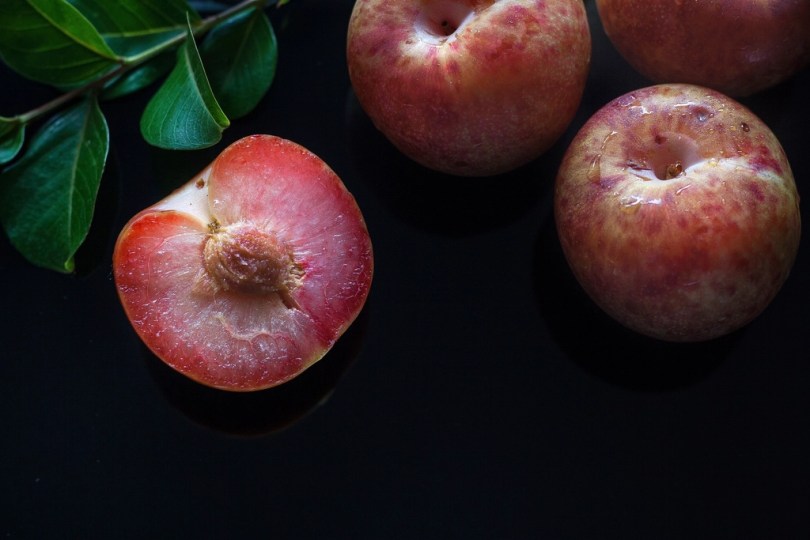
A drupe—the flesh of its fruit enclosing
the fruitstone-pit
of its seeds.

To droop and sag on the branch in the heat,
fresh swelling beneath taut sun
seared skin.

2.
To break skin; to bite into
flesh; to drip down yourself
into crevices.

To be atopic to stone fruits
and to eat them anyway, desperate
and ripe for the anchoring.

3.
And I think to kiss your mouth
is to eat a seed; to kiss and to eat and to seed.
And I think to kiss your mouth

is to cede ourselves to the blank
palimpsest, rubbed out hard
for growing.

4.
Oxidation of flesh; slight foxing;
lentigines that persist past fall.
The age and the wearing

of the page and the fruit,
sliver of thigh, high rise
suggestion of blush-pale meat.

5.
So what I really was doing was kissing myself
the way I used to kiss the side of my hand
when I didn’t think I’d survive you.

So what I really was doing was subjecting myself
to reaction the way the catalyst persists
unchanged and unchanging despite.

6.
Drupe—so close to dupe; to
duplication; to mark. Long lessons
patient bees can teach you.

Fuitit was missing
the r for reduplication. Eritit will
be
loose transposition for writ.


Author’s note: “Fruit” came into Middle English from the Latin frui, meaning “to enjoy” (cf. fruition and fruitless). Fuit / erit: Latin indicative perfect and future indicative tense of esse, “to be,” respectively. The title is from W. Paley’s 1802 Natural Theology: “The flesh of an apple, the pulp of an orange, the meat of a plum, the fatness of the olive, appear to be more than sufficient for the nourishing of the seed or kernel. . . . when we observe a provision to be more than sufficient for one purpose, yet wanted for another purpose, it is not unfair to conclude that both purposes were contemplated together.” 

Emily Kramer is an editor living in Boston, MA. She received her BA in English from Barnard College, and her PhD from Boston University’s Editorial Institute. Her critical edition of Arthur Henry Hallam’s collected poems is forthcoming from Oxford University Press. This is her second publication in Moist.