“Sacrifices” by Staci Halt

My favorite film has an original script;
is shot, and directed by me—
I’m the star, too, in a cast of three.

Your wife speaks no lines.
The opening scene starts after she dies

painlessly, expectedly, unavoidably—
you were prepared as one can be
for the kindest possible removal

of a sympathetic character,
sadly unprotected

by the plot. My character attends
the graveside service—
notes her stiff hands do not claw

through the rain-black earth in protest
of my presence.
The sun supplants the clouds on cue,

and I hold back
while out-of-focus mourners disappear
off screen conveniently.

Our eyes connect with static shock—
the shot breaks to follow a wet, ripping sound
near the trees

at the far end of the cemetery—
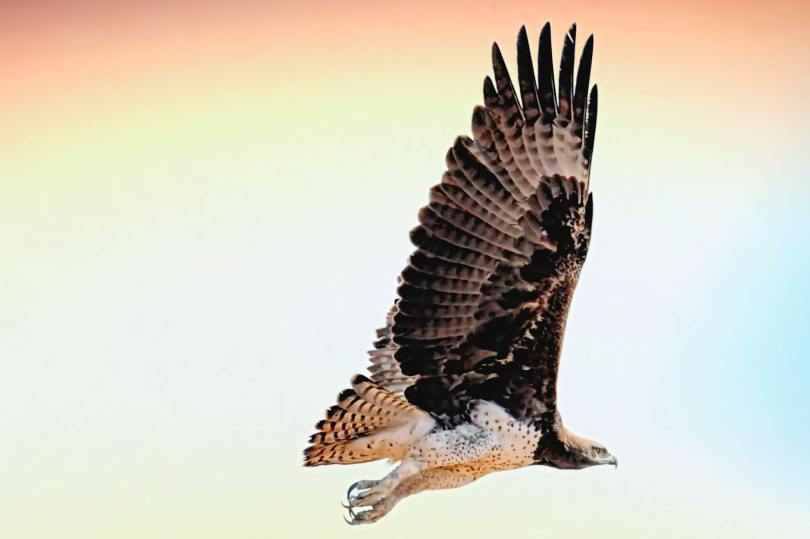
a Cooper’s hawk has caught a vole.

Her talons pierce and quell
the fruitless struggle.

Her banded belly and golden eyes
are striking against the faultless lawn

as she eviscerates her prey.
Nature undeterred and matter-of-fact
requires sacrifices.

The camera leaves the carnage
and we stroll towards your car—
lean back in easy silence

against the immaculate black of the doors.
We pass a flask of bourbon back and forth—
we’ve done this before.

The lens zooms in to capture how your lips
and tongue linger on the flask’s rim.
Time slows, music begins softly,

then swells, heightens
the impression of a quiet, buried longing
which never dissipated

but collected itself;
grew deeper without outlet over years.

I’m collected; controlled: not touching you,
not leaning close—
despite memory of how you used to breathe

in as I exhaled as if I were an antidote,
and you a dying man.
The camera angle shifts to capture your hand

surprising even you
as it finds its way home,

your thumb a gentle knife
on the underside of my jaw—
fingers hardly squeezing
the back of my neck.

The audience holds their breath.
They know what kind of kiss comes next,
and no one

not me, not you, not the hawk,
has done anything
wrong at all.

Author’s note: I have often been asked if I ever write happy poems and or love poems. The answer is, to the first, I think never, and to the second, only if the love poem explores the pain, grief, and hunger that so often accompany love. I recently reread this poem, written a few years ago, wondering if it didn’t need revision so much as the proper title was missing. The annoyingly cliched MFA workshop question rose up to face me, like a spectre: What’s at stake? The speaker of the poem here imagines a world where wanting what they cannot have is not transgressive, but totally acceptable, socially, morally, and emotionally. Issues of conscience are easily and matter-of-factly dealt with, something that is not possible in reality, but in the world of poetry, all one needs is imagination to open doors to possibility that reality locks up with impenetrable finality. I changed the title to reflect what is at the heart of this poem, which, in the imagination of the speaker, is bargaining about a longing that in order to be admitted to and explored, must occur within an ecosystem of morality.

Staci Halt’s work has appeared or is forthcoming in Rattle, december Magazine, Salamander Magazine, The Los Angeles Review, Driftwood Press and others. She parents six rad humans, and a slew of cats, and teachers and writes near Boston, for now.
“The Meat of the Plum” by Emily Kramer

1.
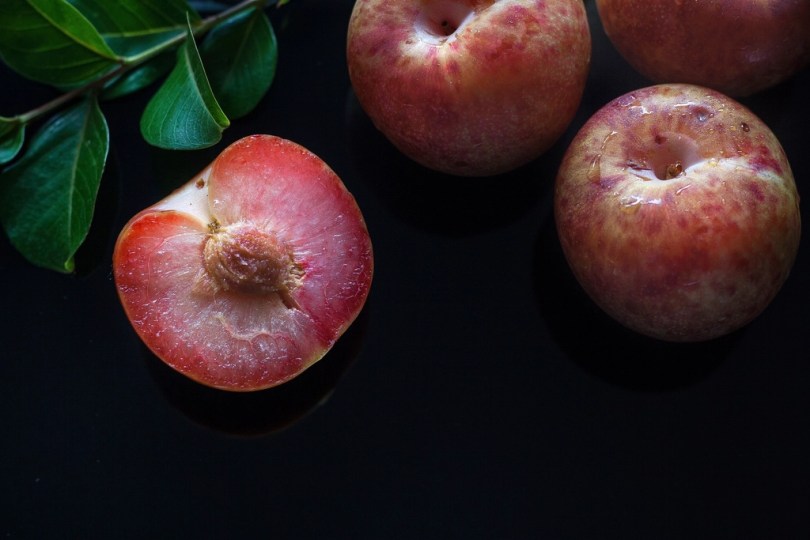
A drupe—the flesh of its fruit enclosing
the fruitstone-pit
of its seeds.

To droop and sag on the branch in the heat,
fresh swelling beneath taut sun
seared skin.

2.
To break skin; to bite into
flesh; to drip down yourself
into crevices.

To be atopic to stone fruits
and to eat them anyway, desperate
and ripe for the anchoring.

3.
And I think to kiss your mouth
is to eat a seed; to kiss and to eat and to seed.
And I think to kiss your mouth

is to cede ourselves to the blank
palimpsest, rubbed out hard
for growing.

4.
Oxidation of flesh; slight foxing;
lentigines that persist past fall.
The age and the wearing

of the page and the fruit,
sliver of thigh, high rise
suggestion of blush-pale meat.

5.
So what I really was doing was kissing myself
the way I used to kiss the side of my hand
when I didn’t think I’d survive you.

So what I really was doing was subjecting myself
to reaction the way the catalyst persists
unchanged and unchanging despite.

6.
Drupe—so close to dupe; to
duplication; to mark. Long lessons
patient bees can teach you.

Fuitit was missing
the r for reduplication. Eritit will
be
loose transposition for writ.


Author’s note: “Fruit” came into Middle English from the Latin frui, meaning “to enjoy” (cf. fruition and fruitless). Fuit / erit: Latin indicative perfect and future indicative tense of esse, “to be,” respectively. The title is from W. Paley’s 1802 Natural Theology: “The flesh of an apple, the pulp of an orange, the meat of a plum, the fatness of the olive, appear to be more than sufficient for the nourishing of the seed or kernel. . . . when we observe a provision to be more than sufficient for one purpose, yet wanted for another purpose, it is not unfair to conclude that both purposes were contemplated together.” 

Emily Kramer is an editor living in Boston, MA. She received her BA in English from Barnard College, and her PhD from Boston University’s Editorial Institute. Her critical edition of Arthur Henry Hallam’s collected poems is forthcoming from Oxford University Press. This is her second publication in Moist.

“Blades” by Matthew Murrey

Outside, the season’s thick sound 
of mowing: that rising, falling drone
of combustion, steel, and resistance.

Persistence of green as this half
of earth turns tilted sunward
so the grass thrives and rises up.

Countless machines are taking on
sprawls of lawns. In noise and fumes
they crop it short; they keep it down.

The mower I hear whines, sputters,
almost stalls. The grass remains
silent, though it smells moist and lush.

Tonight mowers, damp blades stained,
will sit cool in the dark while the grass
endures—healing its cuts and breathless.

Author’s note: I’m used to hearing people mowing grass during the summer, especially if there’s a mild day after several hot ones or a clear day after several rainy ones. A number of years ago I opened a window, and for some reason was really struck by the sound of one person out mowing their grass. It felt good to just stop and listen. I thought about my own experiences cutting grass and ruminated on us humans, our machines, and the living things around us. I had to hand it to grass; it gets cut and cut and cut, but just keeps coming back. In these grim times, I want to think there’s some hope in that.

Matthew Murreys the author of Bulletproof (Jacar Press, 2019) and the forthcoming collection, Little Joy (Cornerstone Press, 2026). Recent poems are in Roanoke Review, ballast and elsewhere. He was a school librarian for 21 years. His website’s at https://www.matthewmurrey.net/, and he’s on Twitter & Instagram @mytwords.

Two Poems by Kyla Houbolt

Weed Lore 2

Not long ago, all flowers
were wildflowers. Thus, to be
a weed is to be history.

We are beneath each other's notice.
How does that work? you might ask.
Cosmically.

Two planets
occupy the same space,
entirely unaware of each other

except when, occasionally,
something bothersome happens
and we need to assign blame.

Weeds are handy for that. So
is history.
Pastime

On the backs of rocks
I feel my archetypes
and how they bloom in summer,
especially the one that
I might call the
Wise-ass Small Time
Criminal. That character
who takes a funny kind
of pride in avoiding rules.

Hot weather seems
to encourage this one.
I think of her as being
related to the kinds of moss
that very slowly make
soil out of boulders. She
makes the rigidities of life
into a growing medium
for whatever wants to grow.

Which is often not wanted
by polite society. There’s
the laughter of straps falling
off shoulders, of a touch of
sunburn. A scent of
permissiveness. We don’t
need to go to the beach,
let’s just laze on this here
warm rock, thinking
of nothing at all.

 A Note About Summer

The more years I work in gardens, the more I value weeds. Summer is weedland, and they give more to humans than we yet fully know, if ever we will. My love for rocks, especially warm ones, is a year-round love. There was one garden I worked in that had a gigantic boulder at the top of its highest hill. That rock magnetized me and I probably spent more time touching and sitting on that rock than I spent on my work. I could no more avoid going to it than an iron shaving can avoid a magnet. I guess that’s kind of like the way summer calls up the green surge from the roots of things. I myself prefer spring.

–Kyla Houbolt


Kyla Houbolt writes poems and occasional reviews. She also gardens. More to be found here: https://kylahoubolt.us/

“After the All-Star Break” by Claire Taylor

tomatoes 
straight off the vine
sun-ripe and wet as
a lover’s July skin

the day runs its
humid tongue up
my thigh

we are only sweat
and angles—exposed
elbows, bare knees, sharp

anger that hangs
heavy in the still
night air

I read once that on
hotter days
a pitcher is more likely
to hit a batter

remind me in October to apologize
for how I always
pitch it inside

aiming straight for your heart

Author’s Note: In my house, we track the year by the baseball season. Opening Day signals spring. Playoff baseball means fall has arrived. And once the All-Star break has come and gone, we are deep into summer, which in Baltimore means unrelenting heat and humidity. I wanted to capture summer’s specific blend of sensuality and aggression. There’s so much skin and sweat—you can’t help but feel horny!—but it’s also such a stifling, uncomfortable season. I spend all summer bouncing back and forth between desire and rage. I doubt I’m the only one. By October, it’s time for the playoffs and fall, and for me to make amends for all the fights I picked when it was too hot to do anything else.

Claire Taylor is the author of multiple chapbooks, including Mother Nature and One Good Thing (Bottlecap Press). She is the founding editor of Little Thoughts Press. Claire lives with her family in Baltimore, Maryland, in an old stone house where birds love to roost. You can find her online at clairemtaylor.com.

Three Poems by C.M. Green

Some Things are Inextricable

The rush of June returns and
once more it’s time
things of beauty spill out of my
mouth like pebbles like teeth
tiny and perfect and I’m only
three years removed from
psychiatric
hospitalization

but I want a prettier word, a neater phrase, something like

revivification
or
the continental divide

Two years ago the first anniversary coincided with my first
dyke march and I peeled away from the crowd to buy
myself pizza and think how it felt to be a dyke and be alive.
In the hospital I read brideshead revisited and it brought
me to life when little else would. I had recently shorn my
head of hair and kissed a girl for the first time and I was
still a woman but I was not very good at being one. Oh well

June will soon cease to signify
madness for me, I’m sure,
give it a year, two, three—
I once thought I’d never look at
my niece without remembering
how I lay on a hospital cot
for her first days, but
now she’s a person all her own.

From the Amtrak between Ashland and Richmond

Virginia is for lovers, a truth that stretches
from the appalachian corner to the peninsula
where I went mad and saved myself from madness.

You can tell me other states have trees, but
I don’t think they have trees like this—on the amtrak
to richmond I remembered what capacious love is,

and to spit truth in my hands and rub it together
I would have to say that this is home in a way
that boston can’t be.

On the james river I leapt from rock to rock
with my best friend who has asked me to
perform her wedding. Capacity, as a quality

of being capacious. The mountains here are
just better, sorry, than any others, because
they remind me of truth as love, as vast

as any ocean—and we have that too,
on the other side, chesapeake bay and atlantic
saltwater, and I grew up knowing that

this is where my bones will be buried.
The Last Summer I Believe We Will Ever Have

Kiera tells me the humidity in Boston is like
being inside a mouth and that
their IMPORTANT PAPERS are DISSOLVING!
And, I read about becoming a citizen archivist
because soon the boot will come for the face
of anyone whose art expands possibility.
And, Vickie says we should go to the beach soon.
And, I have central air in my new apartment
which I feel a tiny amount of shame about.
And, my mother talks about the supreme court
while my senator calls for court packing
while others claim victory and threaten revolution.
And, revolution doesn’t sound so bad at this point,
but not the one they’re talking about.
And, I miss Virginia like a lover.
And, Meadow and I went swimming
in the james river, just two
trans kids enjoying the rapids.
And, I want to move
to Richmond every time I visit.
And, summer makes me remember strawberries—
in childhood dusted with sugar, in adulthood soaked in vodka.
And, forty-thousand people have been murdered in Palestine because
the thing I won’t call my country will not stop sending bombs.
And, I don’t know how to keep writing.

Author’s note: I wrote these poems in the summer of 2024, which to me feels like the very last summer before something. I don’t know what. I spent the first week of July traveling between Massachusetts and New York and Pennsylvania and Virginia, seeing family and beauty at every stop, and as I travelled I wrote about the place of art in the face of rising fascism and genocide. The Supreme Court made some bad decisions. My three-year-old niece became my best friend for two days. I saw every one of my four siblings, and I saw my high school best friend for the first time since 2019. The news talked about the rise of the right in Europe. I visited my 95-year-old grandmother and brought her farm-grown plums. My mom watched a lot of MSNBC. And always, since October, Palestinian people are being murdered by Israeli forces and American weapons. How to write in the face of all this? How to reconcile the love in my life with the hatred in the world? Poetry is the place I have turned to to work through these questions, and these poems are the result.

C.M. Green is a Boston-based writer with a focus on history, memory, gender, and religion. Their work has appeared in Full House Literary, beestung, and elsewhere. They stand for a free Palestine, and encourage you to find tangible ways to do the same. You can find their work at cmgreenwrites.com.

“Spring Evening” by Taylor Brunson

	Andrew Wyeth, 1948

Fields no longer seized by a sere sameness,
sunlight lingers to breathe warmth into
the room’s every seam, returning to

remind me: See? Imagine no virtue

in hoping for so little. Here, I find myself
given back to the animal I am, all fur,
all flesh, musk and appetite, loping

out of a season that saw the sun leant

into its own diminishment. A creature
surviving just to learn intimately
what rutilance the lengthening day

demands of your eyes, closed to the light.

Held flank against flank, our forms’
every slip and slope exposed. Of this tenderness,
what should I hope when there are so many

seasons left to pass? Imagine no virtue

in hoping for so little.
Your scent, curled
beneath my sheets, a specter
I would follow anywhere. See?

Author’s note: Ekphrasis has become a means of extending how I relate to an art object, a channel to examine the self through a lens that feels beyond it. I wrote this poem at the turn of winter to spring and at a moment where a season of contentment in my life seemed to be drawing to a close, which felt deeply disheartening. And yet here Wyeth opened a spare room to me and asked me to consider, at the end of one season, why I might not hope for even more warmth and affection in the lush seasons sprawling ahead.

Taylor Brunson is a poet whose work has been featured in perhappened, Non.Plus Lit, and The Ex-Puritan. She serves as an assistant poetry editor for Four Way Review and Nashville Review. Taylor can be found on Twitter, @taylor_thefox.